



点击头像可查看其他用户上传的内容哦~

 优质
 车0wO6ar


参考答案
















展开阅读全部
开通会员查看试卷全部内容
本文档由用户提供并上传,若内容存在侵权,请进行举报或认领
 版权异议

资源简介
展开▼
2027广东五校高三10月联考(二)英语试题及参考答案(PDF版下载含详细解析)2026-2027学年度第一学期五校第二次联考
英语试题
本试卷共8页,满分120分。考试用时120分钟。
第二部分 阅读理解(共两节,满分50分)
第一节(共15小题;每小题2.5分,满分37.5分)
阅读下列短文,从每题所给的A、B、C、D四个选项中选出最佳选项。
A
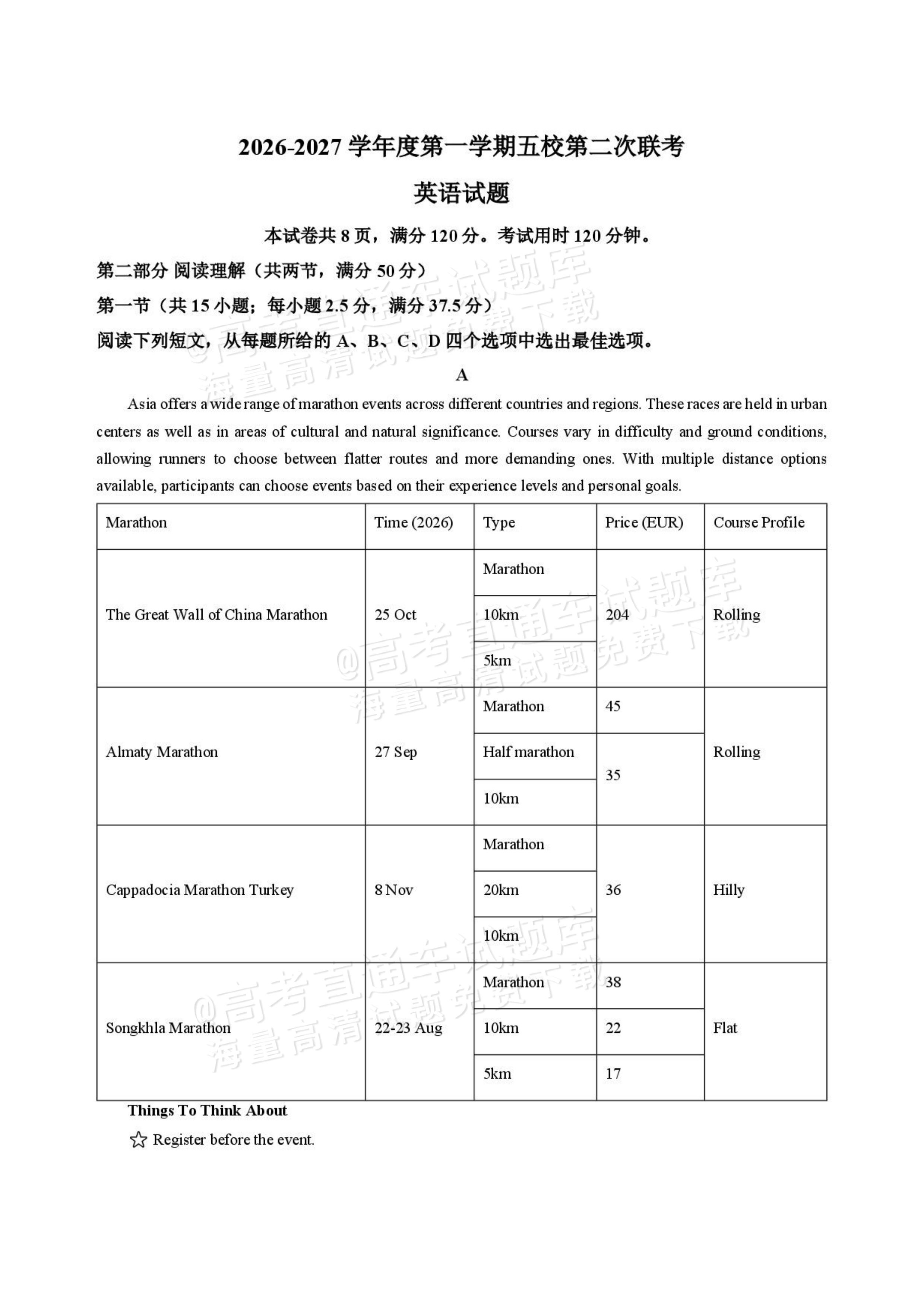
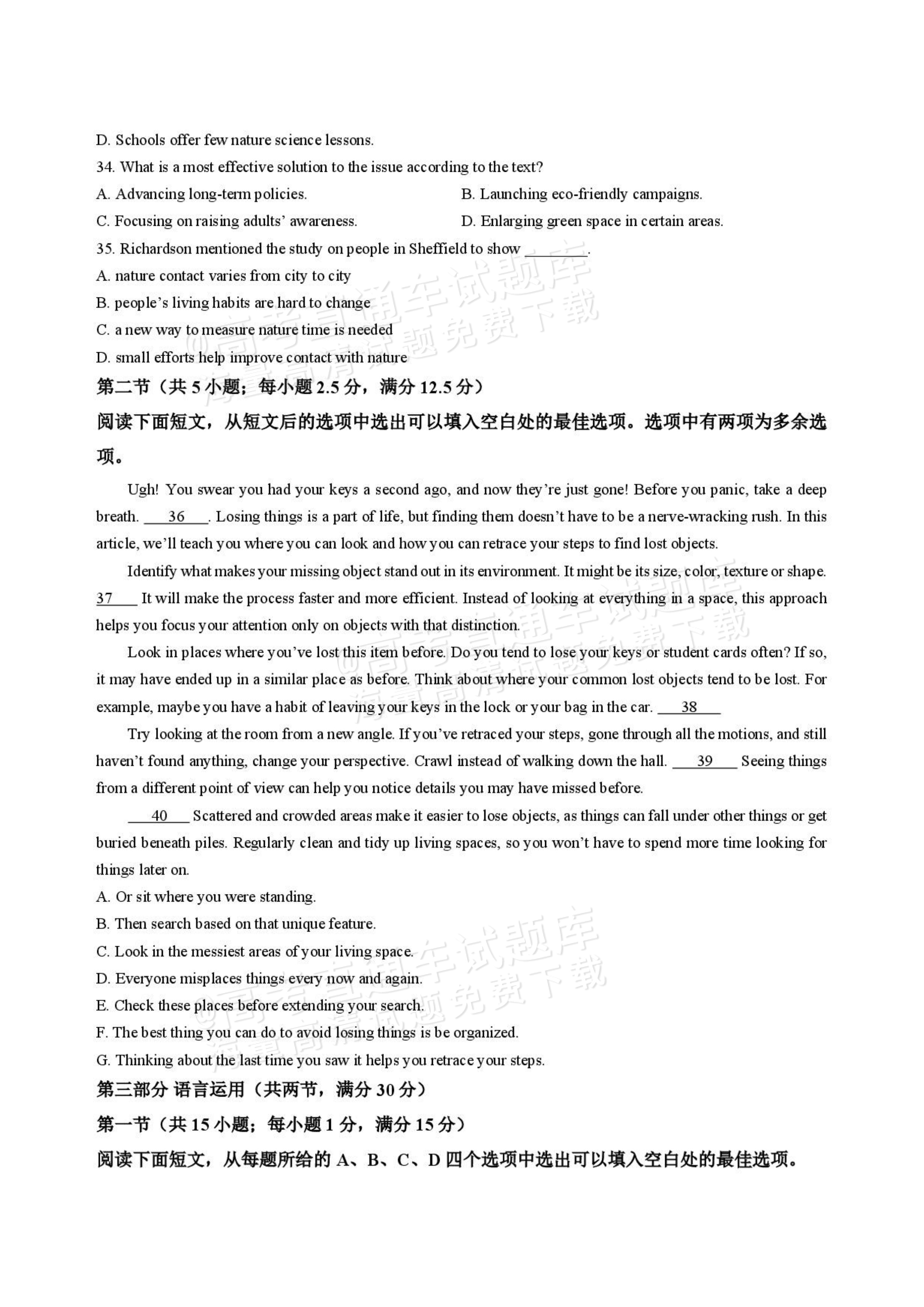
Asia offers a wide range of marathon events across different countries and regions. These races are held in urban centers as well as in areas of cultural and natural significance. Courses vary in difficulty and ground conditions, allowing runners to choose between flatter routes and more demanding ones. With multiple distance options available, participants can choose events based on their experience levels and personal goals.
Marathon Time (2026) Type Price (EUR) Course Profile
The Great Wall of China Marathon 25 Oct Marathon 204 Rolling
10km
5km
Almaty Marathon 27 Sep Marathon 45 Rolling
Half marathon 35
10km
Cappadocia Marathon Turkey 8 Nov Marathon 36 Hilly
20km
10km
Songkhla Marathon 22-23 Aug Marathon 38 Flat
10km 22
5km 17
Things To Think About
☆ Register before the event.
☆ Know the local weather, so you can train and dress appropriately.
☆ Make sure that you are making accommodations through reputable sites for travel.
☆ Don't underestimate how the difference in altitude (海拔) or temperature will affect your running. Read up
and train to make it to the finish line.
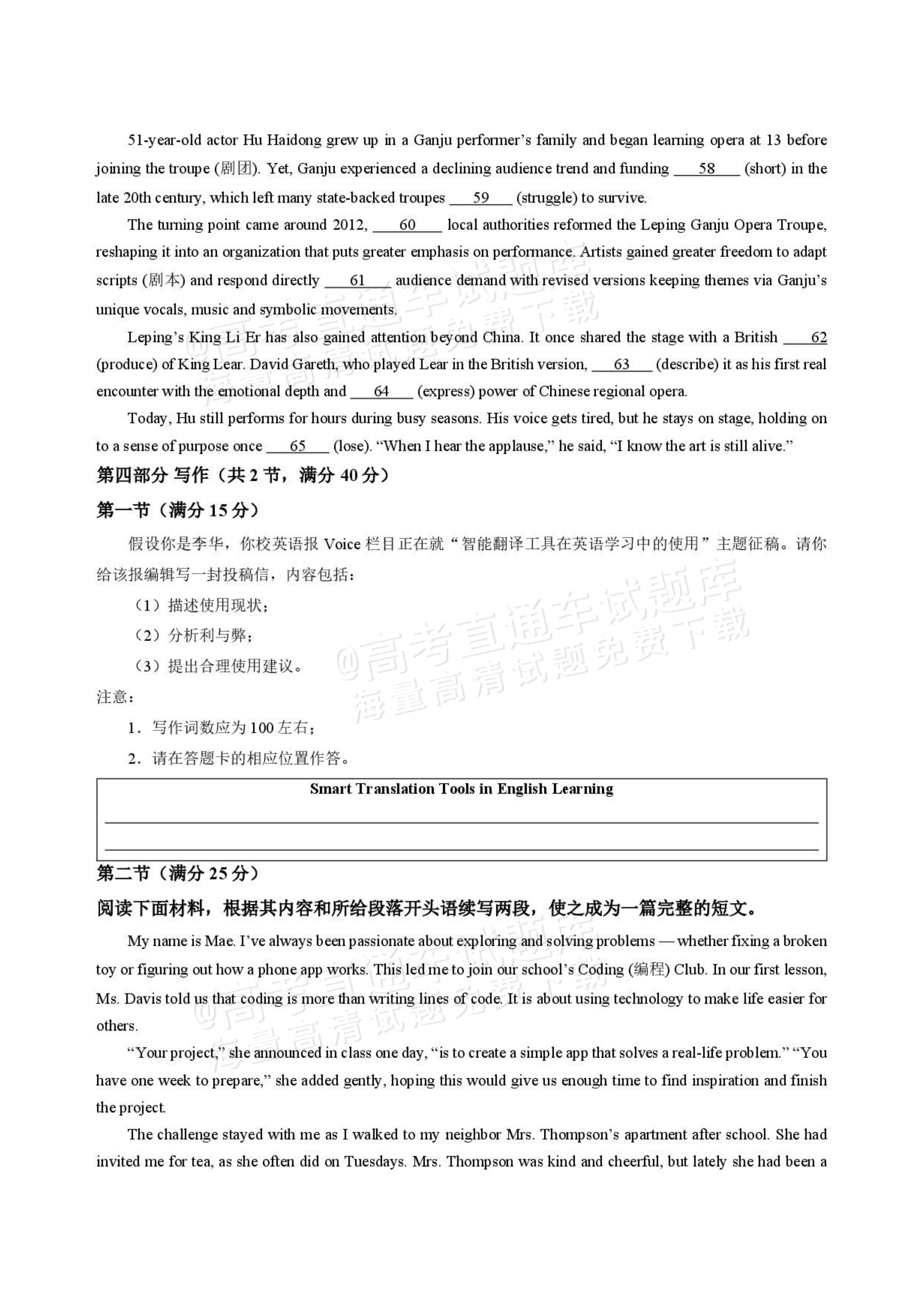
21. What is the purpose of the text?
A. To introduce a new marathon plan.
B. To compare Asian marathon courses.
C. To call for participation in Asian marathons.
D. To provide information about Asian marathons.
22. Which marathon offers the shortest race with more demanding routes?
A. Almaty Marathon. B. The Great Wall of China Marathon.
C. Songkhla Marathon. D. Cappadocia Marathon Turkey.
23. What are runners recommended to do before participation?
A. Book hotels from trusted websites. B. Apply for a discounted entry fee.
C. Email the registration before the deadline. D. Train under the guidance of professionals.
B
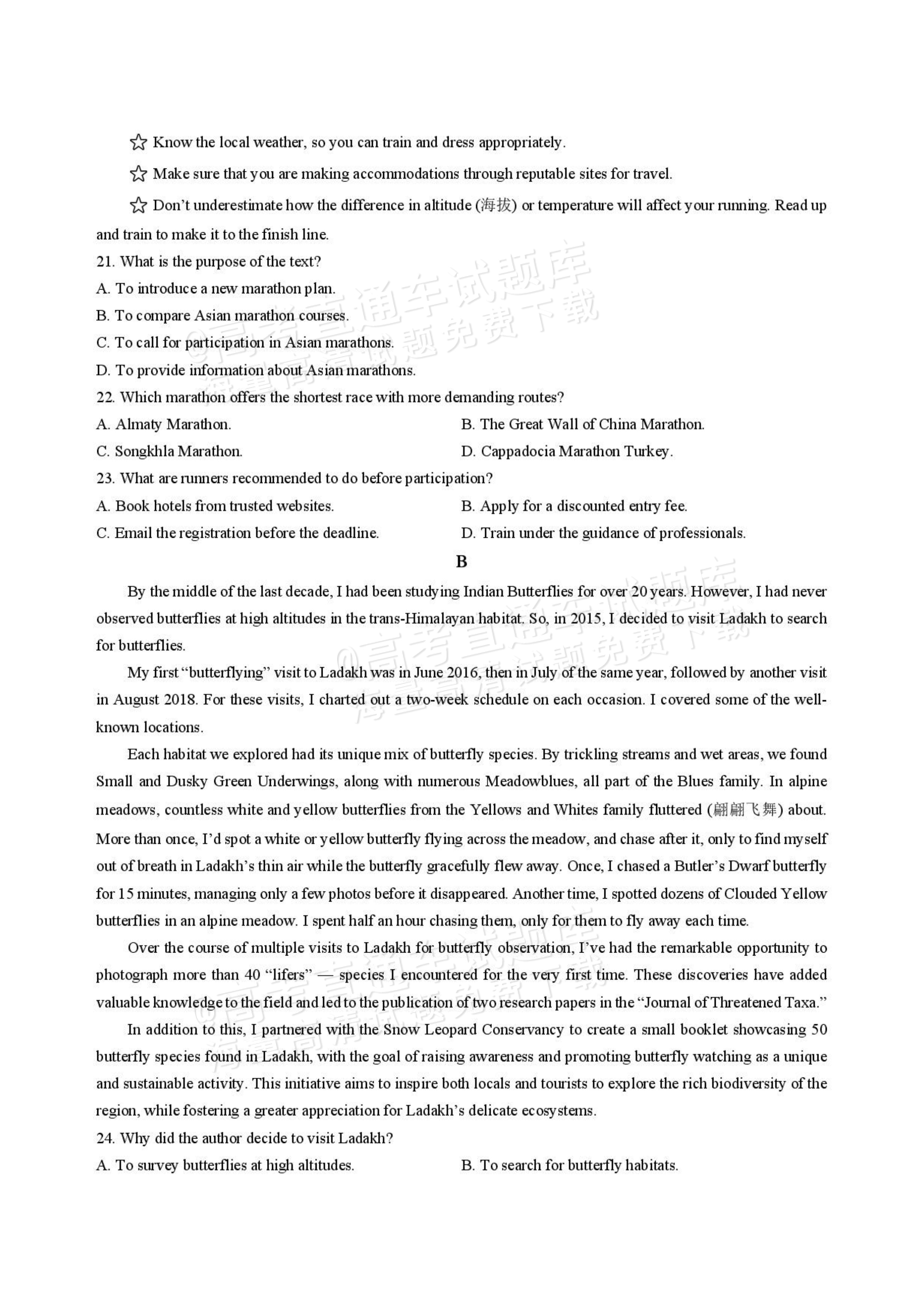
By the middle of the last decade, I had been studying Indian Butterflies for over 20 years. However, I had never
observed butterflies at high altitudes in the trans-Himalayan habitat. So, in 2015, I decided to visit Ladakh to search
for butterflies.
My first "butterflying" visit to Ladakh was in June 2016, then in July of the same year, followed by another visit
in August 2018. For these visits, I charted out a two-week schedule on each occasion. I covered some of the well-
known locations.
Each habitat we explored had its unique mix of butterfly species. By trickling streams and wet areas, we found
Small and Dusky Green Underwings, along with numerous Meadowblues, all part of the Blues family. In alpine
meadows, countless white and yellow butterflies from the Yellows and Whites family fluttered (翩翩飞舞) about.
More than once, I'd spot a white or yellow butterfly flying across the meadow, and chase after it, only to find myself
out of breath in Ladakh's thin air while the butterfly gracefully flew away. Once, I chased a Butler's Dwarf butterfly
for 15 minutes, managing only a few photos before it disappeared. Another time, I spotted dozens of Clouded Yellow
butterflies in an alpine meadow. I spent half an hour chasing them, only for them to fly away each time.
Over the course of multiple visits to Ladakh for butterfly observation, I've had the remarkable opportunity to
photograph more than 40 "lifers" — species I encountered for the very first time. These discoveries have added
valuable knowledge to the field and led to the publication of two research papers in the "Journal of Threatened Taxa."
In addition to this, I partnered with the Snow Leopard Conservancy to create a small booklet showcasing 50
butterfly species found in Ladakh, with the goal of raising awareness and promoting butterfly watching as a unique
and sustainable activity. This initiative aims to inspire both locals and tourists to explore the rich biodiversity of the
region, while fostering a greater appreciation for Ladakh's delicate ecosystems.
24. Why did the author decide to visit Ladakh?
A. To survey butterflies at high altitudes. B. To search for butterfly habitats.
C. To carry out a travel schedule.
D. To recommend tourist attractions.
25. Which best describes the author's chasing butterflies?
A. Scary and exciting.
B. Embarrassing and amusing.
C. Challenging and fascinating.
D. Dangerous and interesting.
26. What is the author's purpose of making a booklet?
A. To document insect species in India.
B. To encourage eco-aware exploration.
C. To promote local tourism in Ladakh.
D. To compare butterfly research findings.
27. What is the best title for the text?
A. Uniqueness of Butterflies
B. A Fascinating Journey
C. Biodiversity in Ladakh
D. A Fluttering Discovery
C
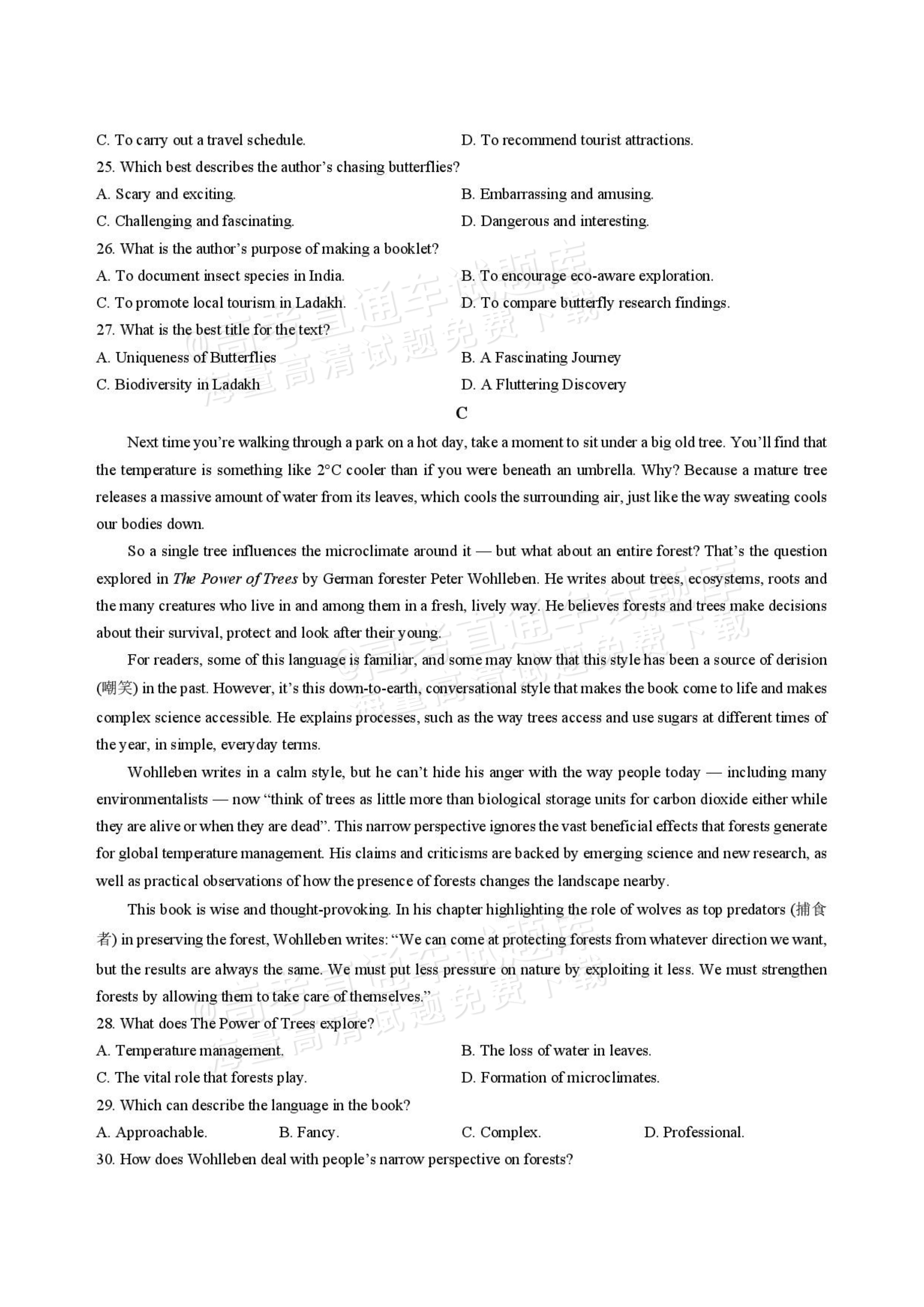
Next time you're walking through a park on a hot day, take a moment to sit under a big old tree. You'll find that
the temperature is something like 2°C cooler than if you were beneath an umbrella. Why? Because a mature tree
releases a massive amount of water from its leaves, which cools the surrounding air, just like the way sweating cools
our bodies down.
So a single tree influences the microclimate around it — but what about an entire forest? That's the question
explored in The Power of Trees by German forester Peter Wohlleben. He writes about trees, ecosystems, roots and
the many creatures who live in and among them in a fresh, lively way. He believes forests and trees make decisions
about their survival, protect and look after their young.
For readers, some of this language is familiar, and some may know that this style has been a source of derision
(嘲笑) in the past. However, it's this down-to-earth, conversational style that makes the book come to life and makes
complex science accessible. He explains processes, such as the way trees access and use sugars at different times of
the year, in simple, everyday terms.
Wohlleben writes in a calm style, but he can't hide his anger with the way people today — including many
environmentalists — now "think of trees as little more than biological storage units for carbon dioxide either while
they are alive or when they are dead". This narrow perspective ignores the vast beneficial effects that forests generate
for global temperature management. His claims and criticisms are backed by emerging science and new research, as
well as practical observations of how the presence of forests changes the landscape nearby.
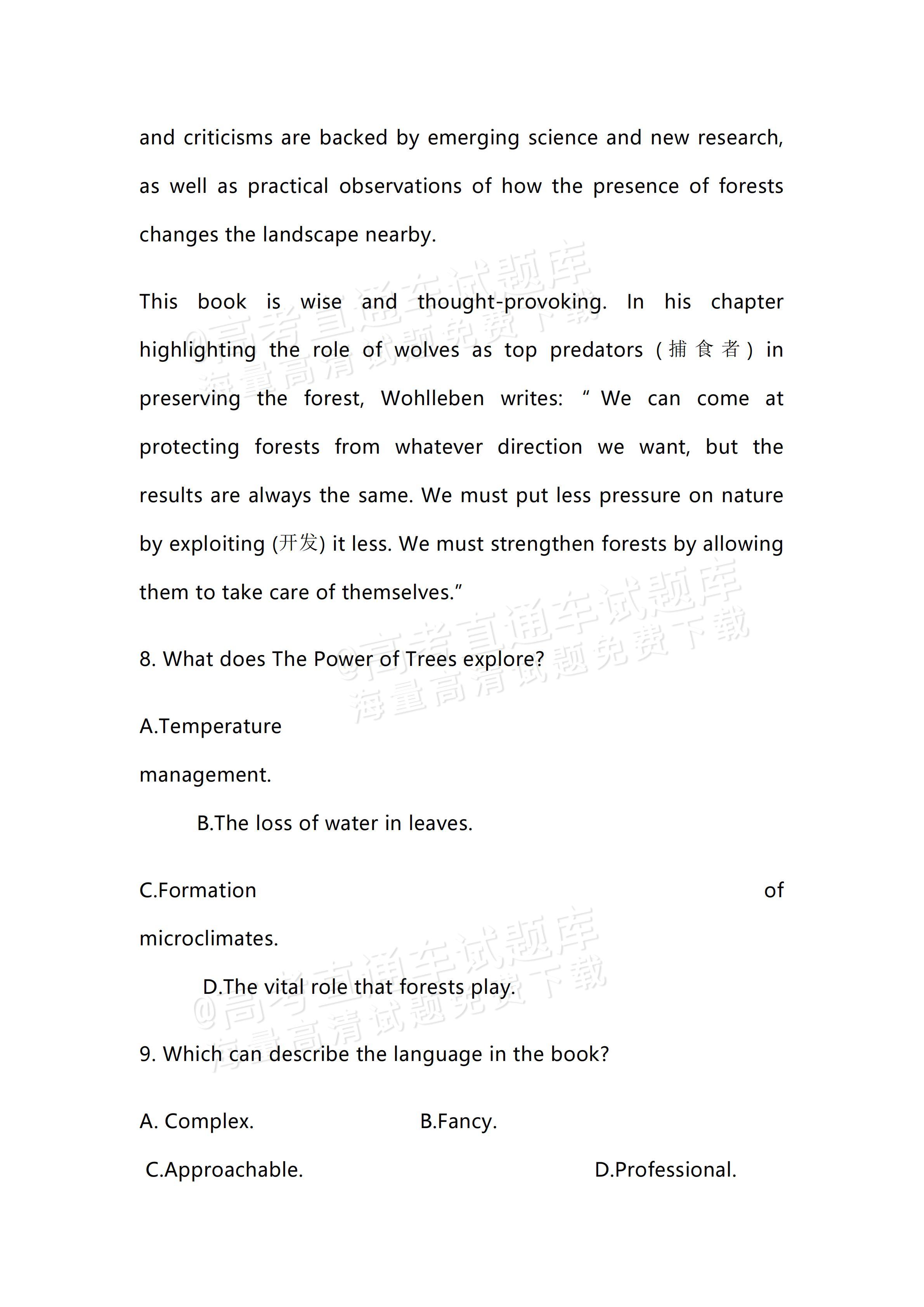
This book is wise and thought-provoking. In his chapter highlighting the role of wolves as top predators (捕食
者) in preserving the forest, Wohlleben writes: "We can come at protecting forests from whatever direction we want,
but the results are always the same. We must put less pressure on nature by exploiting it less. We must strengthen
forests by allowing them to take care of themselves."
28. What does The Power of Trees explore?
A. Temperature management.
B. The loss of water in leaves.
C. The vital role that forests play.
D. Formation of microclimates.
29. Which can describe the language in the book?
A. Approachable.
B. Fancy.
C. Complex.
D. Professional.
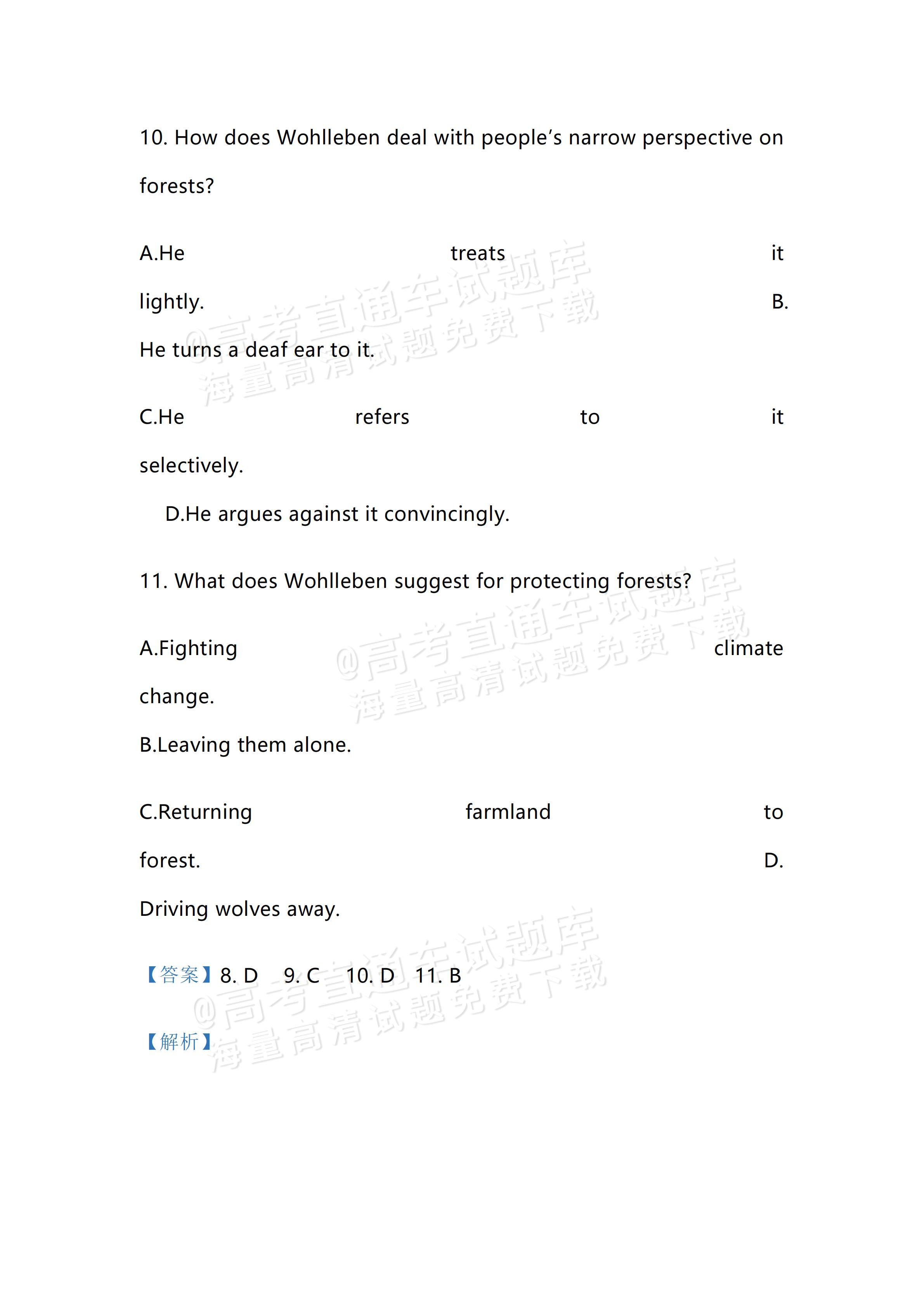
30. How does Wohlleben deal with people's narrow perspective on forests?
A. He treats it lightly.
B. He turns a deaf ear to it.
C. He refers to it selectively.
D. He argues against it convincingly.
31. What does Wohlleben suggest for protecting forests?
A. Fighting climate change.
B. Leaving them alone.
C. Returning farmland to forest.
D. Driving wolves away.
D
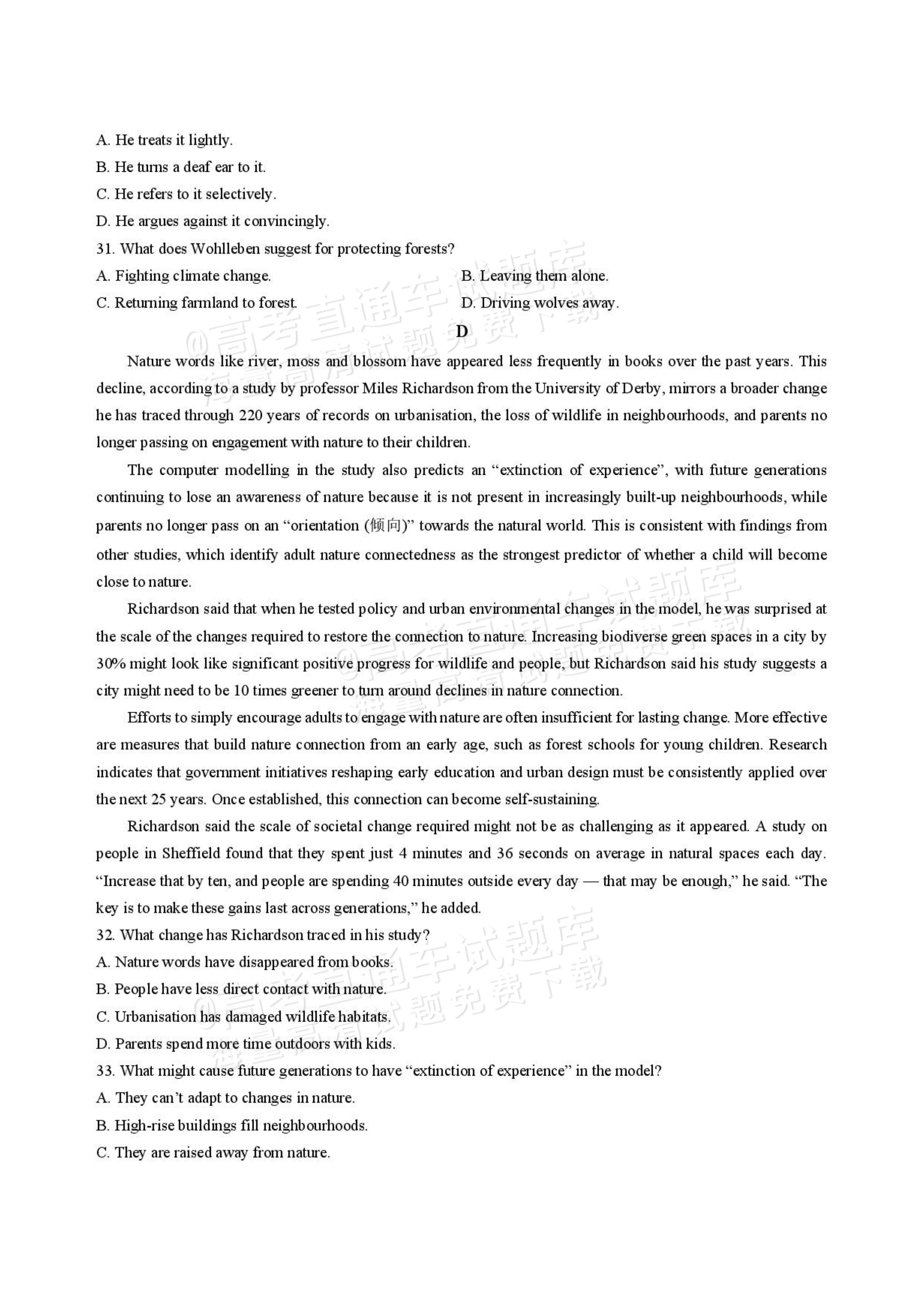
Nature words like river, moss and blossom have appeared less frequently in books over the past years. This decline, according to a study by professor Miles Richardson from the University of Derby, mirrors a broader change he has traced through 220 years of records on urbanisation, the loss of wildlife in neighbourhoods, and parents no longer passing on engagement with nature to their children.
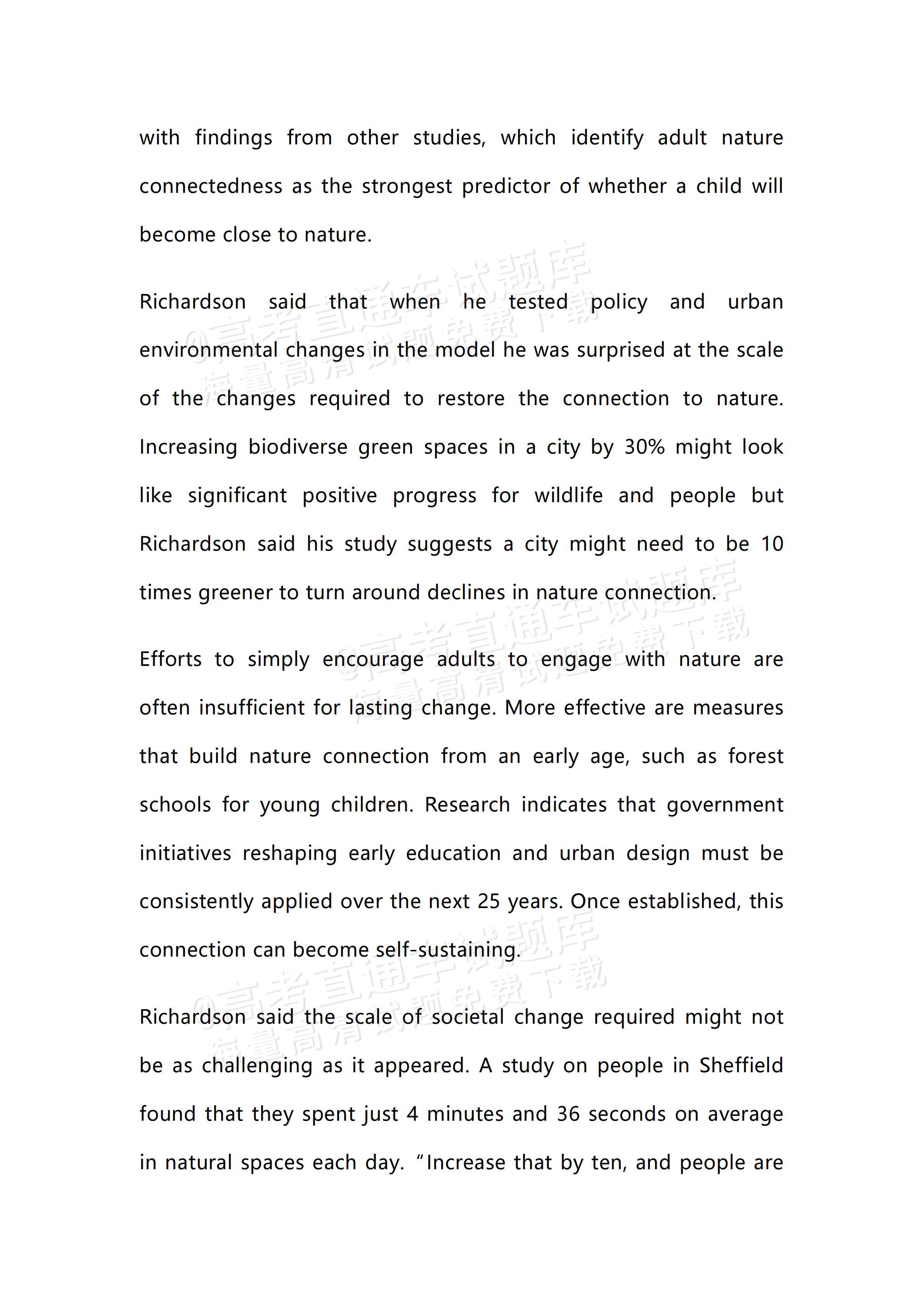
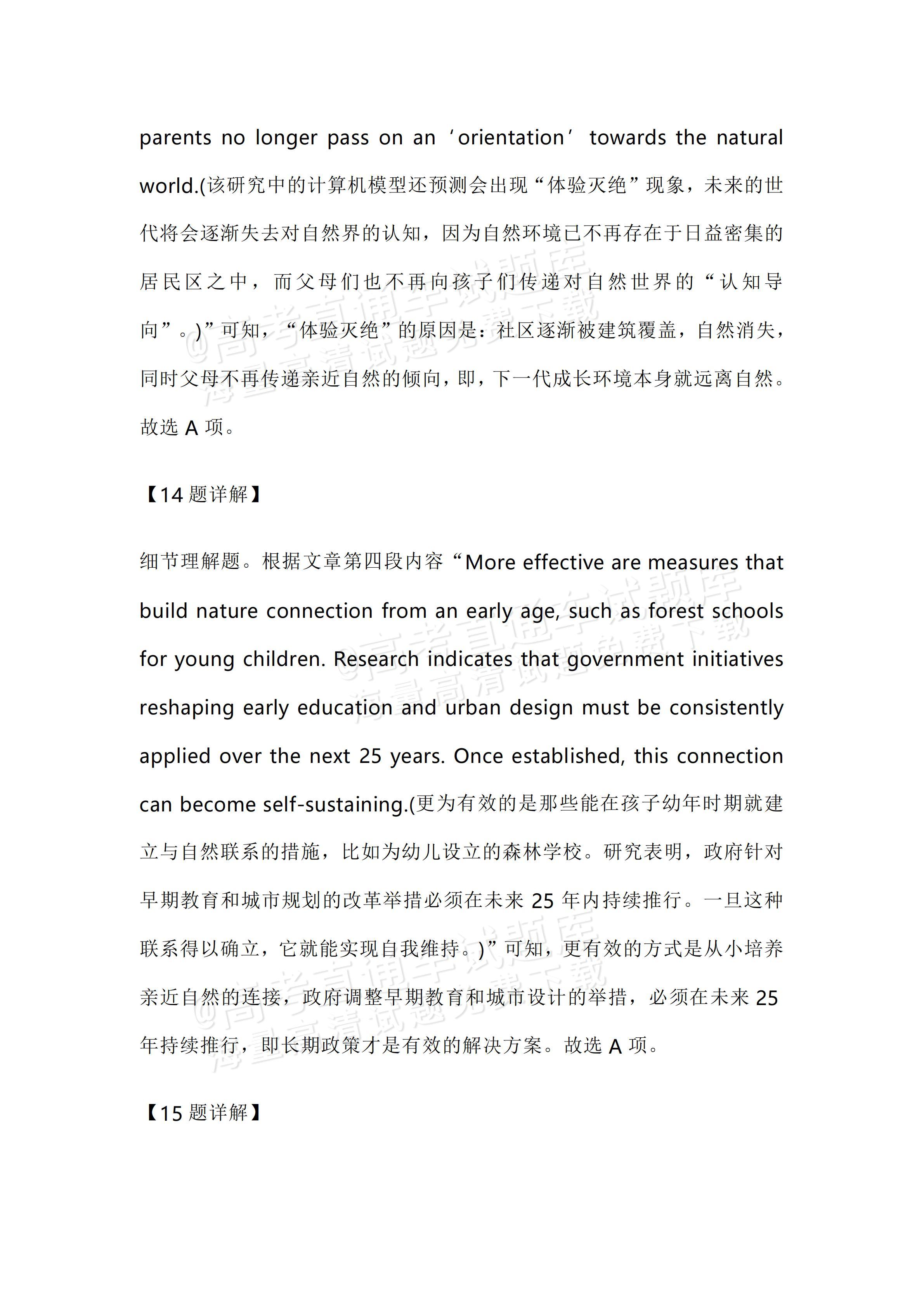
The computer modelling in the study also predicts an "extinction of experience", with future generations continuing to lose an awareness of nature because it is not present in increasingly built-up neighbourhoods, while parents no longer pass on an "orientation (倾向)" towards the natural world. This is consistent with findings from other studies, which identify adult nature connectedness as the strongest predictor of whether a child will become close to nature.
Richardson said that when he tested policy and urban environmental changes in the model, he was surprised at the scale of the changes required to restore the connection to nature. Increasing biodiverse green spaces in a city by 30% might look like significant positive progress for wildlife and people, but Richardson said his study suggests a city might need to be 10 times greener to turn around declines in nature connection.
Efforts to simply encourage adults to engage with nature are often insufficient for lasting change. More effective are measures that build nature connection from an early age, such as forest schools for young children. Research indicates that government initiatives reshaping early education and urban design must be consistently applied over the next 25 years. Once established, this connection can become self-sustaining.
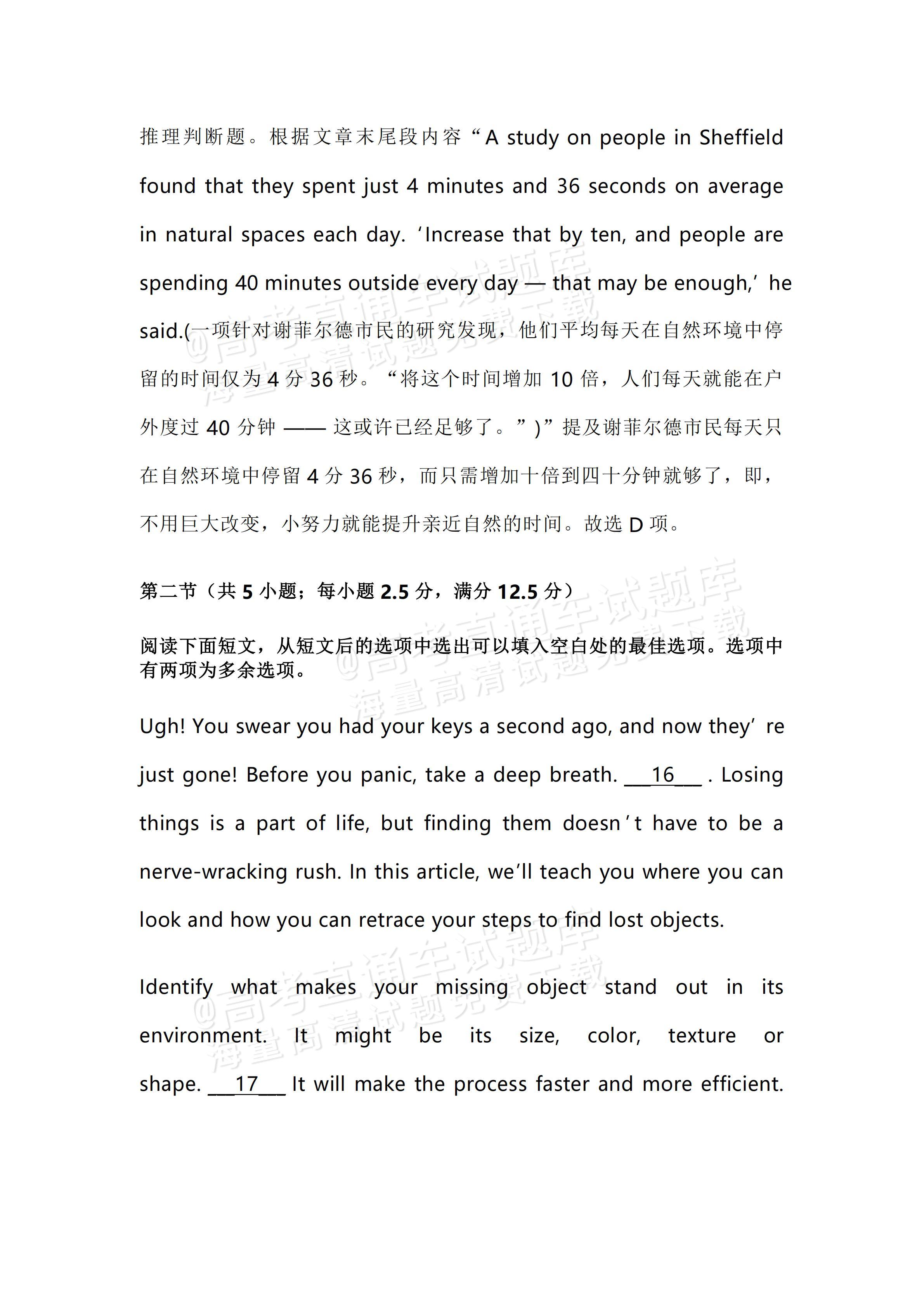
Richardson said the scale of societal change required might not be as challenging as it appeared. A study on people in Sheffield found that they spent just 4 minutes and 36 seconds on average in natural spaces each day. "Increase that by ten, and people are spending 40 minutes outside every day — that may be enough," he said. "The key is to make these gains last across generations," he added.
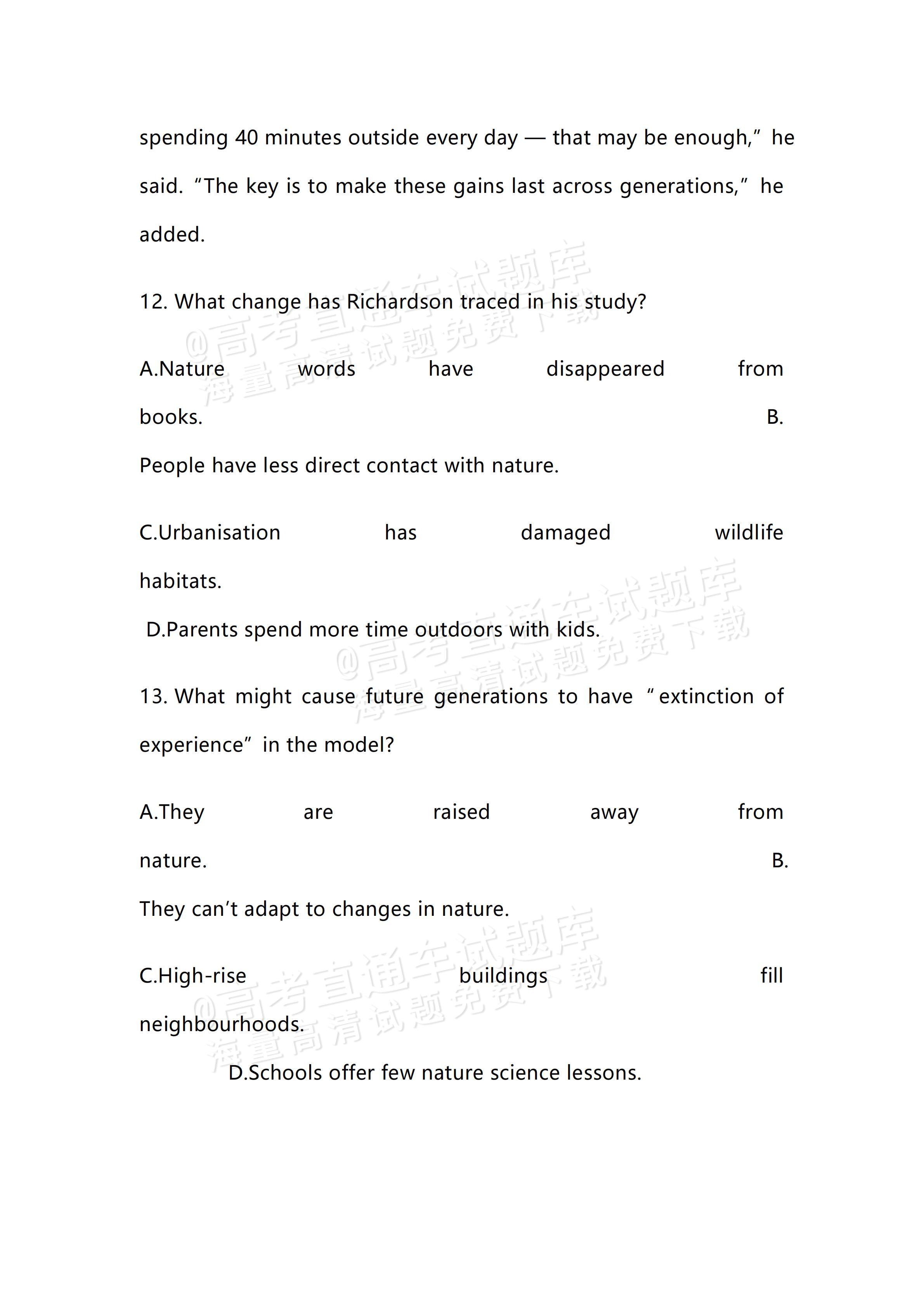
32. What change has Richardson traced in his study?
A. Nature words have disappeared from books.
B. People have less direct contact with nature.
C. Urbanisation has damaged wildlife habitats.
D. Parents spend more time outdoors with kids.
33. What might cause future generations to have "extinction of experience" in the model?
A. They can't adapt to changes in nature.
B. High-rise buildings fill neighbourhoods.
C. They are raised away from nature.
D. Schools offer few nature science lessons.
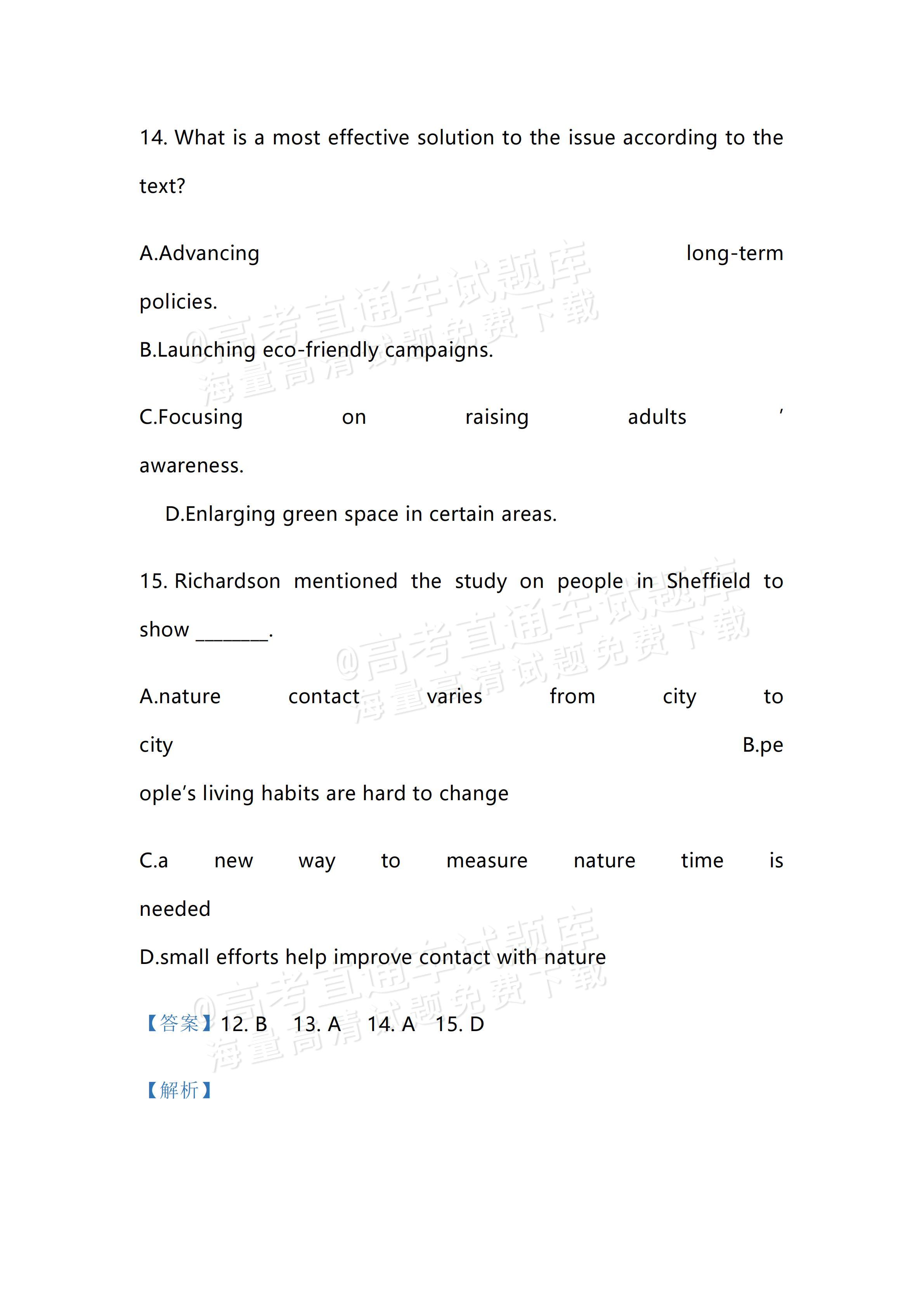
34. What is a most effective solution to the issue according to the text?
A. Advancing long-term policies. B. Launching eco-friendly campaigns.
C. Focusing on raising adults' awareness. D. Enlarging green space in certain areas.
35. Richardson mentioned the study on people in Sheffield to show ________.
A. nature contact varies from city to city
B. people's living habits are hard to change
C. a new way to measure nature time is needed
D. small efforts help improve contact with nature
第二节(共5小题;每小题2.5分,满分12.5分)
阅读下面短文,从短文后的选项中选出可以填入空白处的最佳选项。选项中有两项为多余选
项。
Ugh! You swear you had your keys a second ago, and now they're just gone! Before you panic, take a deep
breath. ___36___. Losing things is a part of life, but finding them doesn't have to be a nerve-wracking rush. In this
article, we'll teach you where you can look and how you can retrace your steps to find lost objects.
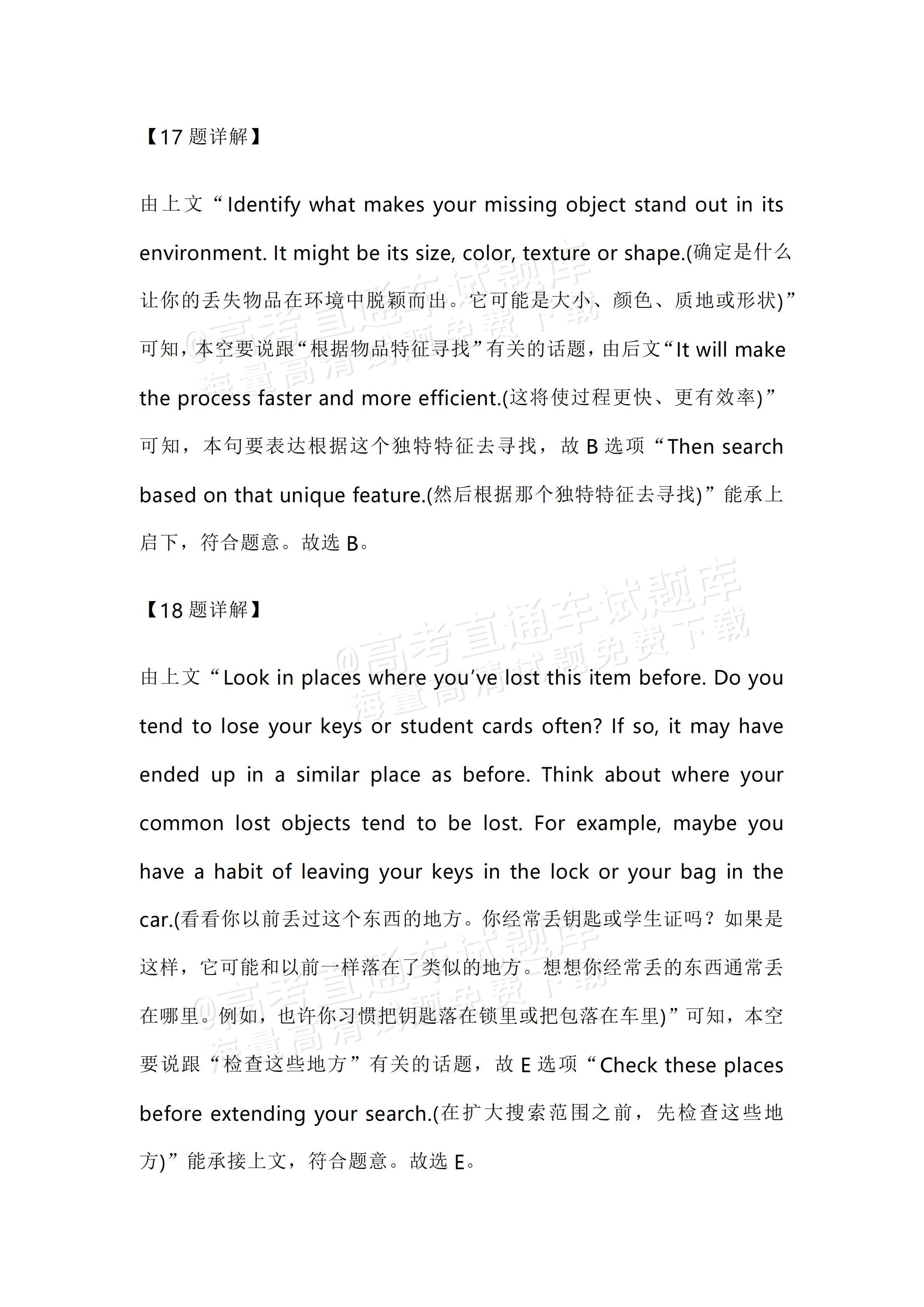
Identify what makes your missing object stand out in its environment. It might be its size, color, texture or shape.
___37___ It will make the process faster and more efficient. Instead of looking at everything in a space, this approach
helps you focus your attention only on objects with that distinction.
Look in places where you've lost this item before. Do you tend to lose your keys or student cards often? If so,
it may have ended up in a similar place as before. Think about where your common lost objects tend to be lost. For
example, maybe you have a habit of leaving your keys in the lock or your bag in the car. ___38___
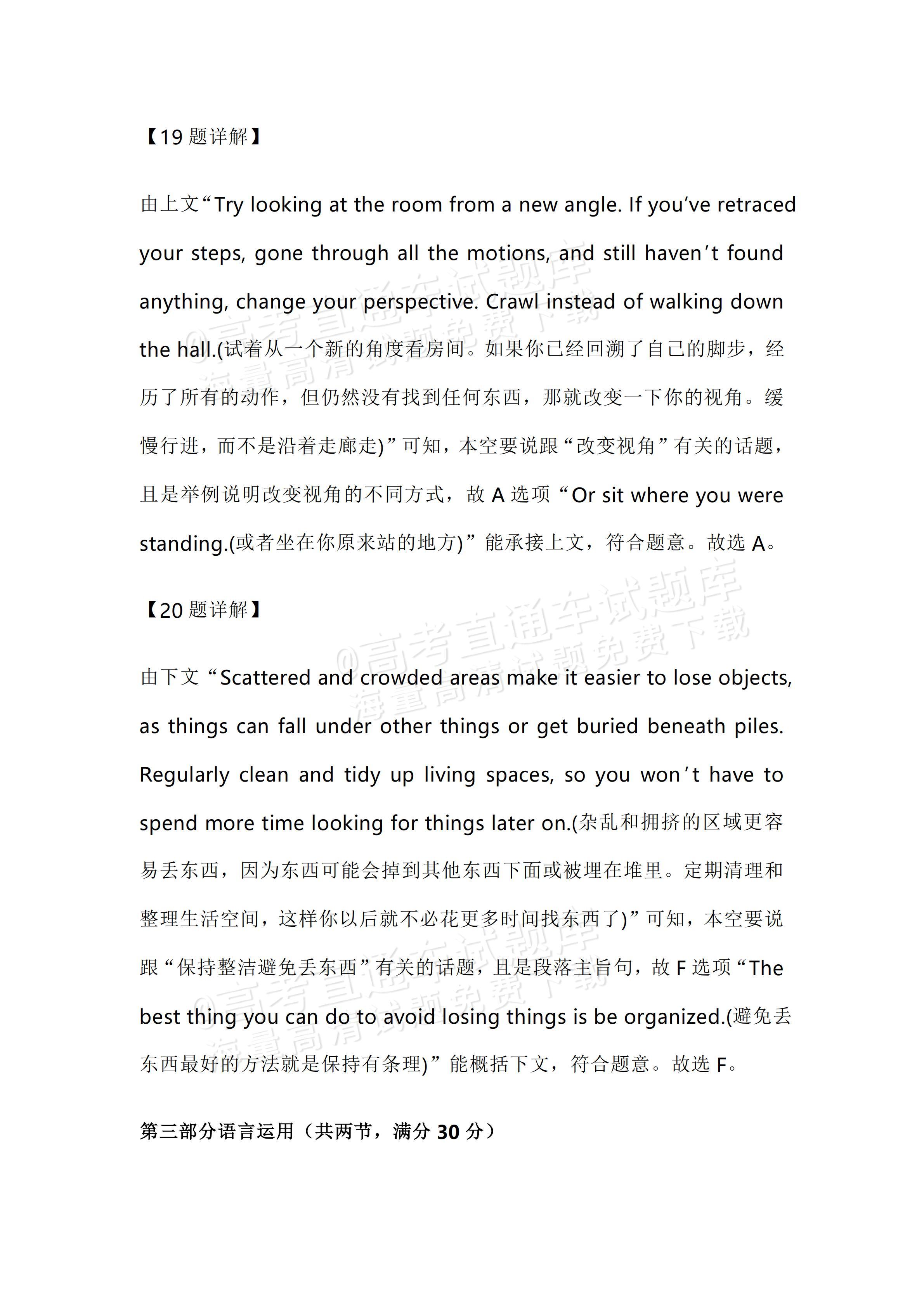
Try looking at the room from a new angle. If you've retraced your steps, gone through all the motions, and still
haven't found anything, change your perspective. Crawl instead of walking down the hall. ___39___ Seeing things
from a different point of view can help you notice details you may have missed before.
___40___ Scattered and crowded areas make it easier to lose objects, as things can fall under other things or get
buried beneath piles. Regularly clean and tidy up living spaces, so you won't have to spend more time looking for
things later on.
A. Or sit where you were standing.
B. Then search based on that unique feature.
C. Look in the messiest areas of your living space.
D. Everyone misplaces things every now and again.
E. Check these places before extending your search.
F. The best thing you can do to avoid losing things is be organized.
G. Thinking about the last time you saw it helps you retrace your steps.
第三部分 语言运用(共两节,满分30分)
第一节(共15小题;每小题1分,满分15分)
阅读下面短文,从每题所给的A、B、C、D四个选项中选出可以填入空白处的最佳选项。
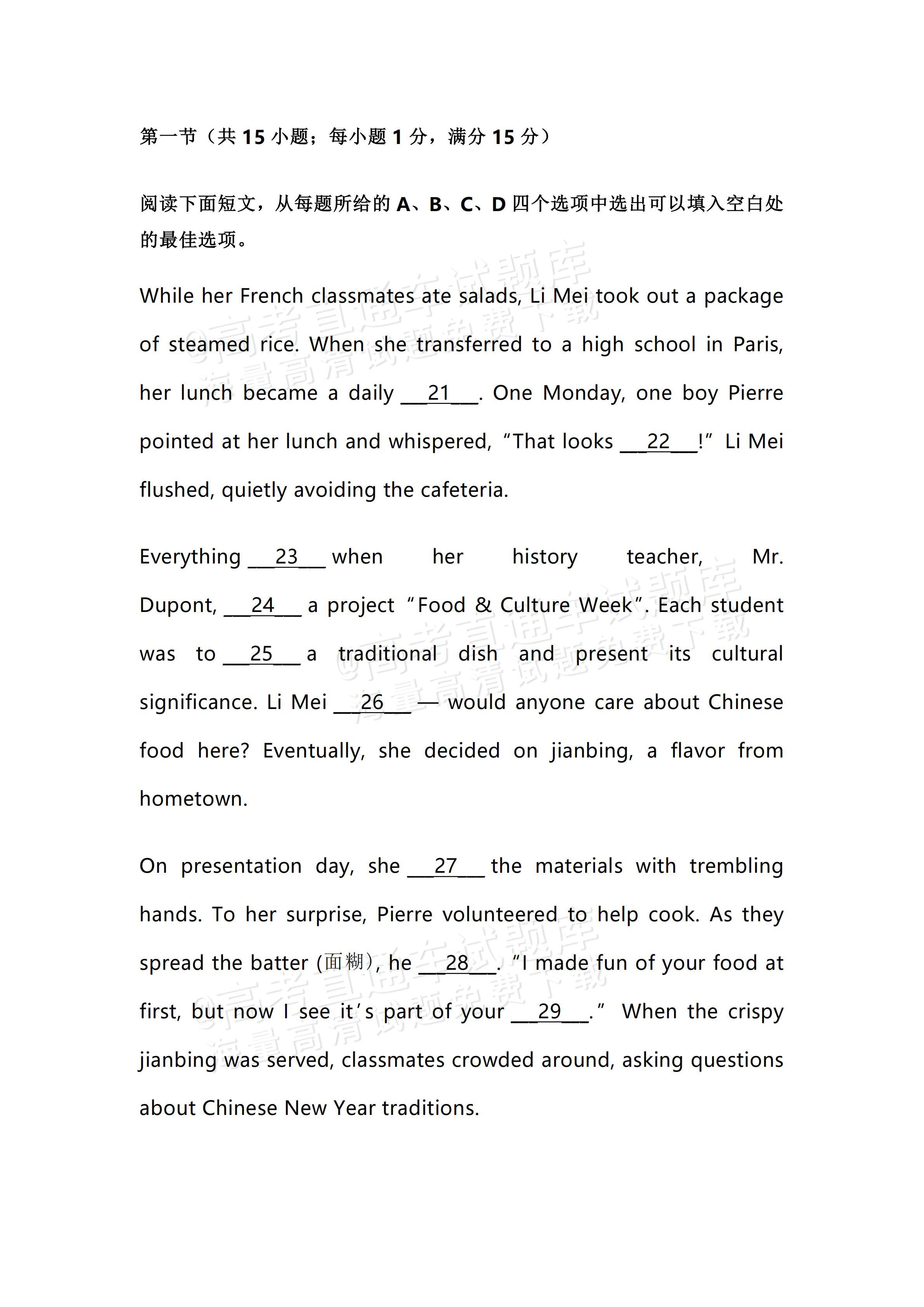
While her French classmates ate salads, Li Mei took out a package of steamed rice. When she transferred to a
high school in Paris, her lunch became a daily ___41___. One Monday, one boy Pierre pointed at her lunch and
whispered, “That looks ___42___!” Li Mei flushed, quietly avoiding the cafeteria.
Everything ___43___ when her history teacher, Mr. Dupont, ___44___ a project “Food & Culture Week”. Each
student was to ___45___ a traditional dish and present its cultural significance. Li Mei ___46___ — would anyone
care about Chinese food here? Eventually, she decided on jianbing, a flavor from hometown.
On presentation day, she ___47___ the materials with trembling hands. To her surprise, Pierre volunteered to
help cook. As they spread the batter (面糊), he ___48___. “I made fun of your food at first, but now I see it’s part of
your ___49___.” When the crispy jianbing was served, classmates crowded around, asking questions about Chinese
New Year traditions.
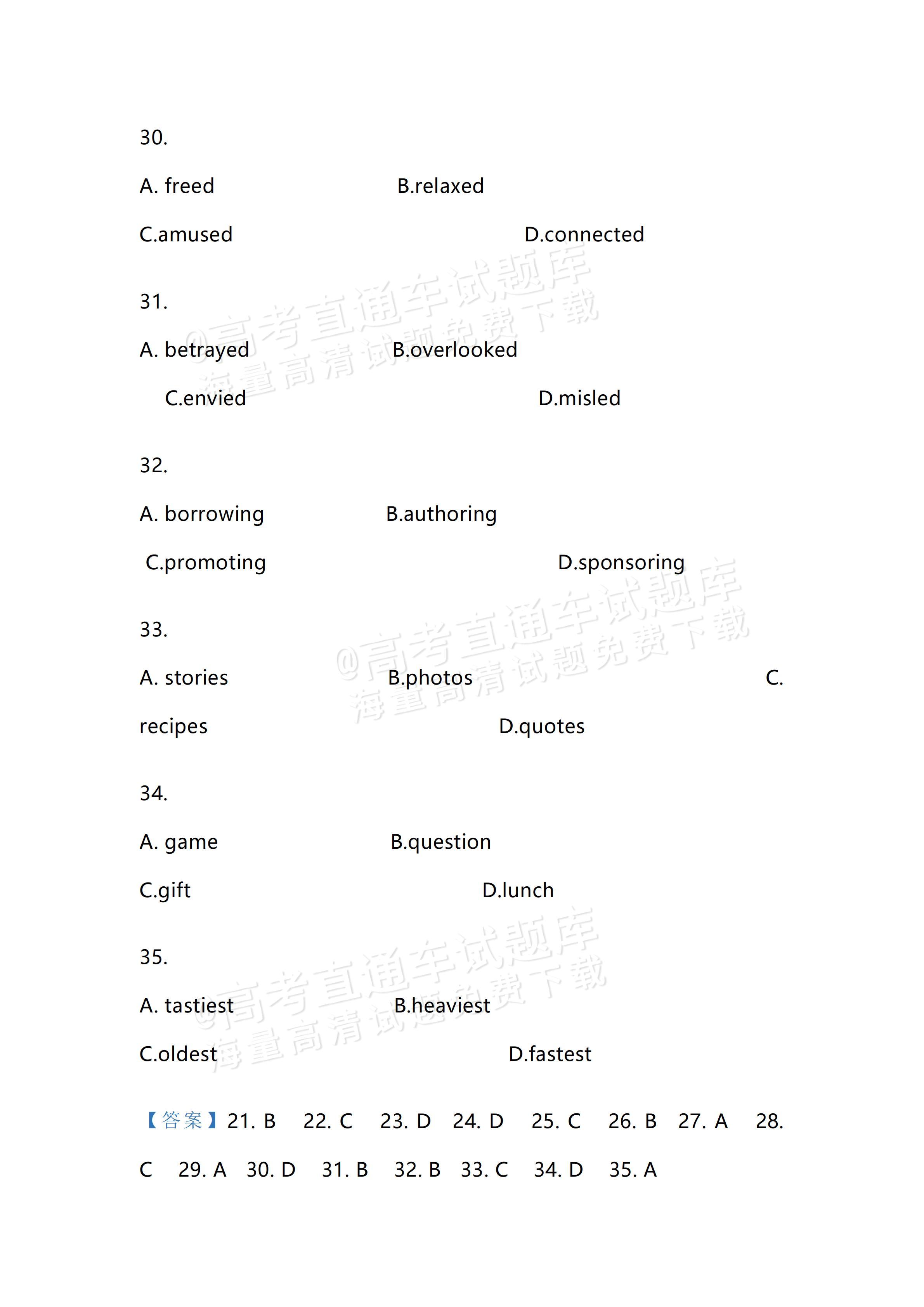
The event made everyone ___50___. Students who once ___51___ her now greeted her warmly. A girl named
Sophie even proposed ___52___ a French-Chinese cookbook together for the school fair and suggested including
family dishes passed down through generations.
On the final day, ___53___ filled a book titled Bites Beyond Borders. Holding it, Li Mei realized that cultural
gaps weren’t about walls but doors — waiting to be unlocked. A simple ___54___ had taught her more about
belonging than any textbook.
“Food is the ___55___ foreign policy,” Mr. Dupont said, biting into a red bean croissant.
41. A. adventure B. struggle C. routine D. necessity
42. A. messy B. ordinary C. strange D. special
43. A. mattered B. worked C. rested D. changed
44. A. praised B. postponed C. concluded D. launched
45. A. purchase B. review C. prepare D. receive
46. A. joked B. hesitated C. insisted D. protested
47. A. laid out B. held back C. heated up D. gave away
48. A. argued B. denied C. admitted D. added
49. A. identity B. interest C. personality D. quality
50. A. freed B. relaxed C. amused D. connected
51. A. betrayed B. overlooked C. envied D. misled
52. A. borrowing B. authoring C. promoting D. sponsoring
53. A. stories B. photos C. recipes D. quotes
54. A. game B. question C. gift D. lunch
55. A. tastiest B. heaviest C. oldest D. fastest
第二节(共10小题;每小题1.5分,满分15分)
阅读下面短文,在空白处填入1个适当的单词或括号内单词的正确形式。
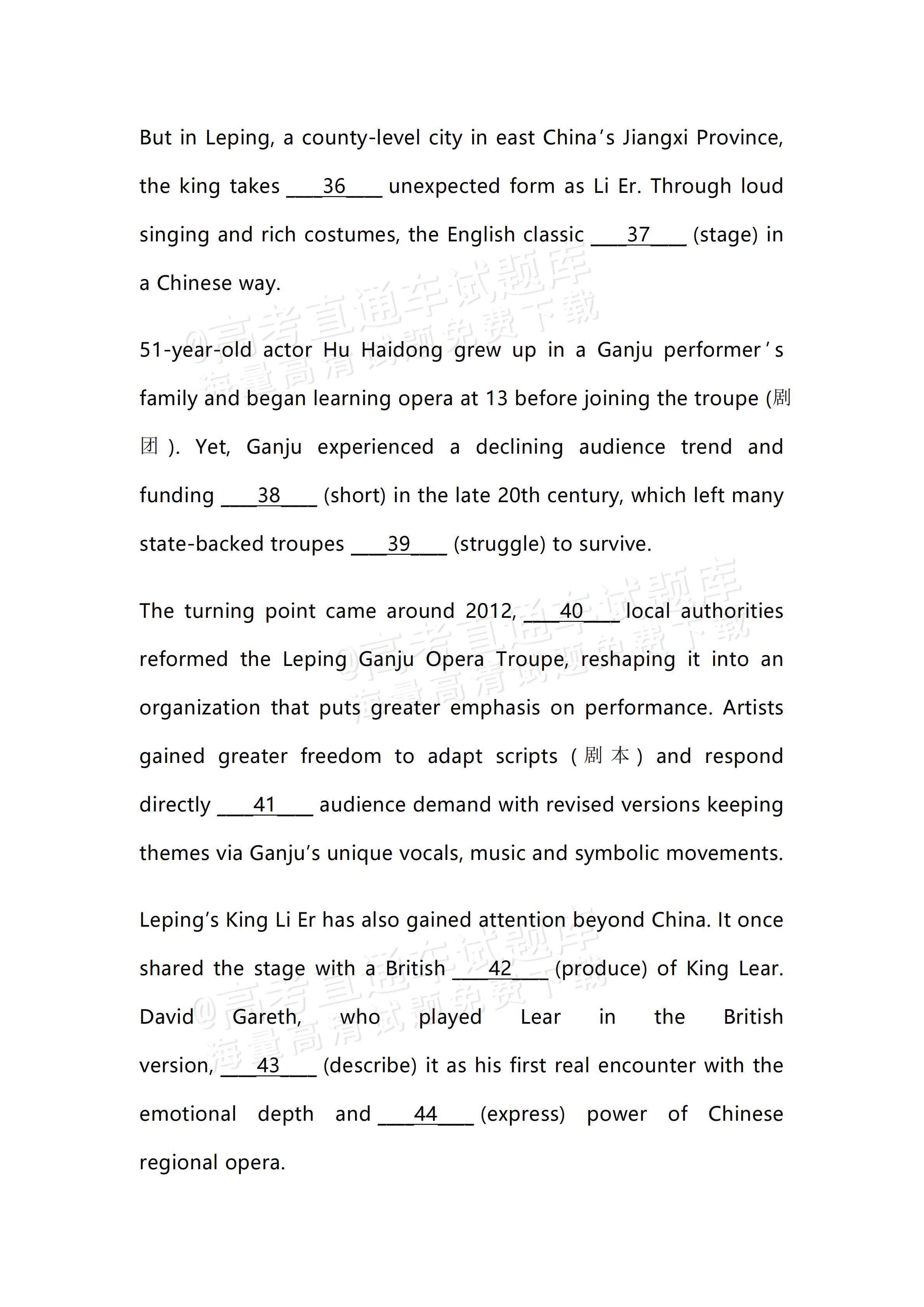
William Shakespeare’s King Lear《李尔王》 is often associated with the grand theaters of London’s West End
or New York’s Broadway. But in Leping, a county-level city in east China’s Jiangxi Province, the king takes ___56___
unexpected form as Li Er. Through loud singing and rich costumes, the English classic ___57___ (stage) in a Chinese
way.
51-year-old actor Hu Haidong grew up in a Ganju performer’s family and began learning opera at 13 before
joining the troupe (剧团). Yet, Ganju experienced a declining audience trend and funding ___58___ (short) in the
late 20th century, which left many state-backed troupes ___59___ (struggle) to survive.
The turning point came around 2012, ___60___ local authorities reformed the Leping Ganju Opera Troupe,
reshaping it into an organization that puts greater emphasis on performance. Artists gained greater freedom to adapt
scripts (剧本) and respond directly ___61___ audience demand with revised versions keeping themes via Ganju’s
unique vocals, music and symbolic movements.
Leping’s King Li Er has also gained attention beyond China. It once shared the stage with a British ___62___
(produce) of King Lear. David Gareth, who played Lear in the British version, ___63___ (describe) it as his first real
encounter with the emotional depth and ___64___ (express) power of Chinese regional opera.
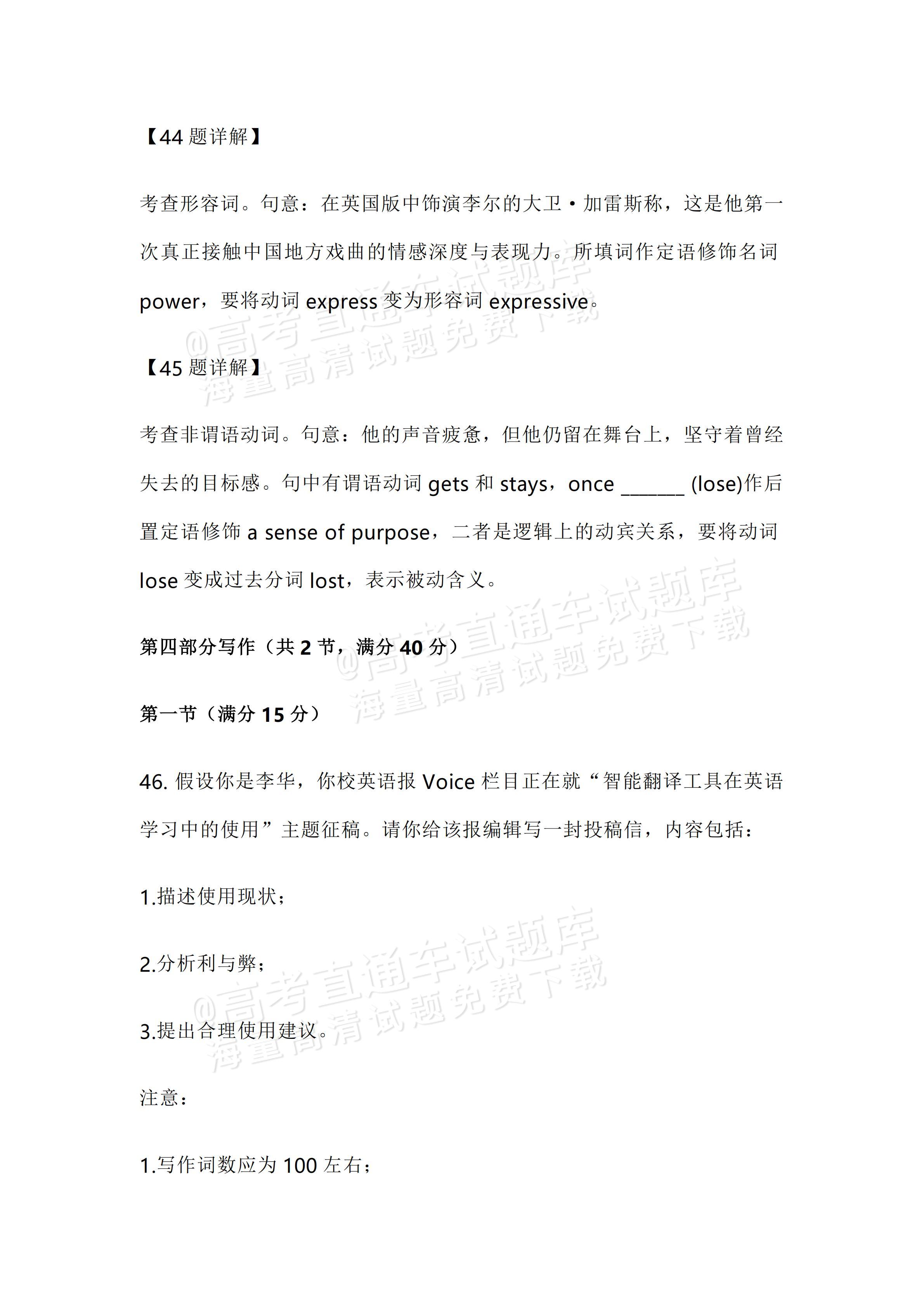
Today, Hu still performs for hours during busy seasons. His voice gets tired, but he stays on stage, holding on
to a sense of purpose once ___65___ (lose). “When I hear the applause,” he said, “I know the art is still alive.”
第四部分 写作(共 2 节,满分 40 分)
第一节(满分 15 分)
假设你是李华,你校英语报 Voice 栏目正在就“智能翻译工具在英语学习中的使用”主题征稿。请你
给该报编辑写一封投稿信,内容包括:
(1)描述使用现状;
(2)分析利与弊;
(3)提出合理使用建议。
注意:
1. 写作词数应为 100 左右;
2. 请在答题卡的相应位置作答。
Smart Translation Tools in English Learning
第二节(满分 25 分)
阅读下面材料,根据其内容和所给段落开头语续写两段,使之成为一篇完整的短文。
My name is Mae. I’ve always been passionate about exploring and solving problems — whether fixing a broken
toy or figuring out how a phone app works. This led me to join our school’s Coding (编程) Club. In our first lesson,
Ms. Davis told us that coding is more than writing lines of code. It is about using technology to make life easier for
others.
“Your project,” she announced in class one day, “is to create a simple app that solves a real-life problem.” “You
have one week to prepare,” she added gently, hoping this would give us enough time to find inspiration and finish
the project.
The challenge stayed with me as I walked to my neighbor Mrs. Thompson’s apartment after school. She had
invited me for tea, as she often did on Tuesdays. Mrs. Thompson was kind and cheerful, but lately she had been a
little forgetful, often misplacing her keys or repeating the same story twice without realizing it. When I arrived, she was in the kitchen.
“Mae! Good timing,” she greeted me warmly, and then stopped, glancing at the kettle. “Did I already boil water for tea?”
I checked the kettle — it was still warm. We laughed about it as I poured water, and soon we were chatting. Our conversation turned to her weekly book club with friends. Mrs. Thompson smiled, talking about her two old friends. Mr. Brown arrived late for the game, and Mrs. Smith failed to bring her glasses twice. “We're quite a group,” she said.
Then her expression grew thoughtful. “We manage, of course. But sometimes I think wouldn't it be nice if something simply reminds us? Take medicine. Water the plants. Friday for book club.” She tapped her head with a soft laugh.
Her words sank in. At that moment, an idea formed in my mind. As I stood up to leave, I smiled mysteriously, “Give me a few days, and I'll bring you a little surprise.”
“Oh? I'll try not to forget that,” she laughed.
注意:
(1)续写词数应为 150 个左右;
(2)请按如下格式在答题卡的相应位置作答。
Paragraph 1: That night, I sat at my desk, notebook open and mind racing with details.
Paragraph 2: A week later, I presented my project to Ms. Davis.
A
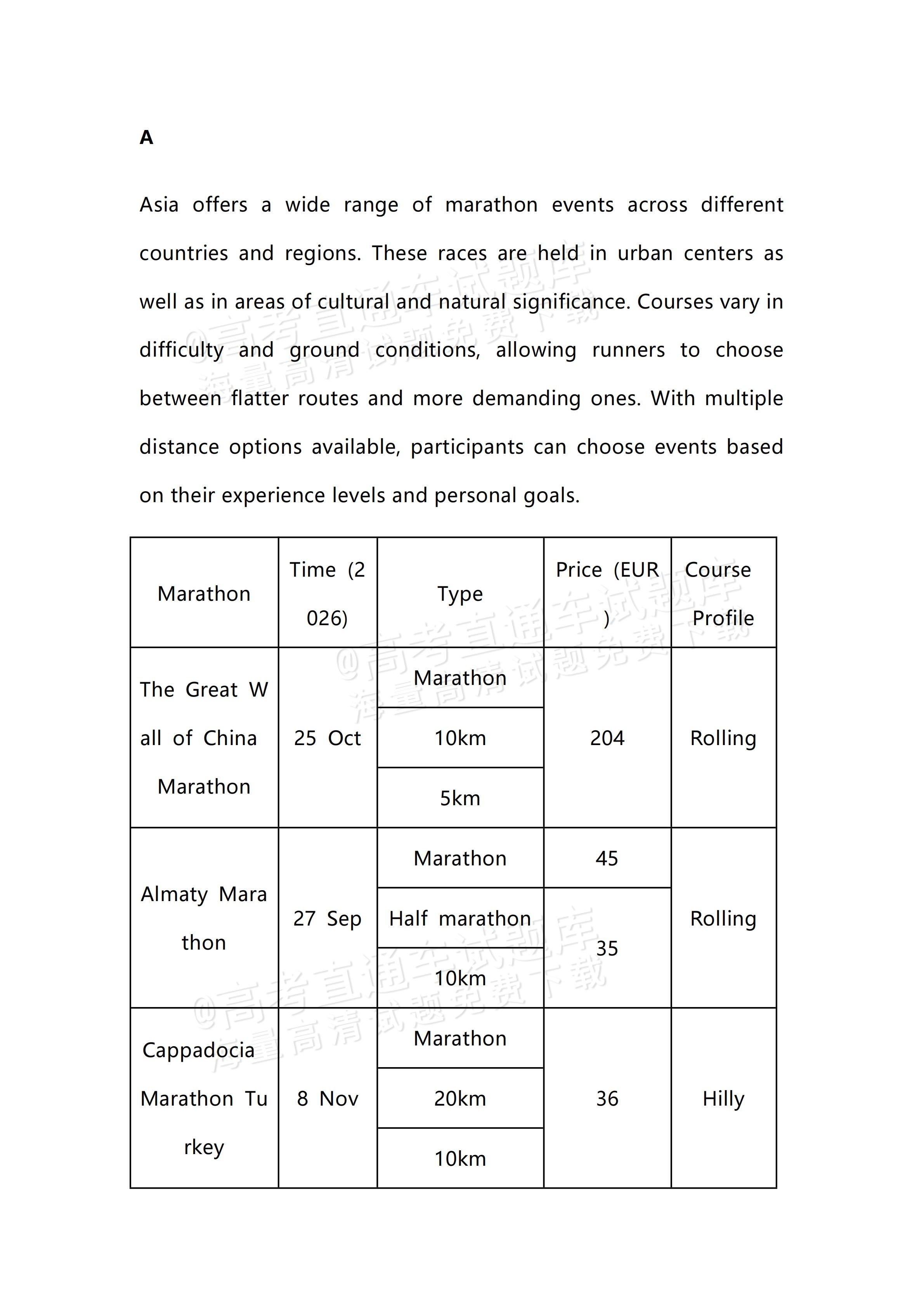
Asia offers a wide range of marathon events across different
countries and regions. These races are held in urban centers as
well as in areas of cultural and natural significance. Courses vary in
difficulty and ground conditions, allowing runners to choose
between flatter routes and more demanding ones. With multiple
distance options available, participants can choose events based
on their experience levels and personal goals.
Marathon Time (2 Type Price (EUR Course
026) ) Profile
The Great W 25 Oct Marathon 204 Rolling
all of China 10km
Marathon 5km
Almaty Mara 27 Sep Marathon 45 Rolling
thon Half marathon 35
10km
Cappadocia 8 Nov Marathon 36 Hilly
Marathon Tu 20km
rkey 10km
Songkhla M
arathon
22-23
Aug
Marathon
38
10km
22
5km
17
Flat
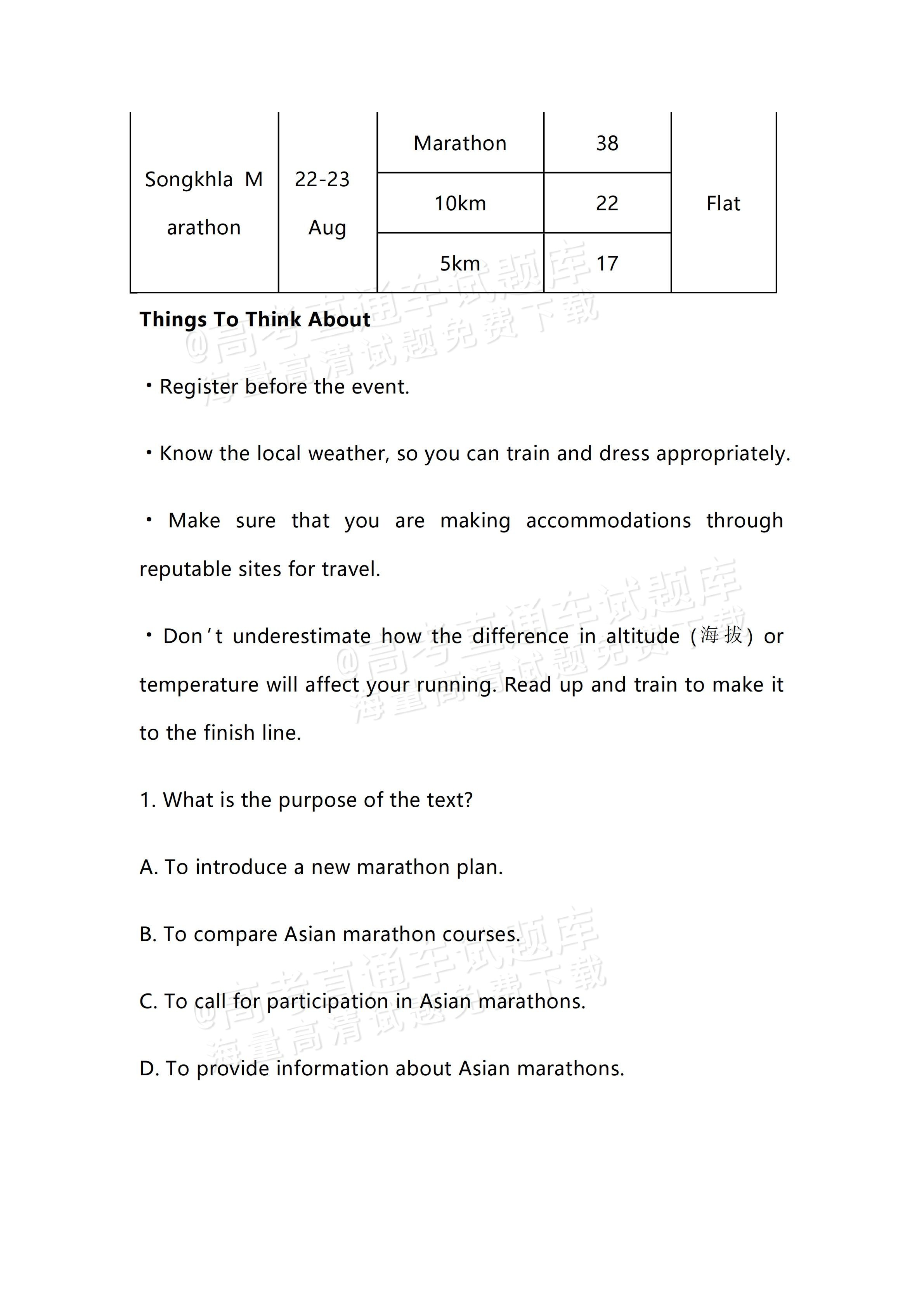
Things To Think About
• Register before the event.
• Know the local weather, so you can train and dress appropriately.
• Make sure that you are making accommodations through
reputable sites for travel.
• Don't underestimate how the difference in altitude (海拔) or
temperature will affect your running. Read up and train to make it
to the finish line.
1. What is the purpose of the text?
A. To introduce a new marathon plan.
B. To compare Asian marathon courses.
C. To call for participation in Asian marathons.
D. To provide information about Asian marathons.
2. Which marathon offers the shortest race with more demanding
routes?
A. Almaty
Marathon.
B.The Great Wall of China Marathon.
C. Songkhla
Marathon.
D.Cappadocia Marathon Turkey.
3. What are runners recommended to do before participation?
A. Book hotels from trusted websites.
B. Apply for a discounted entry fee.
C. Email the registration before the deadline.
D. Train under the guidance of professionals.
【答案】1. D 2. B 3. A
【解析】
【导语】本文是一篇应用文。文章主要介绍了亚洲多场马拉松的相关信息
及参赛注意事项。
【1 题详解】
主旨大意题。根据全文内容,第一段介绍了亚洲马拉松的整体情况“Asia
offers a wide range of marathon events across different countries
and regions. These races are held in urban centers as well as in
areas of cultural and natural significance.(亚洲在不同国家和地区举办
各种各样的马拉松赛事,这些赛事既有在城市中心举办的,也有在具有文
化和自然意义的地区举办的)”,表格列出了四场马拉松的具体信息,最后
给出参赛注意事项,可知本文旨在提供亚洲马拉松的相关信息。故选 D。
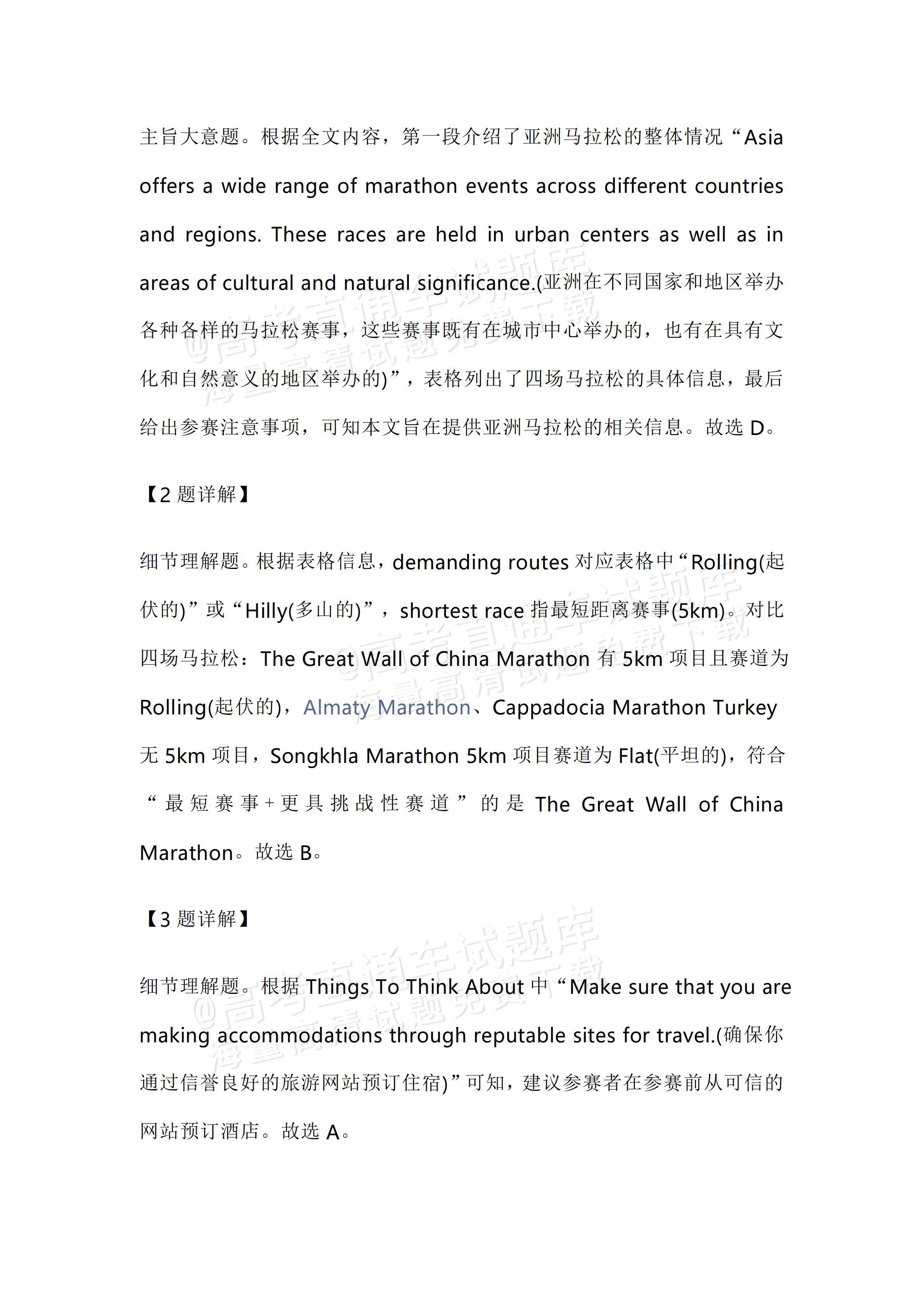
【2 题详解】
细节理解题。根据表格信息,demanding routes 对应表格中“Rolling(起
伏的)”或“Hilly(多山的)”,shortest race 指最短距离赛事(5km)。对比
四场马拉松:The Great Wall of China Marathon 有 5km 项目且赛道为
Rolling(起伏的),Almaty Marathon、Cappadocia Marathon Turkey
无 5km 项目,Songkhla Marathon 5km 项目赛道为 Flat(平坦的),符合
“最短赛事+更具挑战性赛道”的是 The Great Wall of China
Marathon。故选 B。
【3 题详解】
细节理解题。根据 Things To Think About 中“Make sure that you are
making accommodations through reputable sites for travel.(确保你
通过信誉良好的旅游网站预订住宿)”可知,建议参赛者在参赛前从可信的
网站预订酒店。故选 A。
B
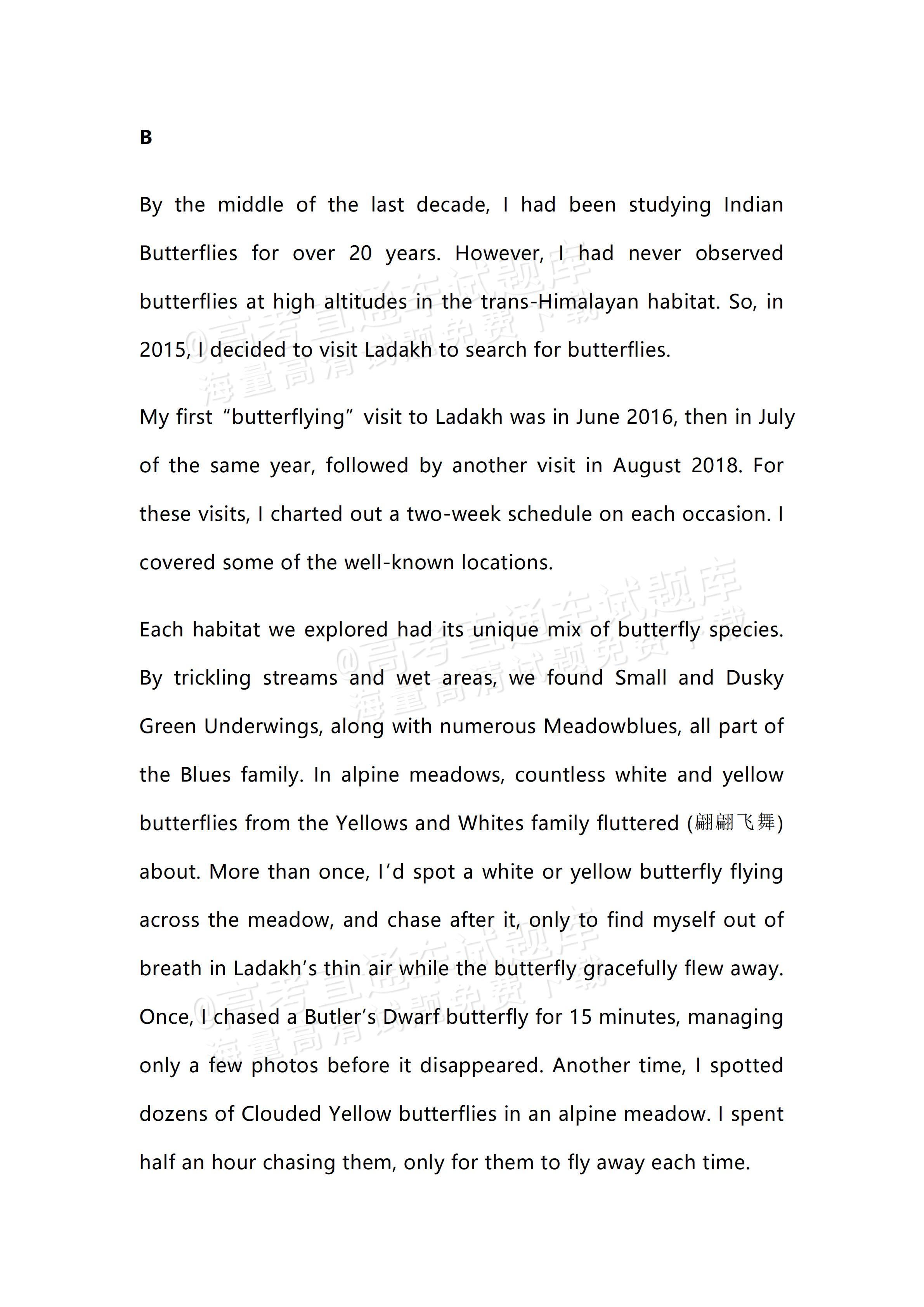
By the middle of the last decade, I had been studying Indian
Butterflies for over 20 years. However, I had never observed
butterflies at high altitudes in the trans-Himalayan habitat. So, in
2015, I decided to visit Ladakh to search for butterflies.
My first “butterflying” visit to Ladakh was in June 2016, then in July
of the same year, followed by another visit in August 2018. For
these visits, I charted out a two-week schedule on each occasion. I
covered some of the well-known locations.
Each habitat we explored had its unique mix of butterfly species.
By trickling streams and wet areas, we found Small and Dusky
Green Underwings, along with numerous Meadowblues, all part of
the Blues family. In alpine meadows, countless white and yellow
butterflies from the Yellows and Whites family fluttered (翩翩飞舞)
about. More than once, I’d spot a white or yellow butterfly flying
across the meadow, and chase after it, only to find myself out of
breath in Ladakh’s thin air while the butterfly gracefully flew away.
Once, I chased a Butler’s Dwarf butterfly for 15 minutes, managing
only a few photos before it disappeared. Another time, I spotted
dozens of Clouded Yellow butterflies in an alpine meadow. I spent
half an hour chasing them, only for them to fly away each time.
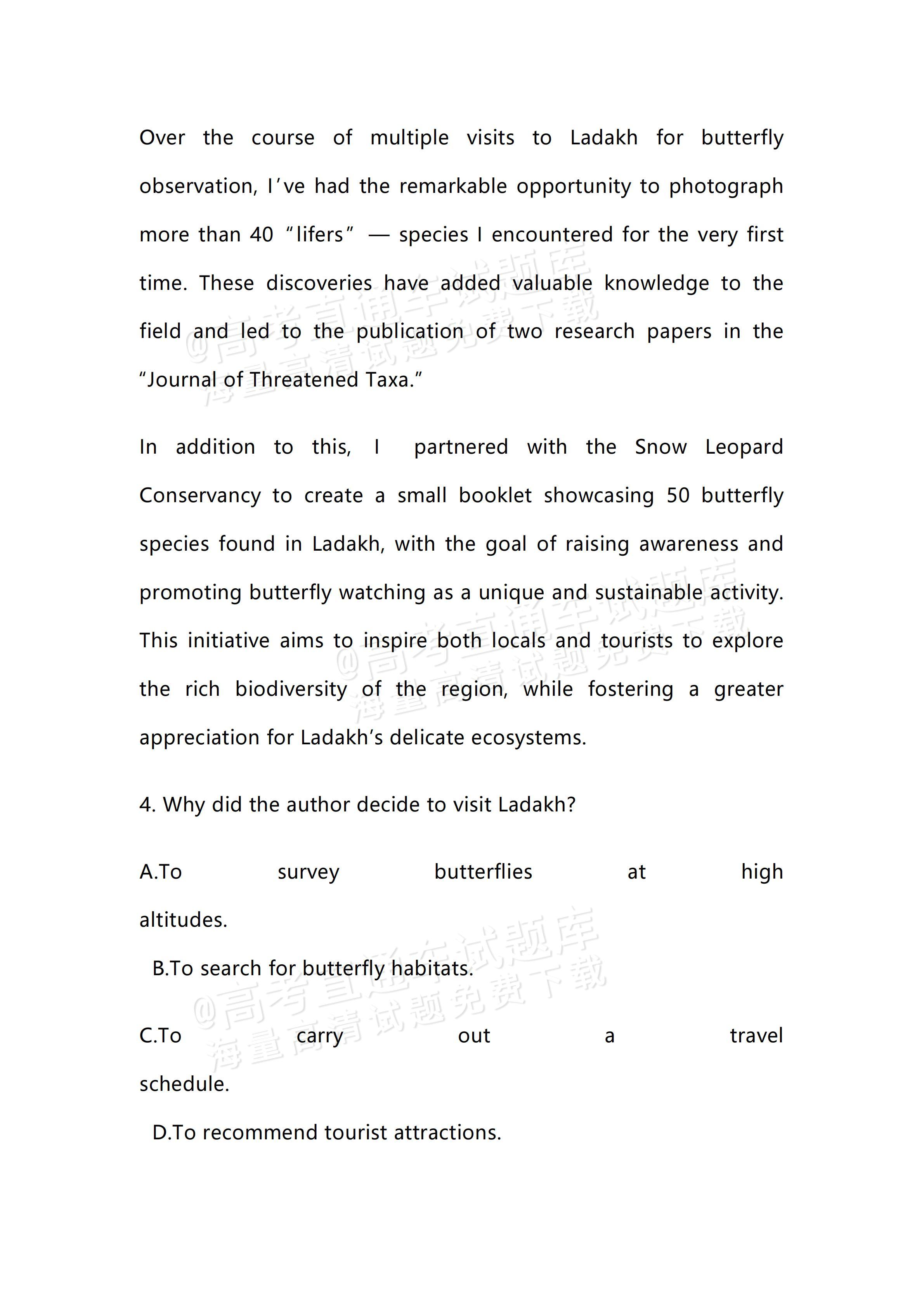
Over the course of multiple visits to Ladakh for butterfly
observation, I've had the remarkable opportunity to photograph
more than 40 "lifers" — species I encountered for the very first
time. These discoveries have added valuable knowledge to the
field and led to the publication of two research papers in the
"Journal of Threatened Taxa."
In addition to this, I partnered with the Snow Leopard
Conservancy to create a small booklet showcasing 50 butterfly
species found in Ladakh, with the goal of raising awareness and
promoting butterfly watching as a unique and sustainable activity.
This initiative aims to inspire both locals and tourists to explore
the rich biodiversity of the region, while fostering a greater
appreciation for Ladakh's delicate ecosystems.
4. Why did the author decide to visit Ladakh?
A.To survey butterflies at high
altitudes.
B.To search for butterfly habitats.
C.To carry out a travel
schedule.
D.To recommend tourist attractions.
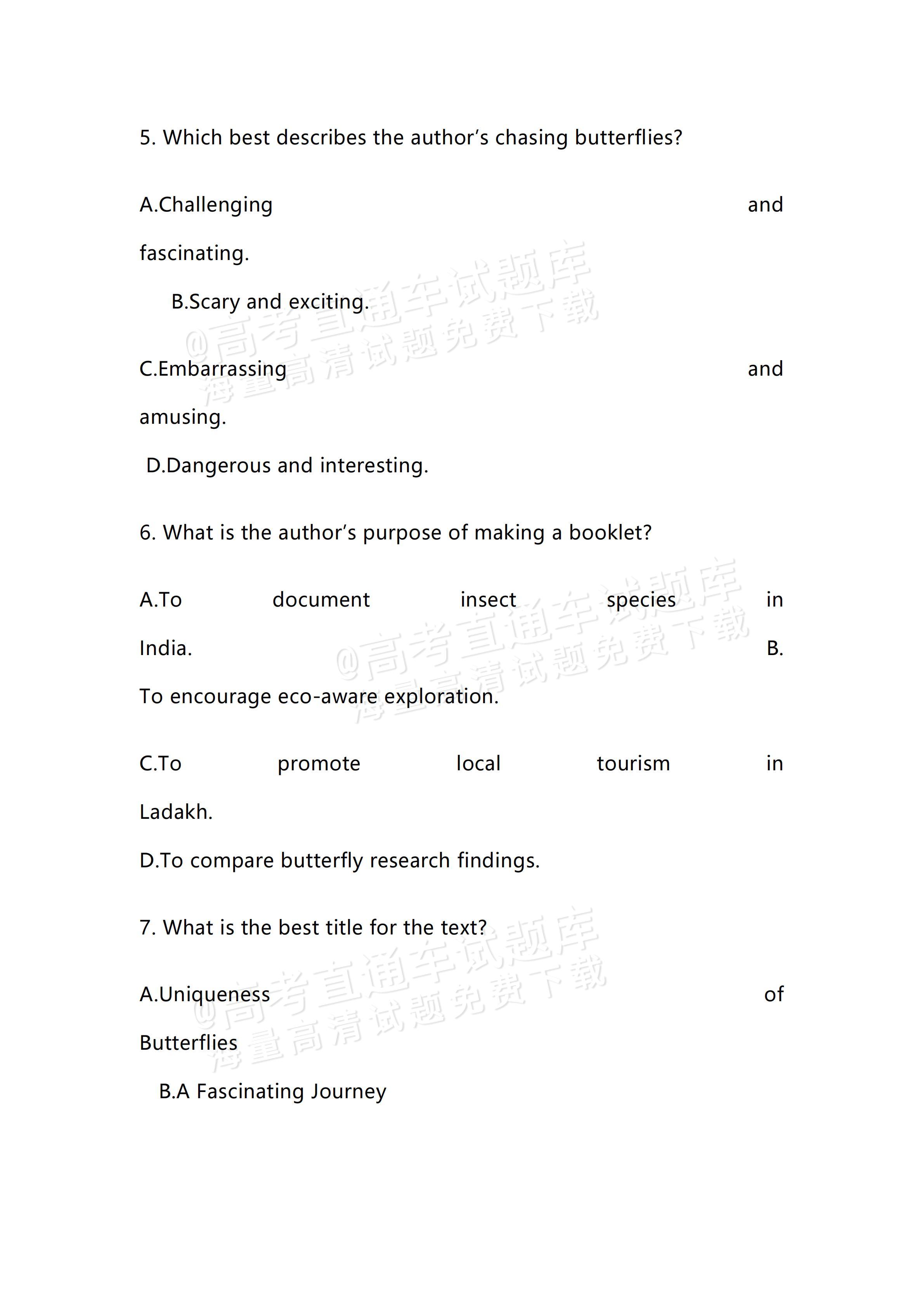
5. Which best describes the author’s chasing butterflies?
A.Challenging and
fascinating.
B.Scary and exciting.
C.Embarrassing and
amusing.
D.Dangerous and interesting.
6. What is the author’s purpose of making a booklet?
A.To document insect species in
India. B.
To encourage eco-aware exploration.
C.To promote local tourism in
Ladakh.
D.To compare butterfly research findings.
7. What is the best title for the text?
A.Uniqueness of
Butterflies
B.A Fascinating Journey
C.Biodiversity in
Ladakh
D.A Fluttering Discovery
【答案】4. A 5. A 6. B 7. D
【解析】
【导语】这是一篇记叙文。文章主要讲述了作者去拉达克高海拔地区观察蝴蝶,描述了追逐蝴蝶的过程以及感受。
【4题详解】
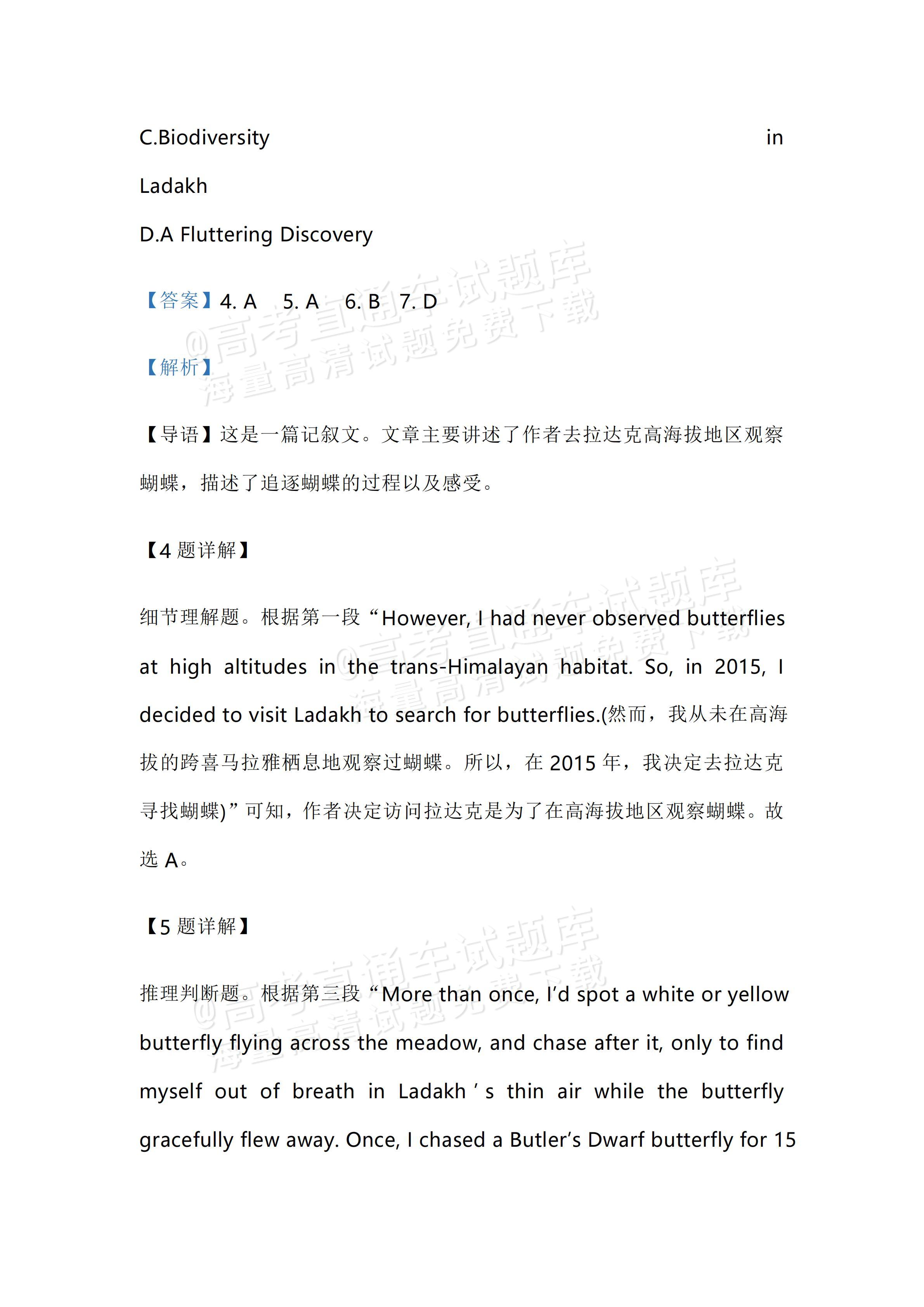
细节理解题。根据第一段“However, I had never observed butterflies at high altitudes in the trans-Himalayan habitat. So, in 2015, I decided to visit Ladakh to search for butterflies.(然而,我从未在高海拔的跨喜马拉雅栖息地观察过蝴蝶。所以,在2015年,我决定去拉达克寻找蝴蝶)”可知,作者决定访问拉达克是为了在高海拔地区观察蝴蝶。故选A。
【5题详解】
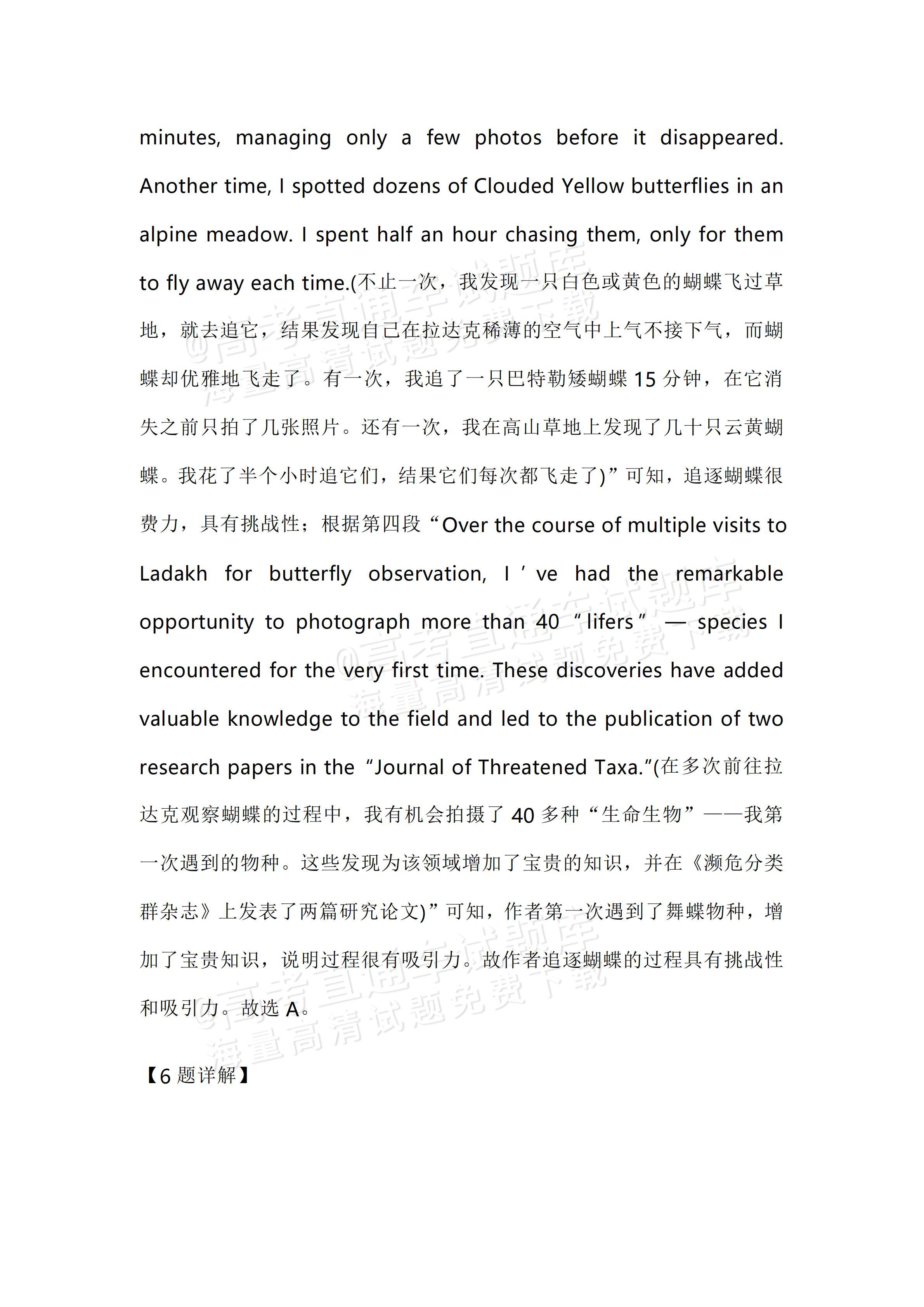
推理判断题。根据第三段“More than once, I'd spot a white or yellow butterfly flying across the meadow, and chase after it, only to find myself out of breath in Ladakh's thin air while the butterfly gracefully flew away. Once, I chased a Butler's Dwarf butterfly for 15
minutes, managing only a few photos before it disappeared.
Another time, I spotted dozens of Clouded Yellow butterflies in an
alpine meadow. I spent half an hour chasing them, only for them
to fly away each time.(不止一次,我发现一只白色或黄色的蝴蝶飞过草
地,就去追它,结果发现自己在拉达克稀薄的空气中上气不接下气,而蝴
蝶却优雅地飞走了。有一次,我追了一只巴特勒矮蝴蝶 15 分钟,在它消
失之前只拍了几张照片。还有一次,我在高山草地上发现了几十只云黄蝴
蝶。我花了半个小时追它们,结果它们每次都飞走了)”可知,追逐蝴蝶很
费力,具有挑战性;根据第四段“Over the course of multiple visits to
Ladakh for butterfly observation, I ' ve had the remarkable
opportunity to photograph more than 40 “lifers” — species I
encountered for the very first time. These discoveries have added
valuable knowledge to the field and led to the publication of two
research papers in the “Journal of Threatened Taxa.”(在多次前往拉
达克观察蝴蝶的过程中,我有机会拍摄了 40 多种“生命生物”——我第
一次遇到的物种。这些发现为该领域增加了宝贵的知识,并在《濒危分类
群杂志》上发表了两篇研究论文)”可知,作者第一次遇到了舞蝶物种,增
加了宝贵知识,说明过程很有吸引力。故作者追逐蝴蝶的过程具有挑战性
和吸引力。故选 A。
【6 题详解】
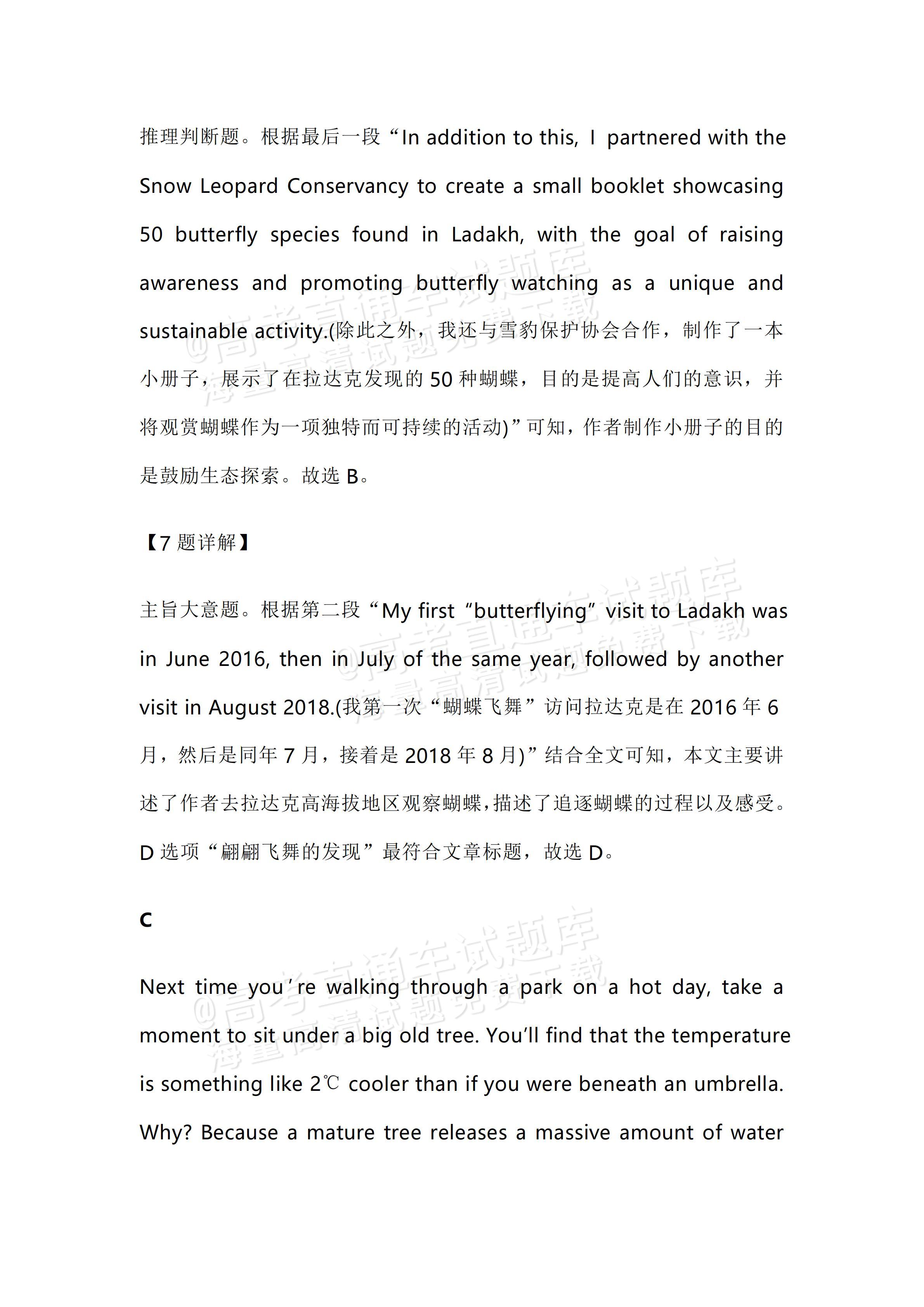
推理判断题。根据最后一段“In addition to this, I partnered with the
Snow Leopard Conservancy to create a small booklet showcasing
50 butterfly species found in Ladakh, with the goal of raising
awareness and promoting butterfly watching as a unique and
sustainable activity.(除此之外,我还与雪豹保护协会合作,制作了一本
小册子,展示了在拉达克发现的50种蝴蝶,目的是提高人们的意识,并
将观赏蝴蝶作为一项独特而可持续的活动)”可知,作者制作小册子的目的
是鼓励生态探索。故选B。
【7题详解】
主旨大意题。根据第二段“My first “butterflying” visit to Ladakh was
in June 2016, then in July of the same year, followed by another
visit in August 2018.(我第一次“蝴蝶飞舞”访问拉达克是在2016年6
月,然后是同年7月,接着是2018年8月)”结合全文可知,本文主要讲
述了作者去拉达克高海拔地区观察蝴蝶,描述了追逐蝴蝶的过程以及感受。
D选项“翩翩飞舞的发现”最符合文章标题,故选D。
C
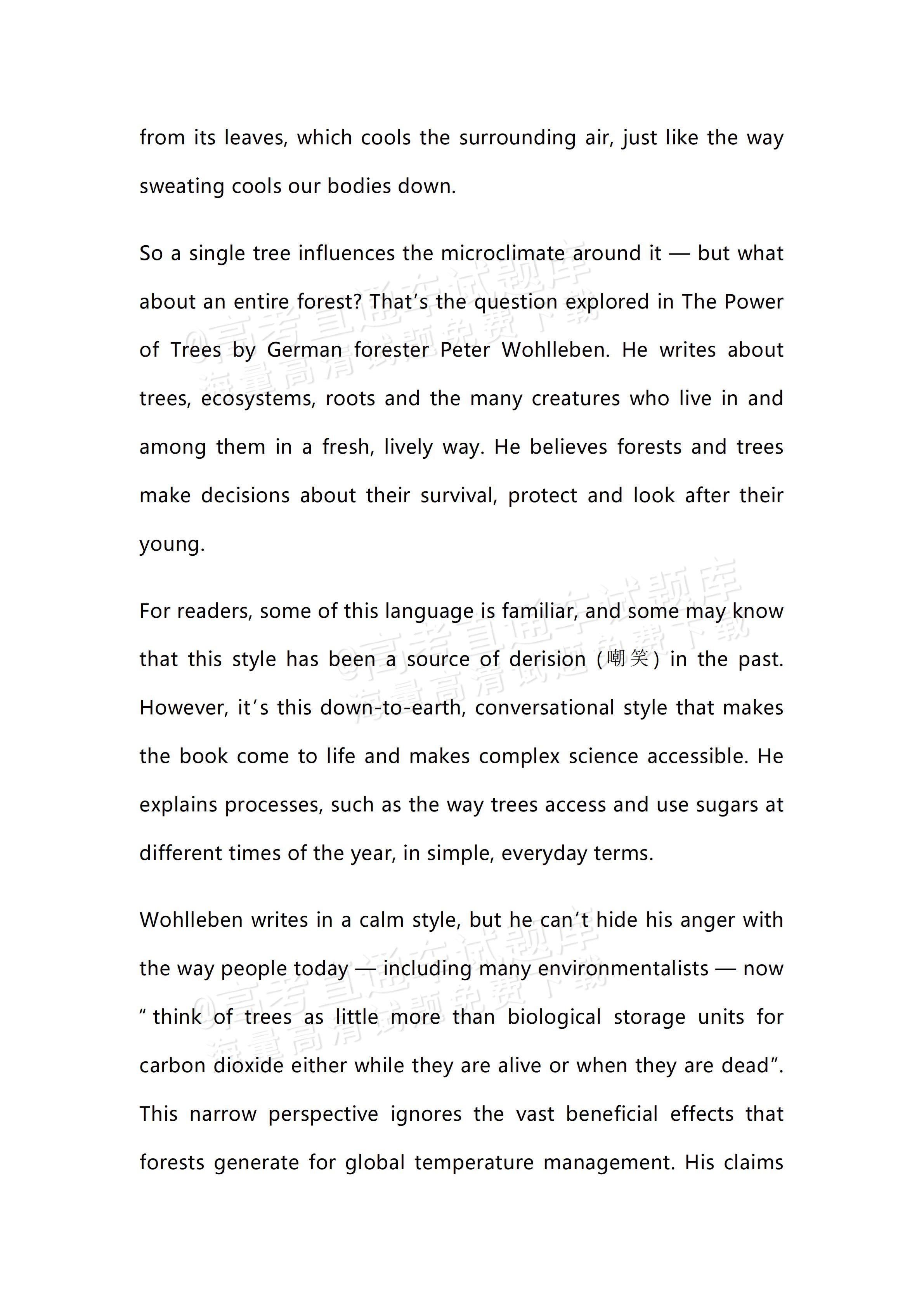
Next time you're walking through a park on a hot day, take a
moment to sit under a big old tree. You'll find that the temperature
is something like 2℃ cooler than if you were beneath an umbrella.
Why? Because a mature tree releases a massive amount of water
from its leaves, which cools the surrounding air, just like the way
sweating cools our bodies down.
So a single tree influences the microclimate around it — but what
about an entire forest? That's the question explored in The Power
of Trees by German forester Peter Wohlleben. He writes about
trees, ecosystems, roots and the many creatures who live in and
among them in a fresh, lively way. He believes forests and trees
make decisions about their survival, protect and look after their
young.
For readers, some of this language is familiar, and some may know
that this style has been a source of derision (嘲笑) in the past.
However, it's this down-to-earth, conversational style that makes
the book come to life and makes complex science accessible. He
explains processes, such as the way trees access and use sugars at
different times of the year, in simple, everyday terms.
Wohlleben writes in a calm style, but he can't hide his anger with
the way people today — including many environmentalists — now
" think of trees as little more than biological storage units for
carbon dioxide either while they are alive or when they are dead".
This narrow perspective ignores the vast beneficial effects that
forests generate for global temperature management. His claims
and criticisms are backed by emerging science and new research,
as well as practical observations of how the presence of forests
changes the landscape nearby.
This book is wise and thought-provoking. In his chapter
highlighting the role of wolves as top predators (捕食者) in
preserving the forest, Wohlleben writes: " We can come at
protecting forests from whatever direction we want, but the
results are always the same. We must put less pressure on nature
by exploiting (开发) it less. We must strengthen forests by allowing
them to take care of themselves."
8. What does The Power of Trees explore?
A.Temperature
management.
B.The loss of water in leaves.
C.Formation of
microclimates.
D.The vital role that forests play.
9. Which can describe the language in the book?
A. Complex. B.Fancy.
C.Approachable. D.Professional.
10. How does Wohlleben deal with people's narrow perspective on
forests?
A.He treats it
lightly. B.
He turns a deaf ear to it.
C.He refers to it
selectively.
D.He argues against it convincingly.
11. What does Wohlleben suggest for protecting forests?
A.Fighting climate
change.
B.Leaving them alone.
C.Returning farmland to
forest. D.
Driving wolves away.
【答案】8. D 9. C 10. D 11. B
【解析】
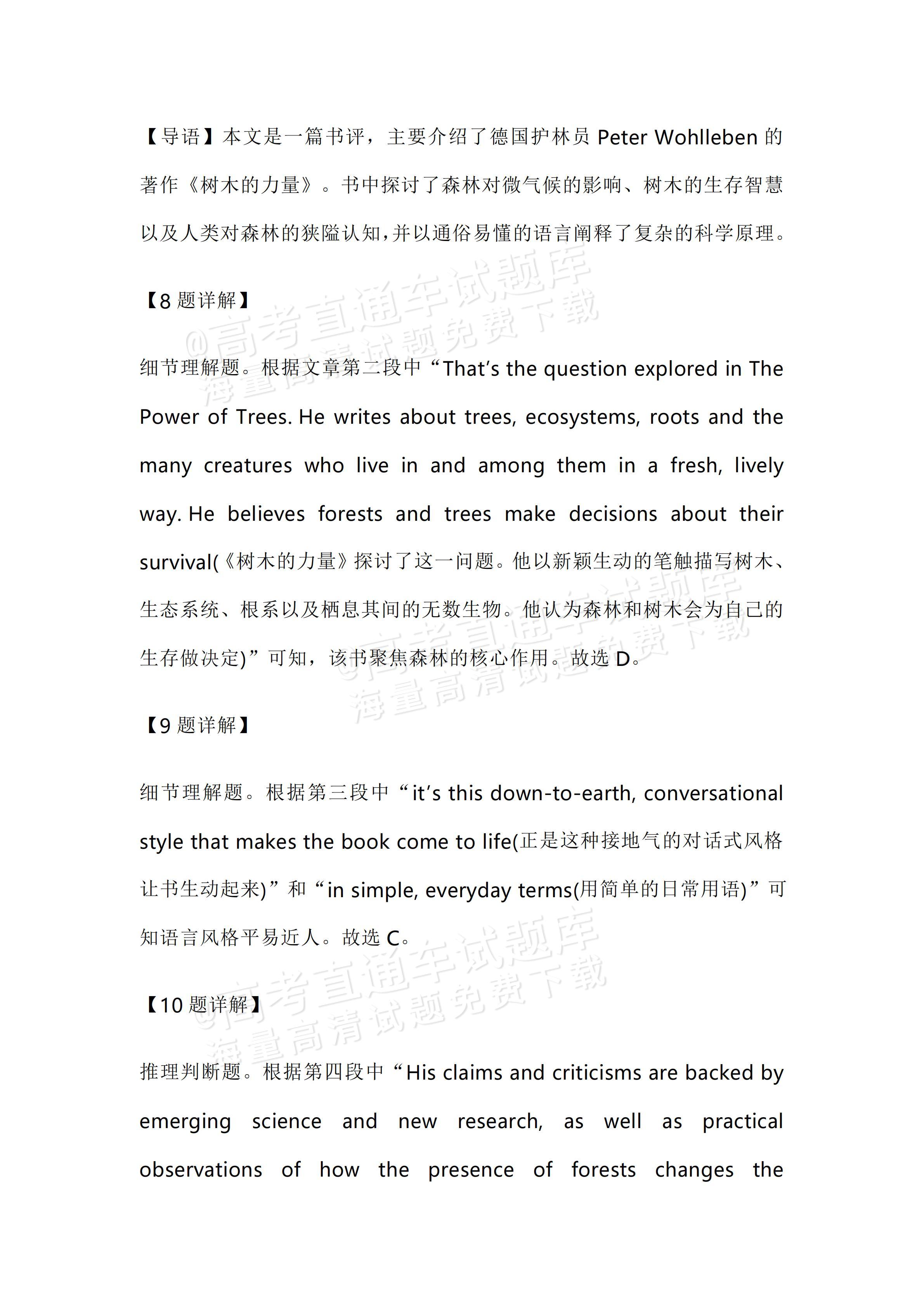
【导语】本文是一篇书评,主要介绍了德国护林员 Peter Wohlleben 的
著作《树木的力量》。书中探讨了森林对微气候的影响、树木的生存智慧
以及人类对森林的狭隘认知,并以通俗易懂的语言阐释了复杂的科学原理。
【8题详解】
细节理解题。根据文章第二段中“That’s the question explored in The
Power of Trees. He writes about trees, ecosystems, roots and the
many creatures who live in and among them in a fresh, lively
way. He believes forests and trees make decisions about their
survival(《树木的力量》探讨了这一问题。他以新颖生动的笔触描写树木、
生态系统、根系以及栖息其间的无数生物。他认为森林和树木会为自己的
生存做决定)”可知,该书聚焦森林的核心作用。故选 D。
【9题详解】
细节理解题。根据第三段中“it’s this down-to-earth, conversational
style that makes the book come to life(正是这种接地气的对话式风格
让书生动起来)”和“in simple, everyday terms(用简单的日常用语)”可
知语言风格平易近人。故选 C。
【10题详解】
推理判断题。根据第四段中“His claims and criticisms are backed by
emerging science and new research, as well as practical
observations of how the presence of forests changes the
landscape nearby.(他的主张和批评得到了新兴科学研究和实地观察的支
撑——这些研究证明了森林如何改变周边地貌。)”可推知,作者用科学
论据有力反驳了狭隘观点。故选 D。
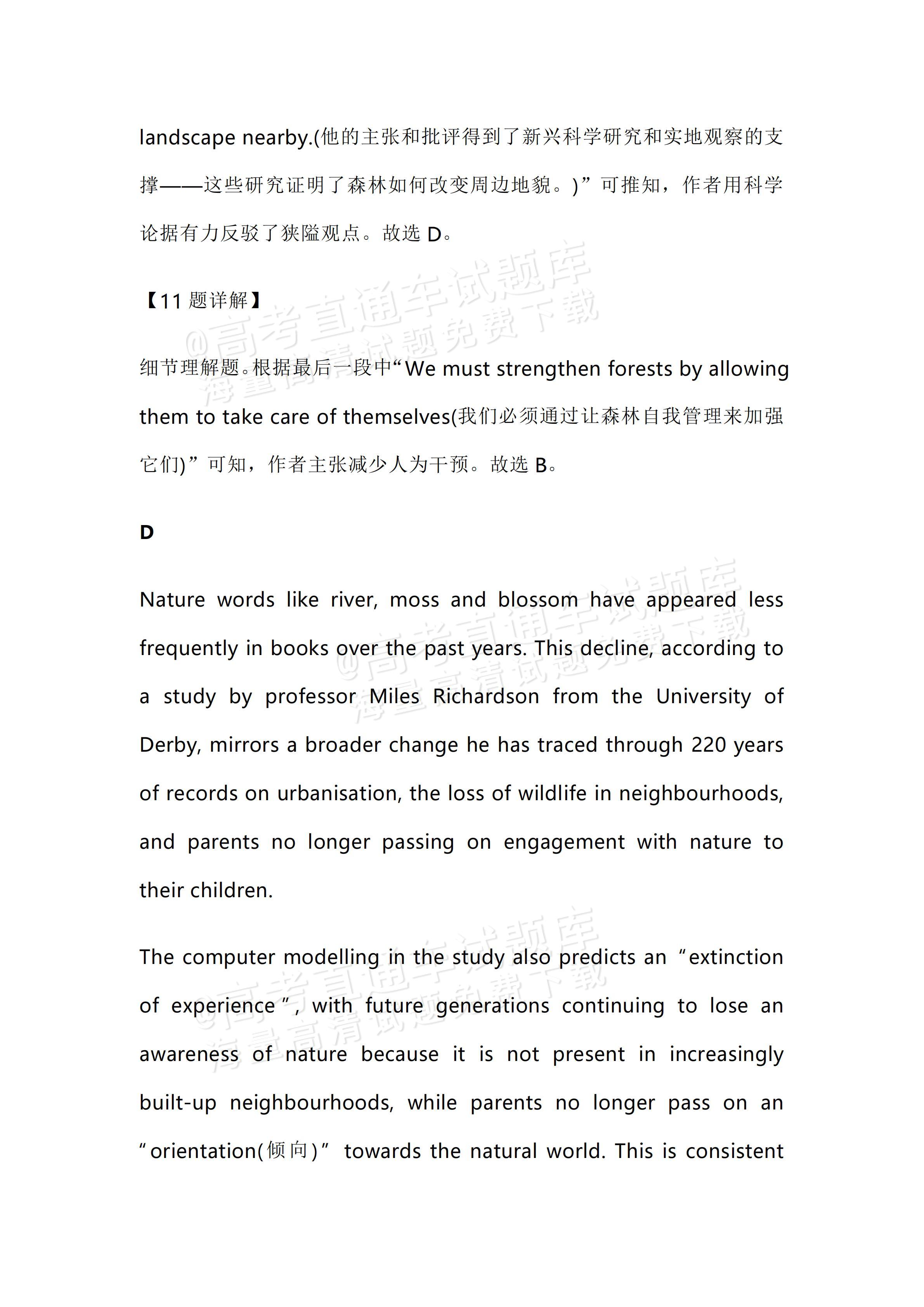
【11 题详解】
细节理解题。根据最后一段中“We must strengthen forests by allowing
them to take care of themselves(我们必须通过让森林自我管理来加强
它们)”可知,作者主张减少人为干预。故选 B。
D
Nature words like river, moss and blossom have appeared less
frequently in books over the past years. This decline, according to
a study by professor Miles Richardson from the University of
Derby, mirrors a broader change he has traced through 220 years
of records on urbanisation, the loss of wildlife in neighbourhoods,
and parents no longer passing on engagement with nature to
their children.
The computer modelling in the study also predicts an “extinction
of experience ”, with future generations continuing to lose an
awareness of nature because it is not present in increasingly
built-up neighbourhoods, while parents no longer pass on an
“orientation(倾向)” towards the natural world. This is consistent
with findings from other studies, which identify adult nature
connectedness as the strongest predictor of whether a child will
become close to nature.
Richardson said that when he tested policy and urban
environmental changes in the model he was surprised at the scale
of the changes required to restore the connection to nature.
Increasing biodiverse green spaces in a city by 30% might look
like significant positive progress for wildlife and people but
Richardson said his study suggests a city might need to be 10
times greener to turn around declines in nature connection.
Efforts to simply encourage adults to engage with nature are
often insufficient for lasting change. More effective are measures
that build nature connection from an early age, such as forest
schools for young children. Research indicates that government
initiatives reshaping early education and urban design must be
consistently applied over the next 25 years. Once established, this
connection can become self-sustaining.
Richardson said the scale of societal change required might not
be as challenging as it appeared. A study on people in Sheffield
found that they spent just 4 minutes and 36 seconds on average
in natural spaces each day. “Increase that by ten, and people are
spending 40 minutes outside every day — that may be enough,” he
said. “The key is to make these gains last across generations,” he
added.
12. What change has Richardson traced in his study?
A.Nature words have disappeared from
books. B.
People have less direct contact with nature.
C.Urbanisation has damaged wildlife
habitats.
D.Parents spend more time outdoors with kids.
13. What might cause future generations to have “ extinction of
experience” in the model?
A.They are raised away from
nature. B.
They can’t adapt to changes in nature.
C.High-rise buildings fill
neighbourhoods.
D.Schools offer few nature science lessons.
14. What is a most effective solution to the issue according to the
text?
A.Advancing long-term
policies.
B.Launching eco-friendly campaigns.
C.Focusing on raising adults '
awareness.
D.Enlarging green space in certain areas.
15. Richardson mentioned the study on people in Sheffield to
show ________.
A.nature contact varies from city to
city
B.pe
ople's living habits are hard to change
C.a new way to measure nature time is
needed
D.small efforts help improve contact with nature
【答案】12. B 13. A 14. A 15. D
【解析】
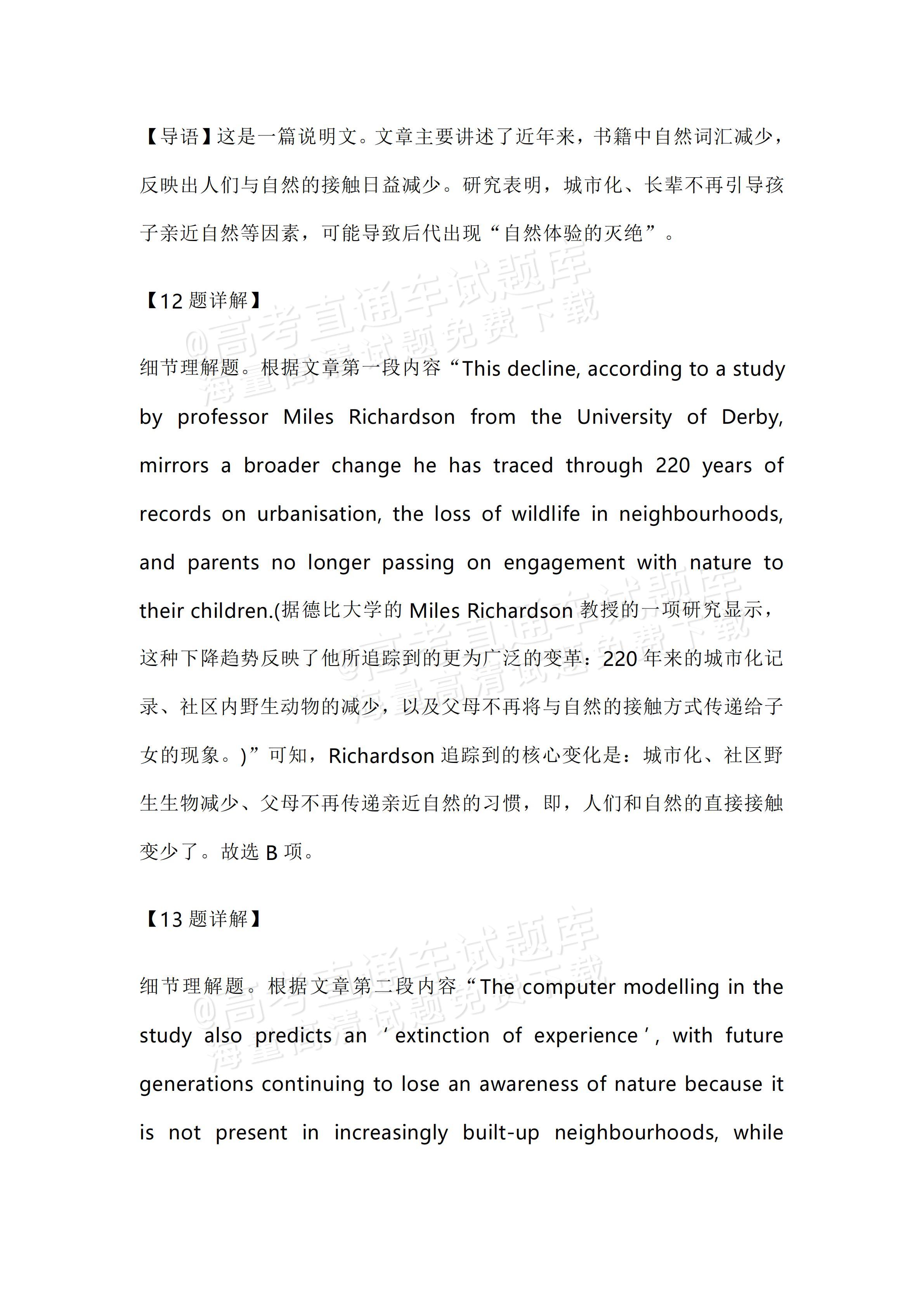
【导语】这是一篇说明文。文章主要讲述了近年来,书籍中自然词汇减少,反映出人们与自然的接触日益减少。研究表明,城市化、长辈不再引导孩子亲近自然等因素,可能导致后代出现“自然体验的灭绝”。
【12题详解】
细节理解题。根据文章第一段内容“This decline, according to a study by professor Miles Richardson from the University of Derby, mirrors a broader change he has traced through 220 years of records on urbanisation, the loss of wildlife in neighbourhoods, and parents no longer passing on engagement with nature to their children.(据德比大学的 Miles Richardson 教授的一项研究显示,这种下降趋势反映了他所追踪到的更为广泛的变革:220 年来的城市化记录、社区内野生动物的减少,以及父母不再将与自然的接触方式传递给子女的现象。)”可知,Richardson 追踪到的核心变化是:城市化、社区野生生物减少、父母不再传递亲近自然的习惯,即,人们和自然的直接接触变少了。故选 B 项。
【13题详解】
细节理解题。根据文章第二段内容“The computer modelling in the study also predicts an ‘extinction of experience’, with future generations continuing to lose an awareness of nature because it is not present in increasingly built-up neighbourhoods, while
parents no longer pass on an ‘orientation’ towards the natural
world.(该研究中的计算机模型还预测会出现“体验灭绝”现象,未来的世
代将会逐渐失去对自然界的认知,因为自然环境已不再存在于日益密集的
居民区之中,而父母们也不再向孩子们传递对自然世界的“认知导
向”。)”可知,“体验灭绝”的原因是:社区逐渐被建筑覆盖,自然消失,
同时父母不再传递亲近自然的倾向,即,下一代成长环境本身就远离自然。
故选 A 项。
【14题详解】
细节理解题。根据文章第四段内容“More effective are measures that
build nature connection from an early age, such as forest schools
for young children. Research indicates that government initiatives
reshaping early education and urban design must be consistently
applied over the next 25 years. Once established, this connection
can become self-sustaining.(更为有效的是那些能在孩子幼年时期就建
立与自然联系的措施,比如为幼儿设立的森林学校。研究表明,政府针对
早期教育和城市规划的改革举措必须在未来 25 年内持续推行。一旦这种
联系得以确立,它就能实现自我维持。)”可知,更有效的方式是从小培养
亲近自然的连接,政府调整早期教育和城市设计的举措,必须在未来 25
年持续推行,即长期政策才是有效的解决方案。故选 A 项。
【15题详解】
推理判断题。根据文章末尾段内容“A study on people in Sheffield found that they spent just 4 minutes and 36 seconds on average in natural spaces each day. 'Increase that by ten, and people are spending 40 minutes outside every day — that may be enough,' he said.(一项针对谢菲尔德市民的研究发现,他们平均每天在自然环境中停留的时间仅为4分36秒。“将这个时间增加10倍,人们每天就能在户外度过40分钟——这或许已经足够了。”)”提及谢菲尔德市民每天只在自然环境中停留4分36秒,而只需增加十倍到四十分钟就够了,即,不用巨大改变,小努力就能提升亲近自然的时间。故选D项。
第二节(共5小题;每小题2.5分,满分12.5分)
阅读下面短文,从短文后的选项中选出可以填入空白处的最佳选项。选项中有两项为多余选项。
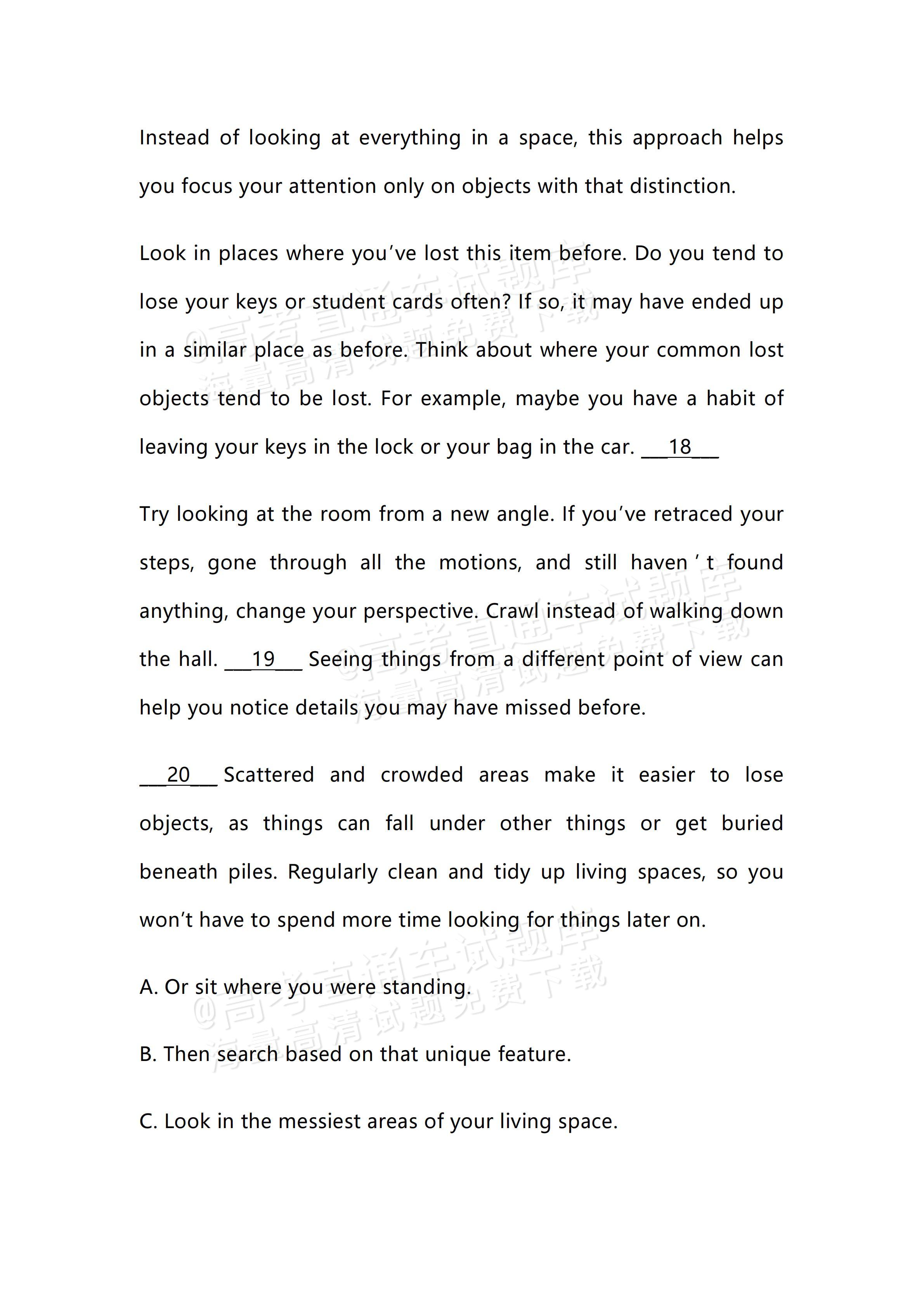
Ugh! You swear you had your keys a second ago, and now they're just gone! Before you panic, take a deep breath. 16 . Losing things is a part of life, but finding them doesn't have to be a nerve-wracking rush. In this article, we'll teach you where you can look and how you can retrace your steps to find lost objects.
Identify what makes your missing object stand out in its environment. It might be its size, color, texture or shape. 17 It will make the process faster and more efficient。
Instead of looking at everything in a space, this approach helps
you focus your attention only on objects with that distinction.
Look in places where you’ve lost this item before. Do you tend to
lose your keys or student cards often? If so, it may have ended up
in a similar place as before. Think about where your common lost
objects tend to be lost. For example, maybe you have a habit of
leaving your keys in the lock or your bag in the car. ___18___
Try looking at the room from a new angle. If you’ve retraced your
steps, gone through all the motions, and still haven’t found
anything, change your perspective. Crawl instead of walking down
the hall. ___19___ Seeing things from a different point of view can
help you notice details you may have missed before.
___20___ Scattered and crowded areas make it easier to lose
objects, as things can fall under other things or get buried
beneath piles. Regularly clean and tidy up living spaces, so you
won’t have to spend more time looking for things later on.
A. Or sit where you were standing.
B. Then search based on that unique feature.
C. Look in the messiest areas of your living space.
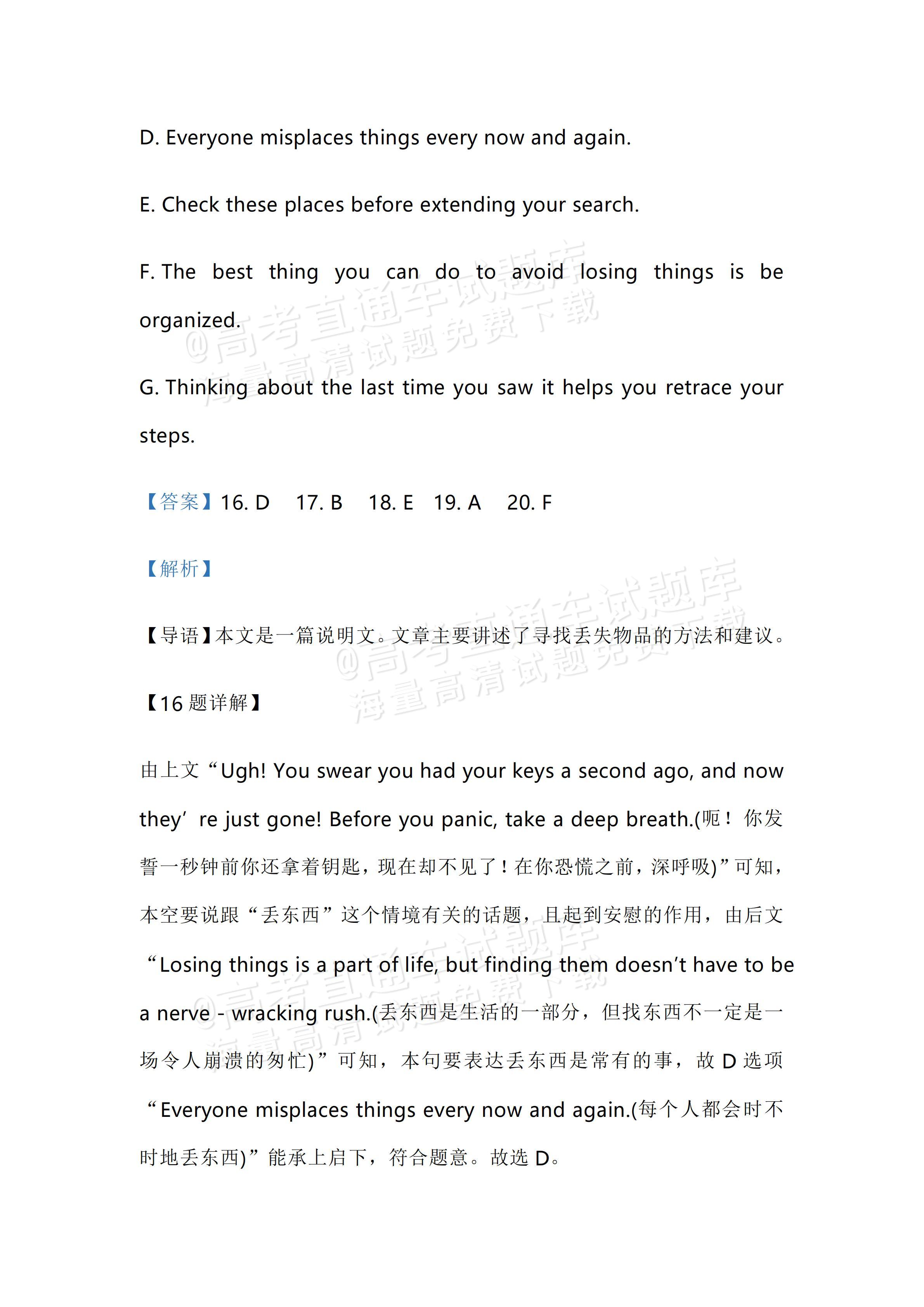
D. Everyone misplaces things every now and again.
E. Check these places before extending your search.
F. The best thing you can do to avoid losing things is be
organized.
G. Thinking about the last time you saw it helps you retrace your
steps.
【答案】16. D 17. B 18. E 19. A 20. F
【解析】
【导语】本文是一篇说明文。文章主要讲述了寻找丢失物品的方法和建议。
【16题详解】
由上文“Ugh! You swear you had your keys a second ago, and now
they’ re just gone! Before you panic, take a deep breath.(呃!你发
誓一秒钟前你还拿着钥匙,现在却不见了!在你恐慌之前,深呼吸)”可知,
本空要说跟“丢东西”这个情境有关的话题,且起到安慰的作用,由后文
“Losing things is a part of life, but finding them doesn't have to be
a nerve - wracking rush.(丢东西是生活的一部分,但找东西不一定是一
场令人崩溃的匆忙)”可知,本句要表达丢东西是常有的事,故D选项
“Everyone misplaces things every now and again.(每个人都会时不
时地丢东西)”能承上启下,符合题意。故选D。
【17题详解】
由上文 “Identify what makes your missing object stand out in its
environment. It might be its size, color, texture or shape.(确定是什么
让你的丢失物品在环境中脱颖而出。它可能是大小、颜色、质地或形状)”
可知,本空要说跟“根据物品特征寻找”有关的话题,由后文“It will make
the process faster and more efficient.(这将使过程更快、更有效率)”
可知,本句要表达根据这个独特特征去寻找,故 B 选项 “Then search
based on that unique feature.(然后根据那个独特特征去寻找)”能承上
启下,符合题意。故选 B。
【18题详解】
由上文 “Look in places where you’ve lost this item before. Do you
tend to lose your keys or student cards often? If so, it may have
ended up in a similar place as before. Think about where your
common lost objects tend to be lost. For example, maybe you
have a habit of leaving your keys in the lock or your bag in the
car.(看看你以前丢过这个东西的地方。你经常丢钥匙或学生证吗?如果是
这样,它可能和以前一样落在了类似的地方。想想你经常丢的东西通常丢
在哪里。例如,也许你习惯把钥匙落在锁里或把包落在车里)”可知,本空
要说跟“检查这些地方”有关的话题,故 E 选项 “Check these places
before extending your search.(在扩大搜索范围之前,先检查这些地
方)”能承接上文,符合题意。故选 E。
【19 题详解】
由上文“Try looking at the room from a new angle. If you've retraced
your steps, gone through all the motions, and still haven't found
anything, change your perspective. Crawl instead of walking down
the hall.(试着从一个新的角度看房间。如果你已经回溯了自己的脚步,经
历了所有的动作,但仍然没有找到任何东西,那就改变一下你的视角。缓
慢行进,而不是沿着走廊走)”可知,本空要说跟“改变视角”有关的话题,
且是举例说明改变视角的不同方式,故 A 选项“Or sit where you were
standing.(或者坐在你原来站的地方)”能承接上文,符合题意。故选 A。
【20 题详解】
由下文“Scattered and crowded areas make it easier to lose objects,
as things can fall under other things or get buried beneath piles.
Regularly clean and tidy up living spaces, so you won't have to
spend more time looking for things later on.(杂乱和拥挤的区域更容
易丢东西,因为东西可能会掉到其他东西下面或被埋在堆里。定期清理和
整理生活空间,这样你以后就不必花更多时间找东西了)”可知,本空要说
跟“保持整洁避免丢东西”有关的话题,且是段落主旨句,故 F 选项“The
best thing you can do to avoid losing things is be organized.(避免丢
东西最好的方法就是保持有条理)”能概括下文,符合题意。故选 F。
第三部分语言运用(共两节,满分 30 分)
第一节(共 15 小题;每小题 1 分,满分 15 分)
阅读下面短文,从每题所给的 A、B、C、D 四个选项中选出可以填入空白处
的最佳选项。
While her French classmates ate salads, Li Mei took out a package
of steamed rice. When she transferred to a high school in Paris,
her lunch became a daily ___21___. One Monday, one boy Pierre
pointed at her lunch and whispered, “That looks ___22___!” Li Mei
flushed, quietly avoiding the cafeteria.
Everything ___23___ when her history teacher, Mr.
Dupont, ___24___ a project “Food & Culture Week”. Each student
was to ___25___ a traditional dish and present its cultural
significance. Li Mei ___26___ — would anyone care about Chinese
food here? Eventually, she decided on jianbing, a flavor from
hometown.
On presentation day, she ___27___ the materials with trembling
hands. To her surprise, Pierre volunteered to help cook. As they
spread the batter (面糊), he ___28___. “I made fun of your food at
first, but now I see it’s part of your ___29___.” When the crispy
jianbing was served, classmates crowded around, asking questions
about Chinese New Year traditions.
The event made everyone ___30___. Students who
once ___31___ her now greeted her warmly. A girl named Sophie
even proposed ___32___ a French-Chinese cookbook together for
the school fair and suggested including family dishes passed
down through generations.
On the final day, ___33___ filled a book titled Bites Beyond
Borders. Holding it, Li Mei realized that cultural gaps weren't about
walls but doors — waiting to be unlocked. A simple ___34___ had
taught her more about belonging than any textbook.
“Food is the ___35___ foreign policy,” Mr. Dupont said, biting into
a red bean croissant.
21.
A. adventure B.struggle
C.routine D.necessity
22.
A. messy B.ordinary
C.strange D.special
23.
A. mattered B.worked
C.rested D.changed
24.
A. praised
B.postponed
C.concluded
D.launched
25.
A. purchase
B.review
C.
prepare
D.receive
26.
A. joked
B.hesitated
C.insisted
D.protested
27. A. laid out
B.held
back
C.heated
up
D.gave away
28.
A. argued
B.denied
C.
admitted
D.added
29.
A. identity
B.interest
C.
personality
D.quality
30.
A. freed
B.relaxed
C.amused
D.connected
31.
A. betrayed
B.overlooked
C.envied
D.misled
32.
A. borrowing
B.authoring
C.promoting
D.sponsoring
33.
A. stories
B.photos
C.
recipes
D.quotes
34.
A. game
B.question
C.gift
D.lunch
35.
A. tastiest
B.heaviest
C.oldest
D.fastest
【答案】21. B 22. C 23. D 24. D 25. C 26. B 27. A 28.
C 29. A 30. D 31. B 32. B 33. C 34. D 35. A
【解析】
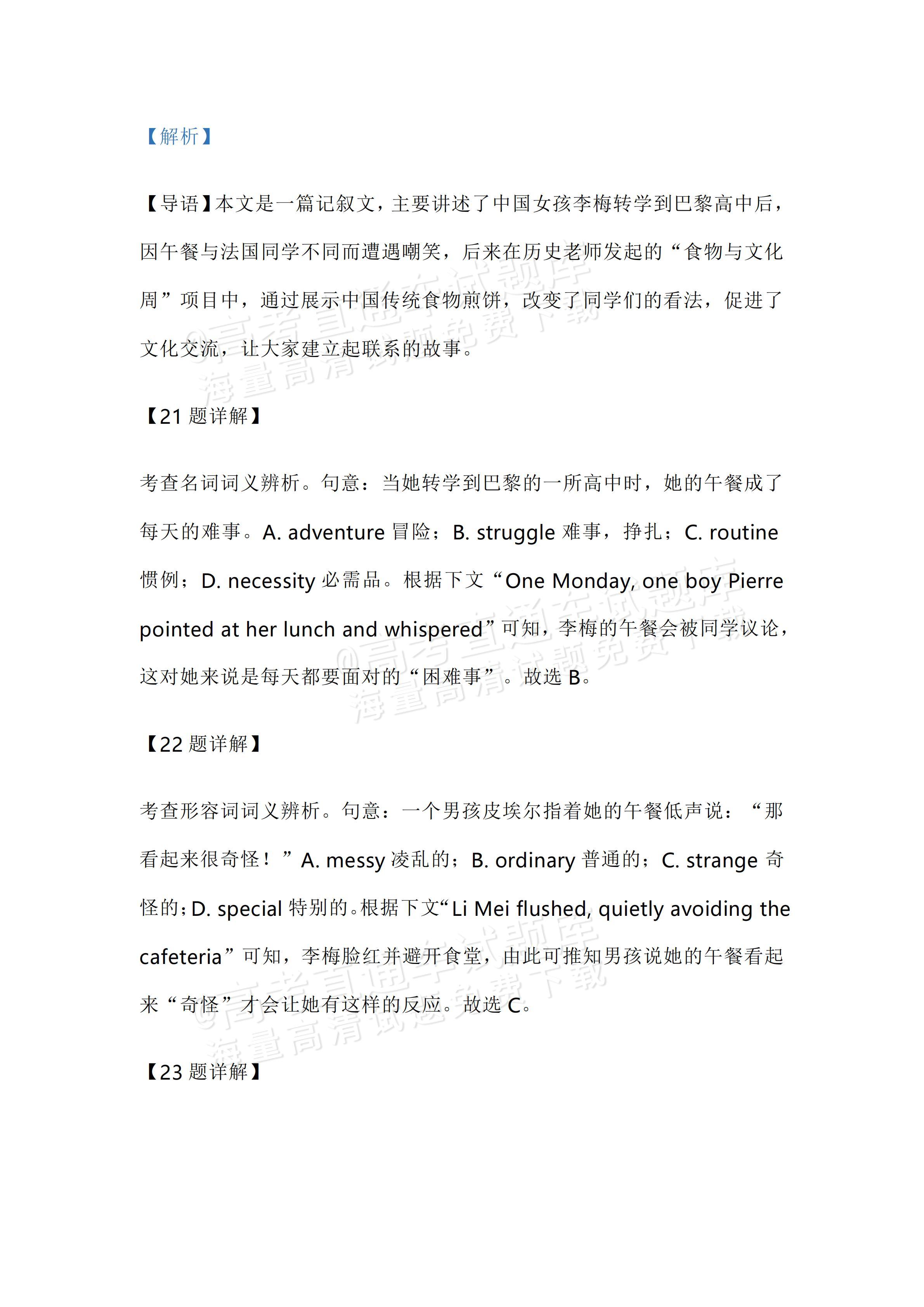
【导语】本文是一篇记叙文,主要讲述了中国女孩李梅转学到巴黎高中后,因午餐与法国同学不同而遭遇嘲笑,后来在历史老师发起的“食物与文化周”项目中,通过展示中国传统食物煎饼,改变了同学们的看法,促进了文化交流,让大家建立起联系的故事。
【21题详解】
考查名词词义辨析。句意:当她转学到巴黎的一所高中时,她的午餐成了每天的难事。A. adventure 冒险;B. struggle 难事,挣扎;C. routine 惯例;D. necessity 必需品。根据下文“One Monday, one boy Pierre pointed at her lunch and whispered”可知,李梅的午餐会被同学议论,这对她来说是每天都要面对的“困难事”。故选 B。
【22题详解】
考查形容词词义辨析。句意:一个男孩皮埃尔指着她的午餐低声说:“那看起来很奇怪!” A. messy 凌乱的;B. ordinary 普通的;C. strange 奇怪的;D. special 特别的。根据下文“Li Mei flushed, quietly avoiding the cafeteria”可知,李梅脸红并避开食堂,由此可推知男孩说她的午餐看起来“奇怪”才会让她有这样的反应。故选 C。
【23题详解】
考查动词词义辨析。句意:当她的历史老师杜邦先生发起“食物与文化周”
项目时,一切都改变了。A. mattered 重要;B. worked 工作,起作用;
C. rested 休息;D. changed 改变。根据前文李梅因午餐被嘲笑,再结合
后文她在项目中的经历和变化可知,这里表示一切都“改变”了。故选
D。
【24题详解】
考查动词词义辨析。句意:当她的历史老师杜邦先生发起“食物与文化周”
项目时,一切都改变了。A. praised 赞扬;B. postponed 推迟;C.
concluded 总结;D. launched 发起。根据下文“a project “Food &
Culture Week””可知,历史老师是“发起”了这个项目。故选D。
【25题详解】
考查动词词义辨析。句意:每个学生都要准备一道传统菜肴并展示其文化
意义。A. purchase 购买;B. review 复习,回顾;C. prepare 准备;D.
receive 接收。根据下文“present its cultural significance”可知,在
该项目中,学生需要“准备”一道传统菜肴并展示其文化意义。故选C。
【26题详解】
考查动词词义辨析。句意:李梅犹豫了——这里有人会在意中国食物吗?
A. joked 开玩笑;B. hesitated 犹豫;C. insisted 坚持;D. protested 抗
议。根据下文“—would anyone care about Chinese food here?”可
知,李梅不确定这里是否有人会对中国食物感兴趣,所以她“犹豫”了。
故选 B。
【27 题详解】
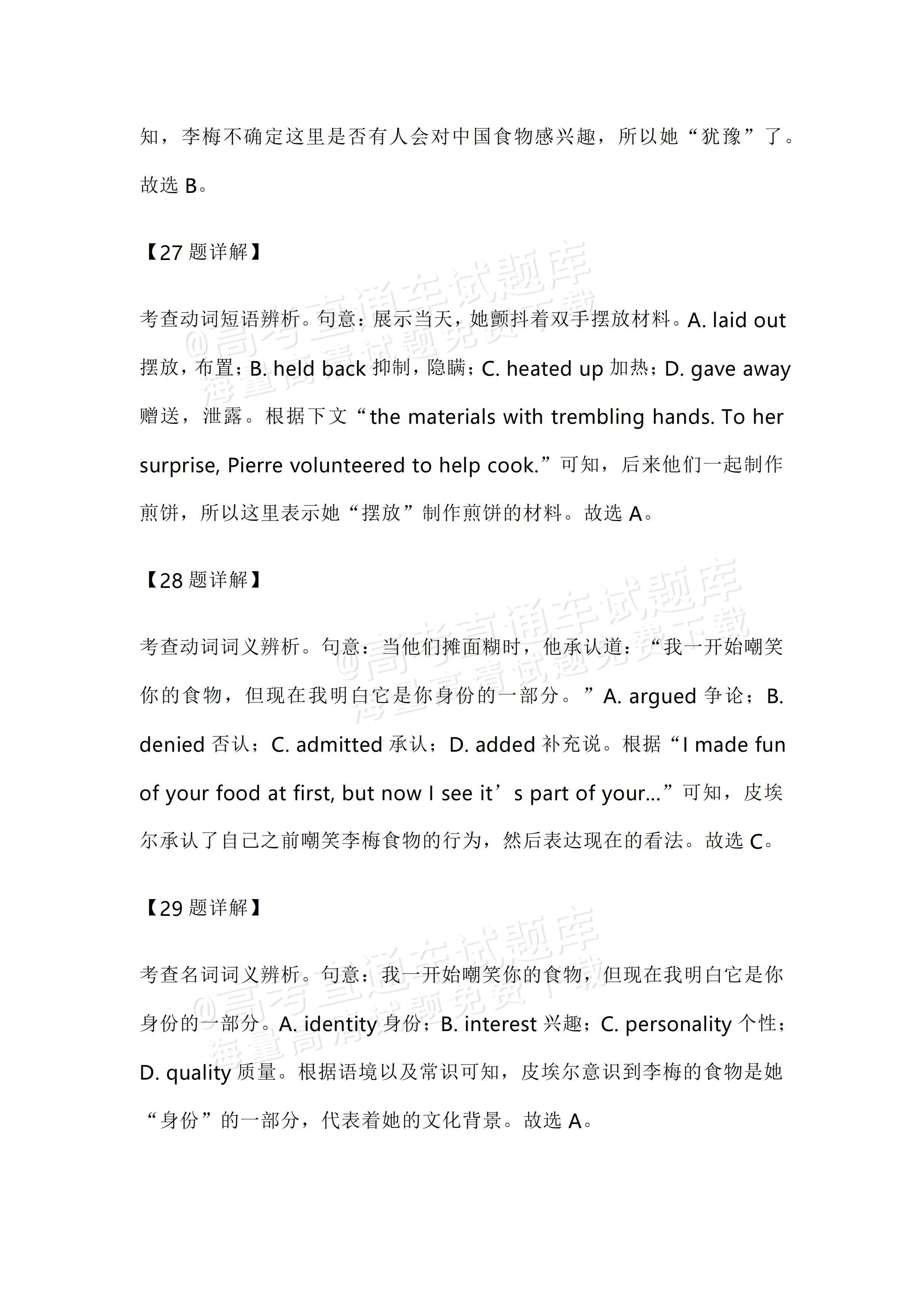
考查动词短语辨析。句意:展示当天,她颤抖着双手摆放材料。A. laid out
摆放,布置;B. held back 抑制,隐瞒;C. heated up 加热;D. gave away
赠送,泄露。根据下文“the materials with trembling hands. To her
surprise, Pierre volunteered to help cook.”可知,后来他们一起制作
煎饼,所以这里表示她“摆放”制作煎饼的材料。故选 A。
【28 题详解】
考查动词词义辨析。句意:当他们摊面糊时,他承认道:“我一开始嘲笑
你的食物,但现在我明白它是你身份的一部分。” A. argued 争论;B.
denied 否认;C. admitted 承认;D. added 补充说。根据“I made fun
of your food at first, but now I see it’s part of your...”可知,皮埃
尔承认了自己之前嘲笑李梅食物的行为,然后表达现在的看法。故选 C。
【29 题详解】
考查名词词义辨析。句意:我一开始嘲笑你的食物,但现在我明白它是你
身份的一部分。A. identity 身份;B. interest 兴趣;C. personality 个性;
D. quality 质量。根据语境以及常识可知,皮埃尔意识到李梅的食物是她
“身份”的一部分,代表着她的文化背景。故选 A。
快来评价一下难度吧~

 简单 0

 一般 0

 困难 0
你的预估分数是多少?拖动后可查看大家的估分统计哦~
估分统计
人数