






 优质
参考答案
展开阅读全部
开通会员查看试卷全部内容
本文档由用户提供并上传,若内容存在侵权,请进行举报或认领
 版权异议

资源简介
展开▼
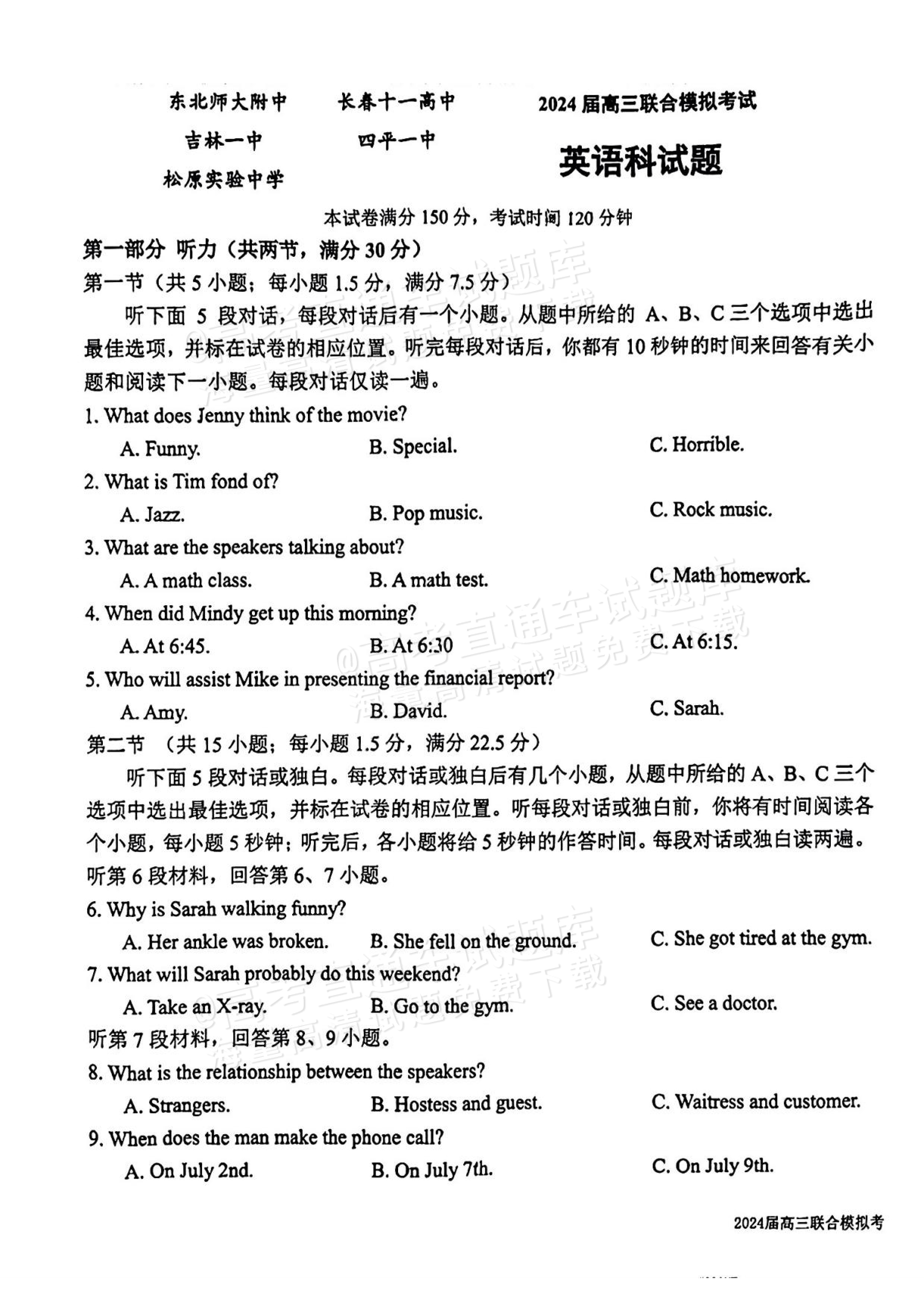
2024吉林五校高三期末联考英语试题及参考答案(PDF版下载)东北师大附中 长春十一高中 2024届高三联合模拟考试吉林一中 四平一中 英语科试题松原实验中学
本试卷满分150分,考试时间120分钟
第一部分 听力(共两节,满分30分)
第一节(共5小题;每小题1.5分,满分7.5分)
听下面5段对话,每段对话后有一个小题。从题中所给的A、B、C三个选项中选出最佳选项,并标在试卷的相应位置。听完每段对话后,你都有10秒钟的时间来回答有关小题和阅读下一小题。每段对话仅读一遍。
1. What does Jenny think of the movie?
A. Funny. B. Special. C. Horrible.
2. What is Tim fond of?
A. Jazz. B. Pop music. C. Rock music.
3. What are the speakers talking about?
A. A math class. B. A math test. C. Math homework.
4. When did Mindy get up this morning?
A. At 6:45. B. At 6:30 C. At 6:15.
5. Who will assist Mike in presenting the financial report?
A. Amy. B. David. C. Sarah.
第二节 (共15小题;每小题1.5分,满分22.5分)
听下面5段对话或独白。每段对话或独白后有几个小题,从题中所给的A、B、C三个选项中选出最佳选项,并标在试卷的相应位置。听每段对话或独白前,你将有时间阅读各个小题,每小题5秒钟;听完后,各小题将给5秒钟的作答时间。每段对话或独白读两遍。
听第6段材料,回答第6、7小题。
6. Why is Sarah walking funny?
A. Her ankle was broken. B. She fell on the ground. C. She got tired at the gym.
7. What will Sarah probably do this weekend?
A. Take an X-ray. B. Go to the gym. C. See a doctor.
听第7段材料,回答第8、9小题。
8. What is the relationship between the speakers?
A. Strangers. B. Hostess and guest. C. Waitress and customer.
9. When does the man make the phone call?
A. On July 2nd. B. On July 7th. C. On July 9th.
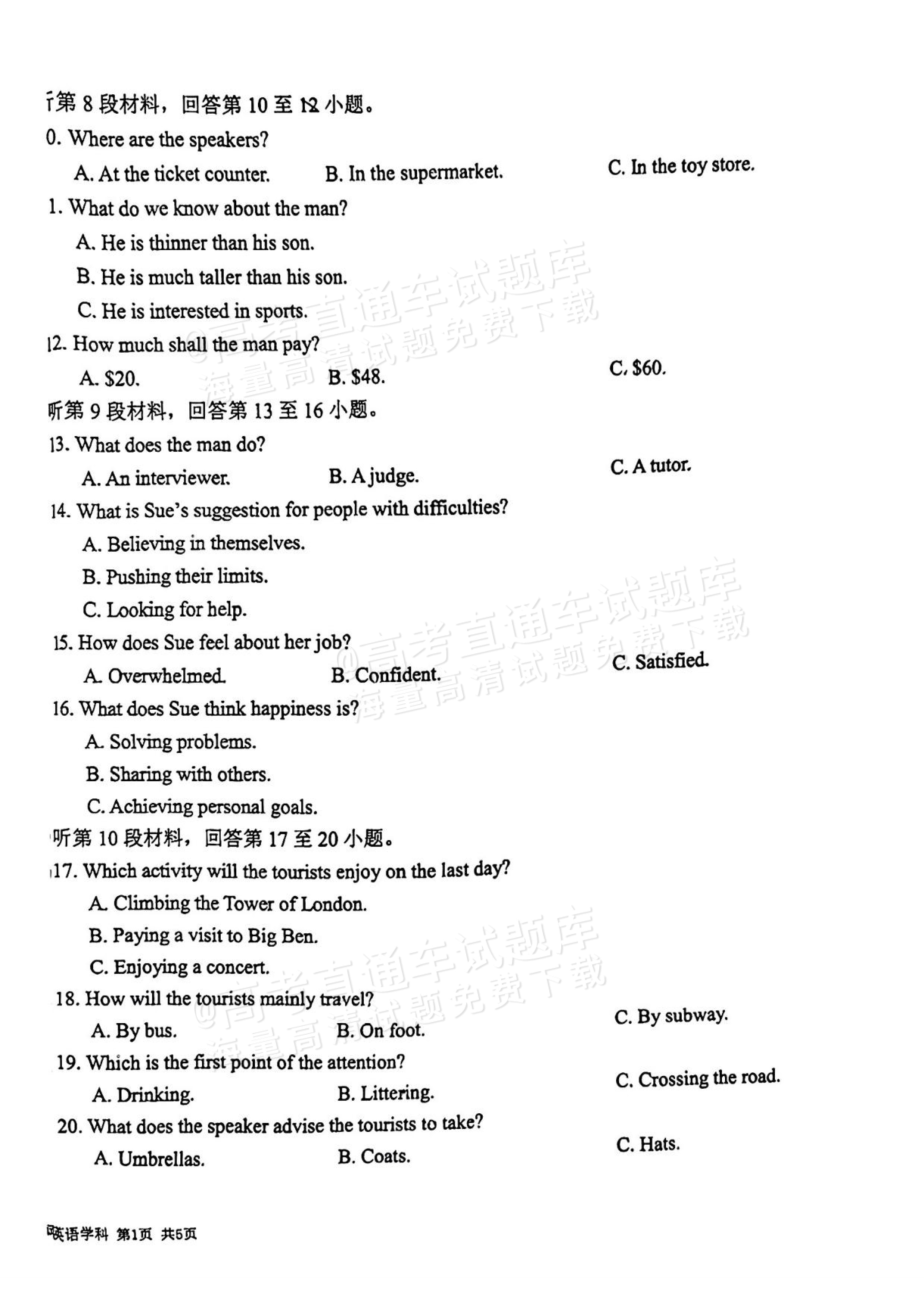
第8段材料,回答第10至12小题。
0. Where are the speakers?
A. At the ticket counter. B. In the supermarket. C. In the toy store.
1. What do we know about the man?
A. He is thinner than his son.
B. He is much taller than his son.
C. He is interested in sports.
12. How much shall the man pay?
A. 20. B.48. C. $60.
听第9段材料,回答第13至16小题。
13. What does the man do?
A. An interviewer. B. A judge. C. A tutor.
14. What is Sue's suggestion for people with difficulties?
A. Believing in themselves.
B. Pushing their limits.
C. Looking for help.
15. How does Sue feel about her job?
A. Overwhelmed. B. Confident. C. Satisfied.
16. What does Sue think happiness is?
A. Solving problems.
B. Sharing with others.
C. Achieving personal goals.
听第10段材料,回答第17至20小题。
17. Which activity will the tourists enjoy on the last day?
A. Climbing the Tower of London.
B. Paying a visit to Big Ben.
C. Enjoying a concert.
18. How will the tourists mainly travel?
A. By bus. B. On foot. C. By subway.
19. Which is the first point of the attention?
A. Drinking. B. Littering. C. Crossing the road.
20. What does the speaker advise the tourists to take?
A. Umbrellas. B. Coats. C. Hats.
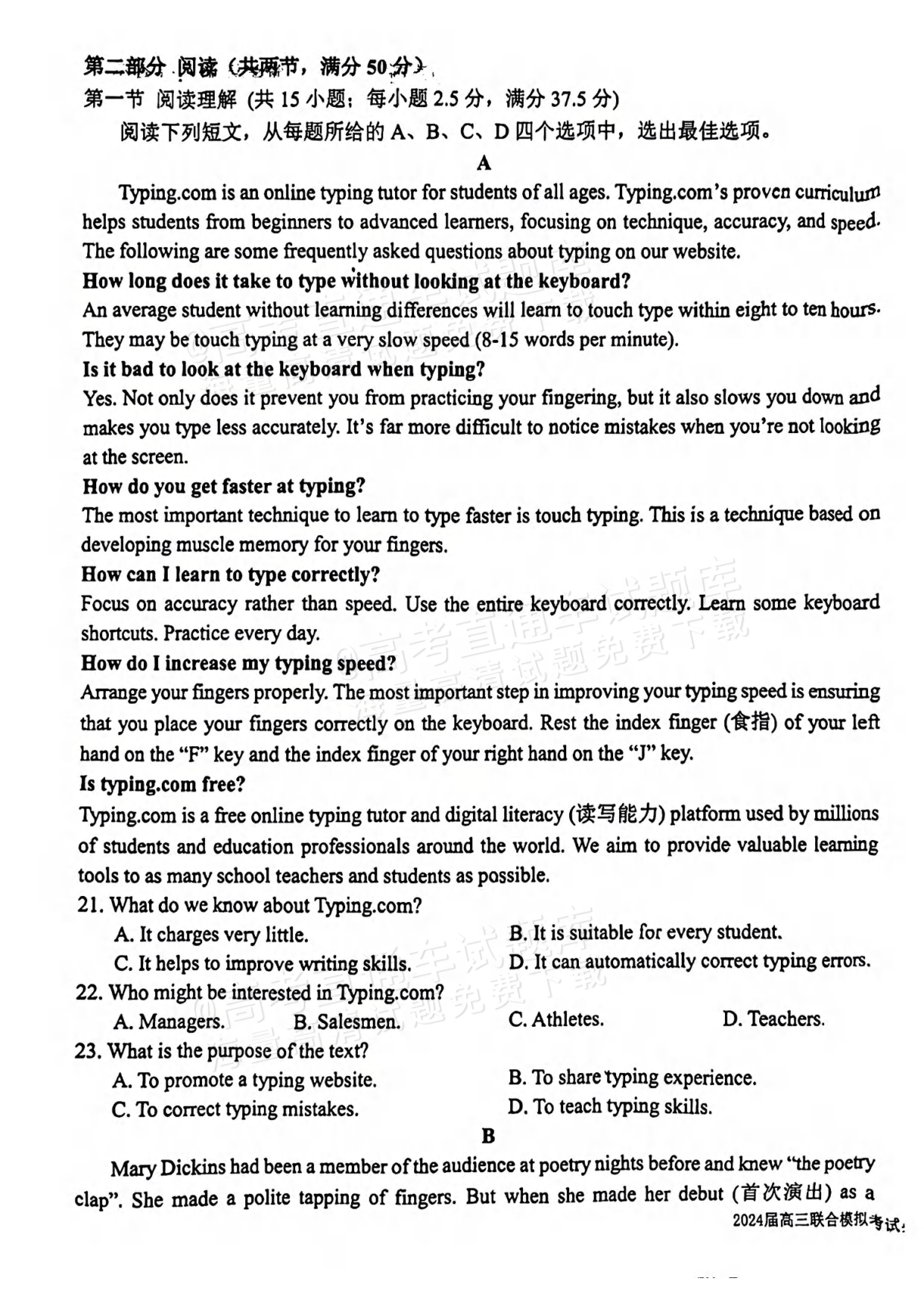
第二部分. 阅读(共两节,满分50分).
第一节 阅读理解(共15小题:每小题2.5分,满分37.5分)
阅读下列短文,从每题所给的A、B、C、D四个选项中,选出最佳选项。
A
Typing.com is an online typing tutor for students of all ages. Typing.com's proven curriculum helps students from beginners to advanced learners, focusing on technique, accuracy, and speed. The following are some frequently asked questions about typing on our website.
How long does it take to type without looking at the keyboard?
An average student without learning differences will learn to touch type within eight to ten hours. They may be touch typing at a very slow speed (8-15 words per minute).
Is it bad to look at the keyboard when typing?
Yes. Not only does it prevent you from practicing your fingering, but it also slows you down and makes you type less accurately. It's far more difficult to notice mistakes when you're not looking at the screen.
How do you get faster at typing?
The most important technique to learn to type faster is touch typing. This is a technique based on developing muscle memory for your fingers.
How can I learn to type correctly?
Focus on accuracy rather than speed. Use the entire keyboard correctly. Learn some keyboard shortcuts. Practice every day.
How do I increase my typing speed?
Arrange your fingers properly. The most important step in improving your typing speed is ensuring that you place your fingers correctly on the keyboard. Rest the index finger (食指) of your left hand on the "F" key and the index finger of your right hand on the "J" key.
Typing.com is a free online typing tutor and digital literacy (读写能力) platform used by millions of students and education professionals around the world. We aim to provide valuable learning tools to as many school teachers and students as possible.
21. What do we know about Typing.com?
A. It charges very little. B. It is suitable for every student.
C. It helps to improve writing skills. D. It can automatically correct typing errors.
22. Who might be interested in Typing.com?
A. Managers. B. Salesmen. C. Athletes. D. Teachers.
23. What is the purpose of the text?
A. To promote a typing website. B. To share typing experience.
C. To correct typing mistakes. D. To teach typing skills.
B
Mary Dickins had been a member of the audience at poetry nights before and knew "the poetry clap". She made a polite tapping of fingers. But when she made her debut (首次演出) as a 2024届高三联合模拟考试
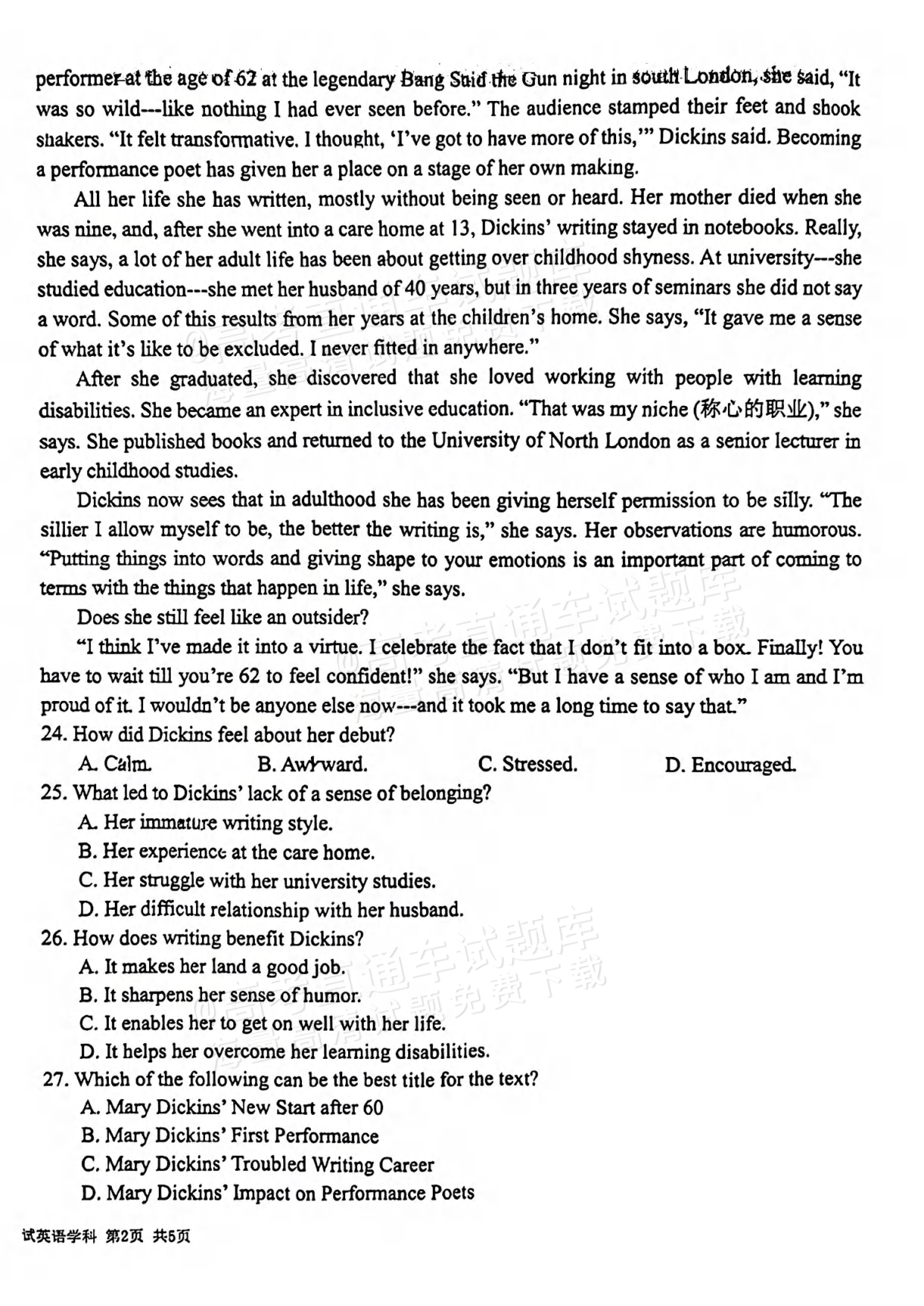
performer at the age of 62 at the legendary Bang Stid the Gun night in south London, she said, "It was so wild---like nothing I had ever seen before." The audience stamped their feet and shook shakers. "It felt transformative. I thought, 'I've got to have more of this,'" Dickins said. Becoming a performance poet has given her a place on a stage of her own making.
All her life she has written, mostly without being seen or heard. Her mother died when she was nine, and, after she went into a care home at 13, Dickins' writing stayed in notebooks. Really, she says, a lot of her adult life has been about getting over childhood shyness. At university--she studied education--she met her husband of 40 years, but in three years of seminars she did not say a word. Some of this results from her years at the children's home. She says, "It gave me a sense of what it's like to be excluded. I never fitted in anywhere."
After she graduated, she discovered that she loved working with people with learning disabilities. She became an expert in inclusive education. "That was my niche (称心的职业)," she says. She published books and returned to the University of North London as a senior lecturer in early childhood studies.
Dickins now sees that in adulthood she has been giving herself permission to be silly. "The sillier I allow myself to be, the better the writing is," she says. Her observations are humorous. "Putting things into words and giving shape to your emotions is an important part of coming to terms with the things that happen in life," she says.
Does she still feel like an outsider?
"I think I've made it into a virtue. I celebrate the fact that I don't fit into a box. Finally! You have to wait till you're 62 to feel confident!" she says. "But I have a sense of who I am and I'm proud of it. I wouldn't be anyone else now---and it took me a long time to say that."
24. How did Dickins feel about her debut?
A. Calm. B. Awrward. C. Stressed. D. Encouraged.
25. What led to Dickins' lack of a sense of belonging?
A. Her immature writing style.
B. Her experience at the care home.
C. Her struggle with her university studies.
D. Her difficult relationship with her husband.
26. How does writing benefit Dickins?
A. It makes her land a good job.
B. It sharpens her sense of humor.
C. It enables her to get on well with her life.
D. It helps her overcome her learning disabilities.
27. Which of the following can be the best title for the text?
A. Mary Dickins' New Start after 60
B. Mary Dickins' First Performance
C. Mary Dickins' Troubled Writing Career
D. Mary Dickins' Impact on Performance Poets
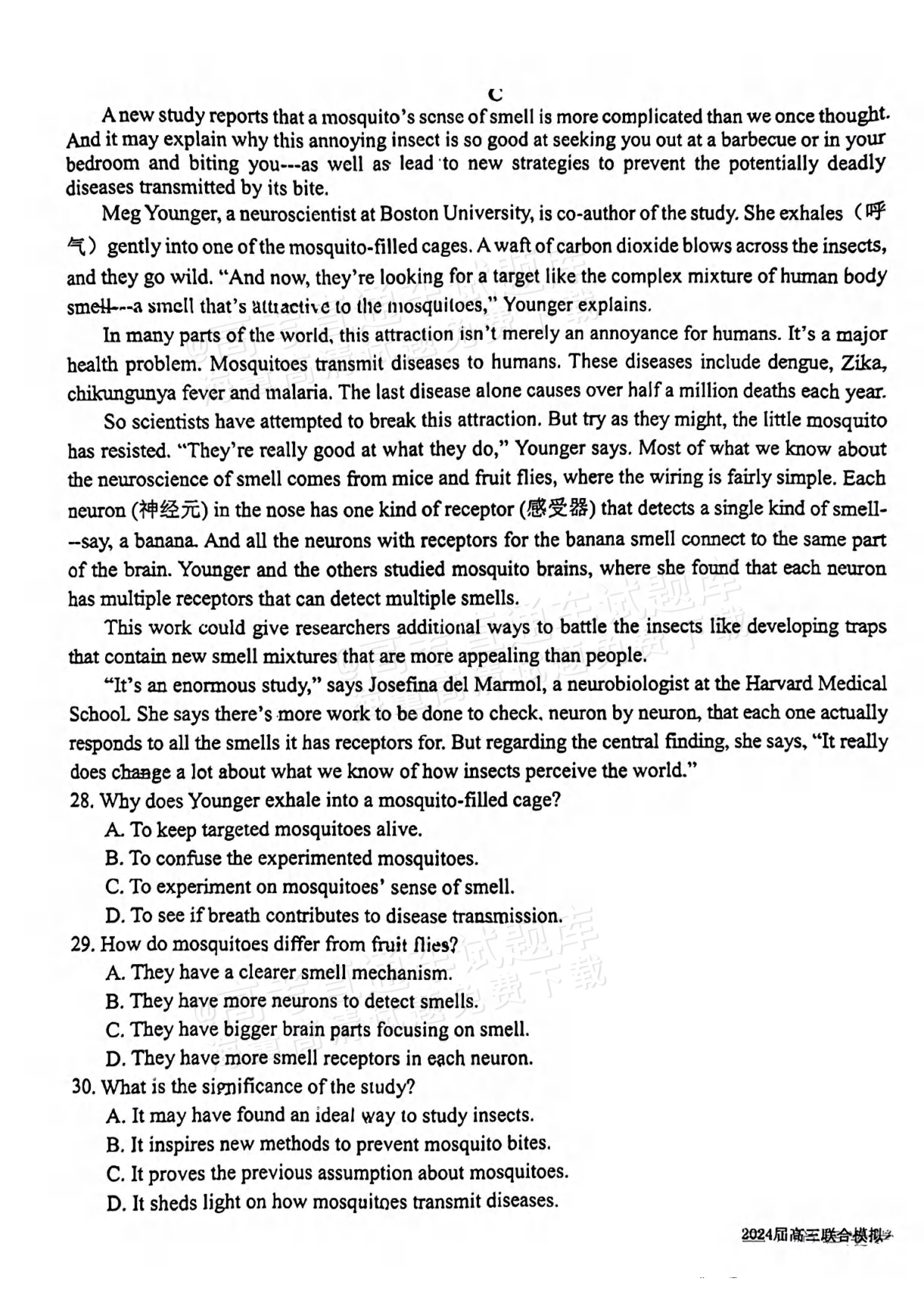
C
A new study reports that a mosquito's sense of smell is more complicated than we once thought. And it may explain why this annoying insect is so good at seeking you out at a barbecue or in your bedroom and biting you---as well as lead to new strategies to prevent the potentially deadly diseases transmitted by its bite.
Meg Younger, a neuroscientist at Boston University, is co-author of the study. She exhales(呼气)gently into one of the mosquito-filled cages. A waft of carbon dioxide blows across the insects, and they go wild. "And now, they're looking for a target like the complex mixture of human body smell-a smell that's attractive to the mosquitoes," Younger explains.
In many parts of the world, this attraction isn't merely an annoyance for humans. It's a major health problem. Mosquitoes transmit diseases to humans. These diseases include dengue, Zika, chikungunya fever and malaria. The last disease alone causes over half a million deaths each year.
So scientists have attempted to break this attraction. But try as they might, the little mosquito has resisted. "They're really good at what they do," Younger says. Most of what we know about the neuroscience of smell comes from mice and fruit flies, where the wiring is fairly simple. Each neuron (神经元) in the nose has one kind of receptor (感受器) that detects a single kind of smell-say, a banana. And all the neurons with receptors for the banana smell connect to the same part of the brain. Younger and the others studied mosquito brains, where she found that each neuron has multiple receptors that can detect multiple smells.
This work could give researchers additional ways to battle the insects like developing traps that contain new smell mixtures that are more appealing than people.
"It's an enormous study," says Josefina del Marmol, a neurobiologist at the Harvard Medical School. She says there's more work to be done to check, neuron by neuron, that each one actually responds to all the smells it has receptors for. But regarding the central finding, she says, "It really does change a lot about what we know of how insects perceive the world."
28. Why does Younger exhale into a mosquito-filled cage?
A. To keep targeted mosquitoes alive.
B. To confuse the experimented mosquitoes.
C. To experiment on mosquitoes' sense of smell.
D. To see if breath contributes to disease transmission.
29. How do mosquitoes differ from fruit flies?
A. They have a clearer smell mechanism.
B. They have more neurons to detect smells.
C. They have bigger brain parts focusing on smell.
D. They have more smell receptors in each neuron.
30. What is the significance of the study?
A. It may have found an ideal way to study insects.
B. It inspires new methods to prevent mosquito bites.
C. It proves the previous assumption about mosquitoes.
D. It sheds light on how mosquitoes transmit diseases.
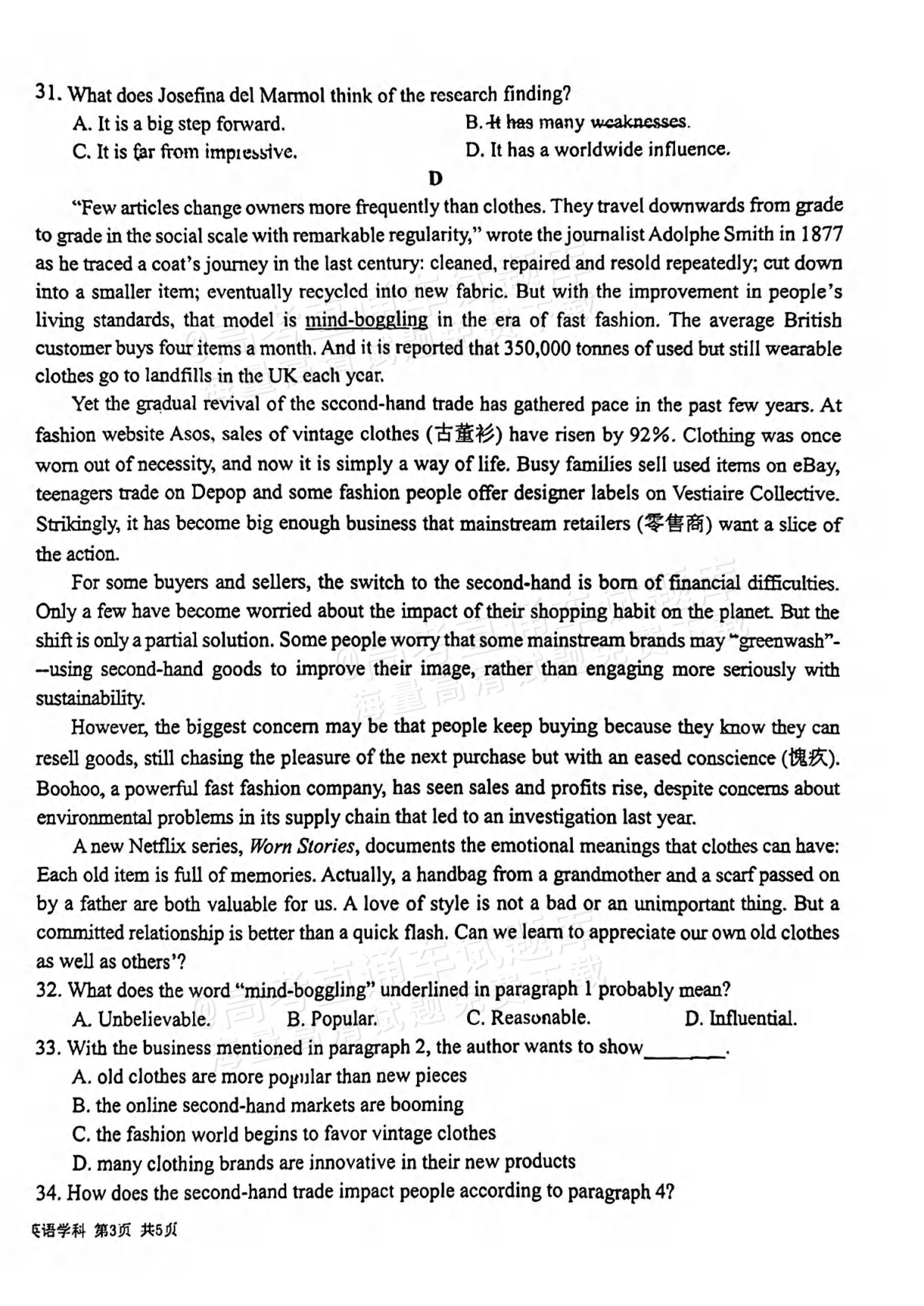
31. What does Josefina del Marmol think of the research finding?
A. It is a big step forward. B. It has many weaknesses.
C. It is far from impressive. D. It has a worldwide influence.
D
"Few articles change owners more frequently than clothes. They travel downwards from grade to grade in the social scale with remarkable regularity," wrote the journalist Adolphe Smith in 1877 as he traced a coat's journey in the last century: cleaned, repaired and resold repeatedly; cut down into a smaller item; eventually recycled into new fabric. But with the improvement in people's living standards, that model is mind-boggling in the era of fast fashion. The average British customer buys four items a month. And it is reported that 350,000 tonnes of used but still wearable clothes go to landfills in the UK each year.
Yet the gradual revival of the second-hand trade has gathered pace in the past few years. At fashion website Asos, sales of vintage clothes (古董衫) have risen by 92%. Clothing was once worn out of necessity, and now it is simply a way of life. Busy families sell used items on eBay, teenagers trade on Depop and some fashion people offer designer labels on Vestiaire Collective. Strikingly, it has become big enough business that mainstream retailers (零售商) want a slice of the action.
For some buyers and sellers, the switch to the second-hand is born of financial difficulties. Only a few have become worried about the impact of their shopping habit on the planet. But the shift is only a partial solution. Some people worry that some mainstream brands may "greenwash"-using second-hand goods to improve their image, rather than engaging more seriously with sustainability.
However, the biggest concern may be that people keep buying because they know they can resell goods, still chasing the pleasure of the next purchase but with an eased conscience (愧疚). Boohoo, a powerful fast fashion company, has seen sales and profits rise, despite concerns about environmental problems in its supply chain that led to an investigation last year.
A new Netflix series, Worn Stories, documents the emotional meanings that clothes can have: Each old item is full of memories. Actually, a handbag from a grandmother and a scarf passed on by a father are both valuable for us. A love of style is not a bad or an unimportant thing. But a committed relationship is better than a quick flash. Can we learn to appreciate our own old clothes as well as others'?
32. What does the word "mind-boggling" underlined in paragraph 1 probably mean?
A. Unbelievable. B. Popular. C. Reasonable. D. Influential.
33. With the business mentioned in paragraph 2, the author wants to show___.
A. old clothes are more popular than new pieces
B. the online second-hand markets are booming
C. the fashion world begins to favor vintage clothes
D. many clothing brands are innovative in their new products
34. How does the second-hand trade impact people according to paragraph 4?
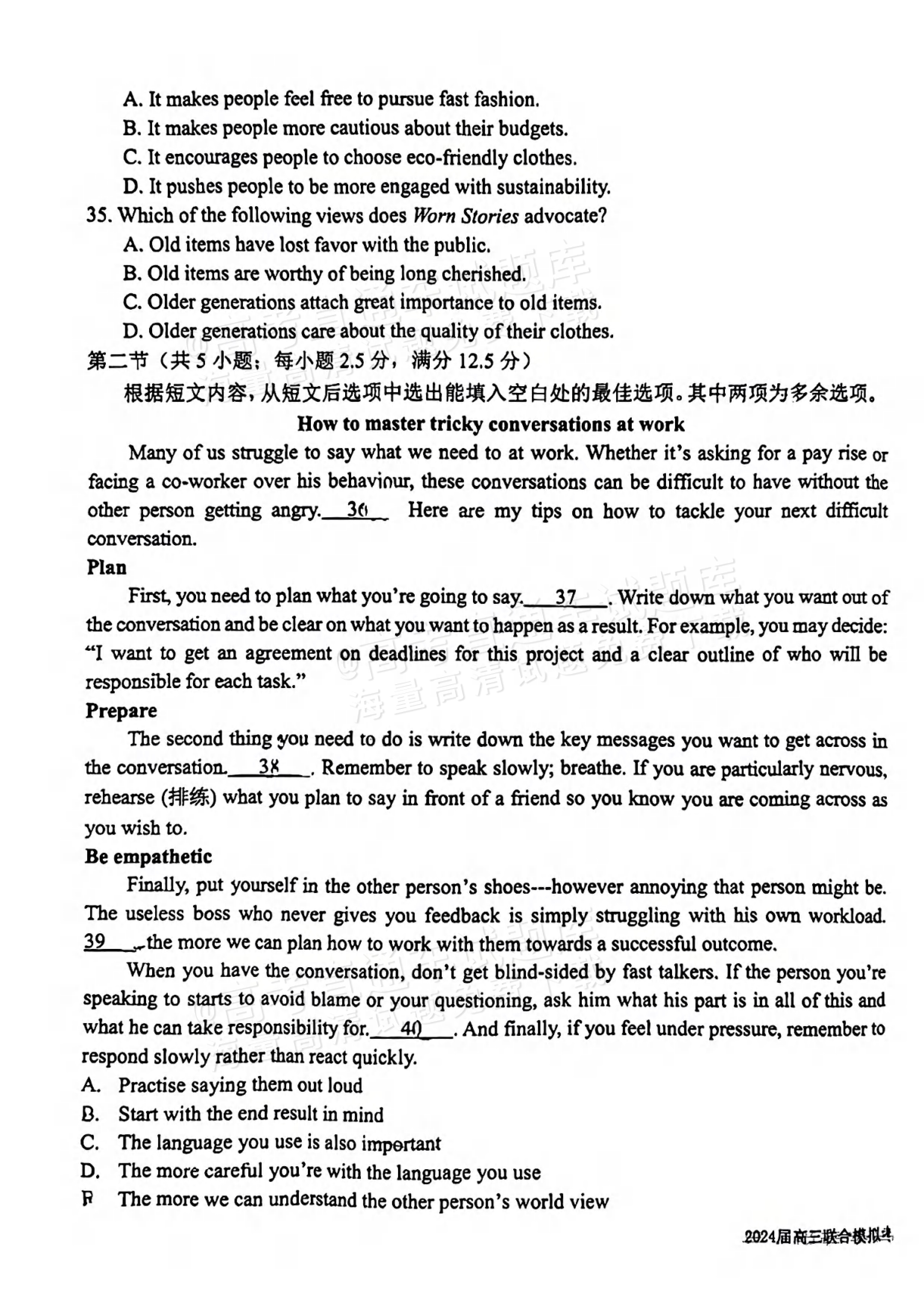
A. It makes people feel free to pursue fast fashion.
B. It makes people more cautious about their budgets.
C. It encourages people to choose eco-friendly clothes.
D. It pushes people to be more engaged with sustainability.
35. Which of the following views does Worn Stories advocate?
A. Old items have lost favor with the public.
B. Old items are worthy of being long cherished.
C. Older generations attach great importance to old items.
D. Older generations care about the quality of their clothes.
第二节(共5小题;每小题2.5分,满分12.5分)
根据短文内容,从短文后选项中选出能填入空白处的最佳选项。其中两项为多余选项。
How to master tricky conversations at work
Many of us struggle to say what we need to at work. Whether it's asking for a pay rise or facing a co-worker over his behaviour, these conversations can be difficult to have without the other person getting angry. 36 Here are my tips on how to tackle your next difficult conversation.
Plan
First, you need to plan what you're going to say. 37. Write down what you want out of the conversation and be clear on what you want to happen as a result. For example, you may decide: "I want to get an agreement on deadlines for this project and a clear outline of who will be responsible for each task."
Prepare
The second thing you need to do is write down the key messages you want to get across in the conversation. 38. Remember to speak slowly; breathe. If you are particularly nervous, rehearse (排练) what you plan to say in front of a friend so you know you are coming across as you wish to.
Be empathetic
Finally, put yourself in the other person's shoes---however annoying that person might be. The useless boss who never gives you feedback is simply struggling with his own workload. 39 the more we can plan how to work with them towards a successful outcome.
When you have the conversation, don't get blind-sided by fast talkers. If the person you're speaking to starts to avoid blame or your questioning, ask him what his part is in all of this and what he can take responsibility for. 40. And finally, if you feel under pressure, remember to respond slowly rather than react quickly.
A. Practise saying them out loud
B. Start with the end result in mind
C. The language you use is also important
D. The more careful you're with the language you use
F The more we can understand the other person's world view
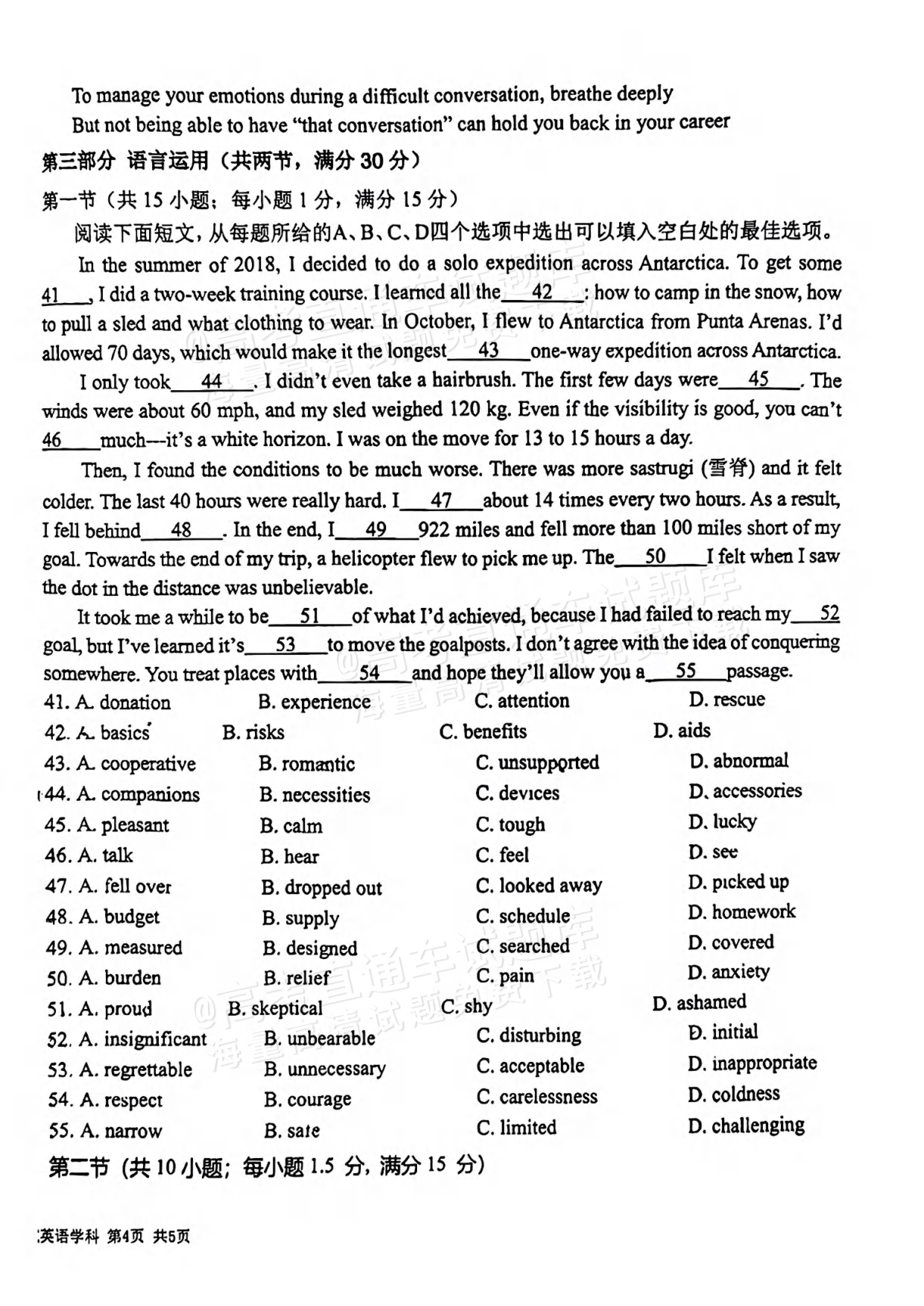
To manage your emotions during a difficult conversation, breathe deeply But not being able to have "that conversation" can hold you back in your career
第三部分 语言运用(共两节,满分30分)
第一节(共15小题;每小题1分,满分15分)
阅读下面短文,从每题所给的A、B、C、D四个选项中选出可以填入空白处的最佳选项。
In the summer of 2018, I decided to do a solo expedition across Antarctica. To get some 41, I did a two-week training course. I learned all the 42: how to camp in the snow, how to pull a sled and what clothing to wear. In October, I flew to Antarctica from Punta Arenas. I'd allowed 70 days, which would make it the longest 43 one-way expedition across Antarctica.
I only took 44. I didn't even take a hairbrush. The first few days were 45. The winds were about 60 mph, and my sled weighed 120 kg. Even if the visibility is good, you can't 46 much—it's a white horizon. I was on the move for 13 to 15 hours a day.
Then, I found the conditions to be much worse. There was more sastrugi (雪脊) and it felt colder. The last 40 hours were really hard. I 47 about 14 times every two hours. As a result, I fell behind 48. In the end, I 49 922 miles and fell more than 100 miles short of my goal. Towards the end of my trip, a helicopter flew to pick me up. The 50 I felt when I saw the dot in the distance was unbelievable.
It took me a while to be _51_of what I'd achieved, because I had failed to reach my _52 goal, but I've learned it's _53_to move the goalposts. I don't agree with the idea of conquering somewhere. You treat places with _54_and hope they'll allow you a _55___passage.
41. A. donation B. experience C. attention D. rescue
42. A. basics B. risks C. benefits D. aids
43. A. cooperative B. romantic C. unsupported D. abnormal
44. A. companions B. necessities C. devices D. accessories
45. A. pleasant B. calm C. tough D. lucky
46. A. talk B. hear C. feel D. see
47. A. fell over B. dropped out C. looked away D. picked up
48. A. budget B. supply C. schedule D. homework
49. A. measured B. designed C. searched D. covered
50. A. burden B. relief C. pain D. anxiety
51. A. proud B. skeptical C. shy D. ashamed
52. A. insignificant B. unbearable C. disturbing D. initial
53. A. regrettable B. unnecessary C. acceptable D. inappropriate
54. A. respect B. courage C. carelessness D. coldness
55. A. narrow B. sate C. limited D. challenging
第二节(共10小题;每小题1.5分,满分15分)
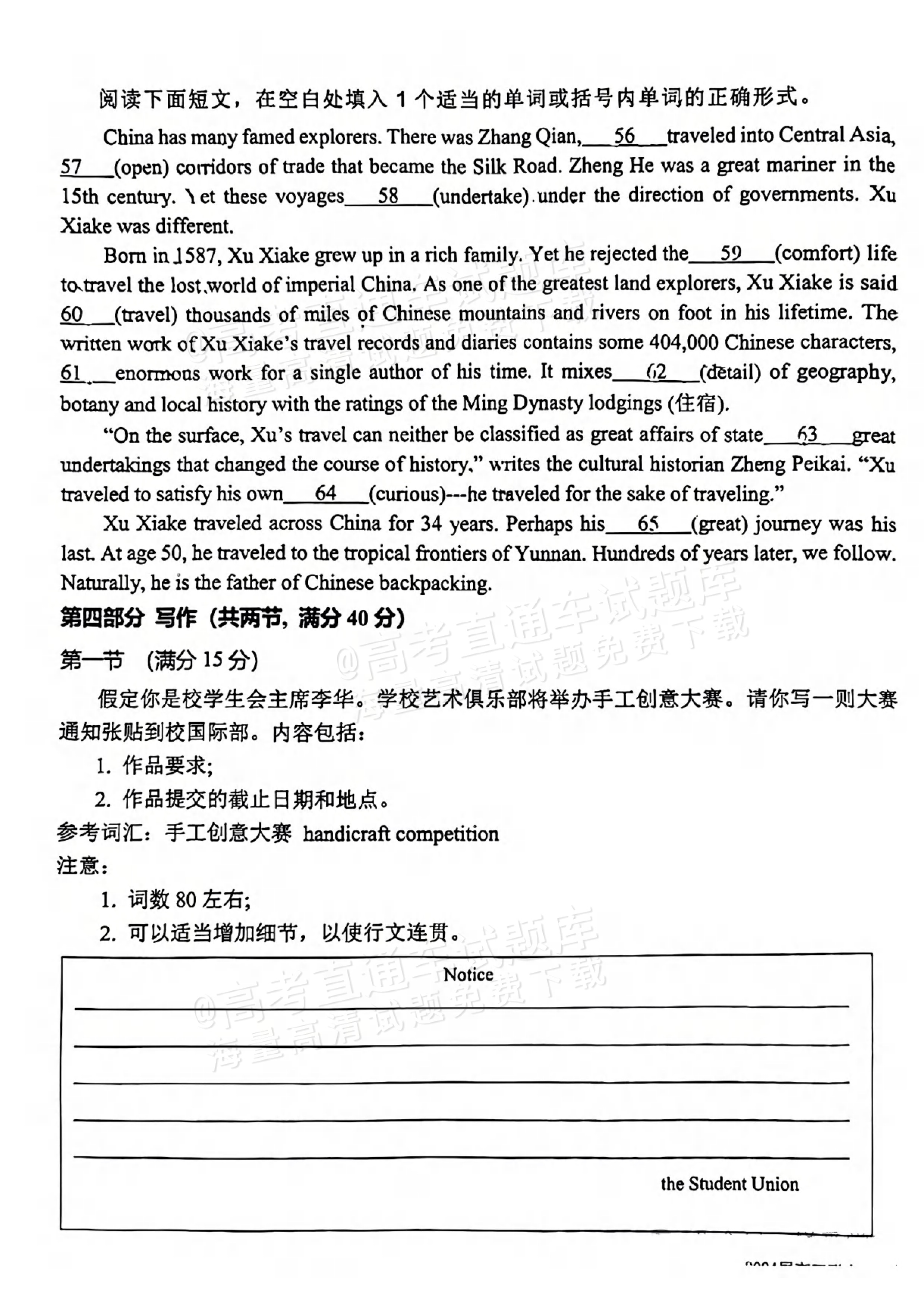
阅读下面短文,在空白处填入1个适当的单词或括号内单词的正确形式。
China has many famed explorers. There was Zhang Qian, 56 traveled into Central Asia, 57 (open) corridors of trade that became the Silk Road. Zheng He was a great mariner in the 15th century. Let these voyages 58 (undertake) under the direction of governments. Xu Xiake was different.
Born in 1587, Xu Xiake grew up in a rich family. Yet he rejected the 59 (comfort) life to travel the lost world of imperial China. As one of the greatest land explorers, Xu Xiake is said 60 (travel) thousands of miles of Chinese mountains and rivers on foot in his lifetime. The written work of Xu Xiake's travel records and diaries contains some 404,000 Chinese characters, 61 enormous work for a single author of his time. It mixes 62 (detail) of geography, botany and local history with the ratings of the Ming Dynasty lodgings (住宿).
"On the surface, Xu's travel can neither be classified as great affairs of state 63 great undertakings that changed the course of history." writes the cultural historian Zheng Peikai. "Xu traveled to satisfy his own 64 (curious)---he traveled for the sake of traveling."
Xu Xiake traveled across China for 34 years. Perhaps his 65 (great) journey was his last. At age 50, he traveled to the tropical frontiers of Yunnan. Hundreds of years later, we follow. Naturally, he is the father of Chinese backpacking.
第四部分 写作(共两节,满分40分)
第一节 (满分15分)
假定你是校学生会主席李华。学校艺术俱乐部将举办手工创意大赛。请你写一则大赛通知张贴到校国际部。内容包括:
1. 作品要求;
2. 作品提交的截止日期和地点。
参考词汇:手工创意大赛 handicraft competition
注意:
1. 词数80左右;
2. 可以适当增加细节,以使行文连贯。
Notice
the Student Union
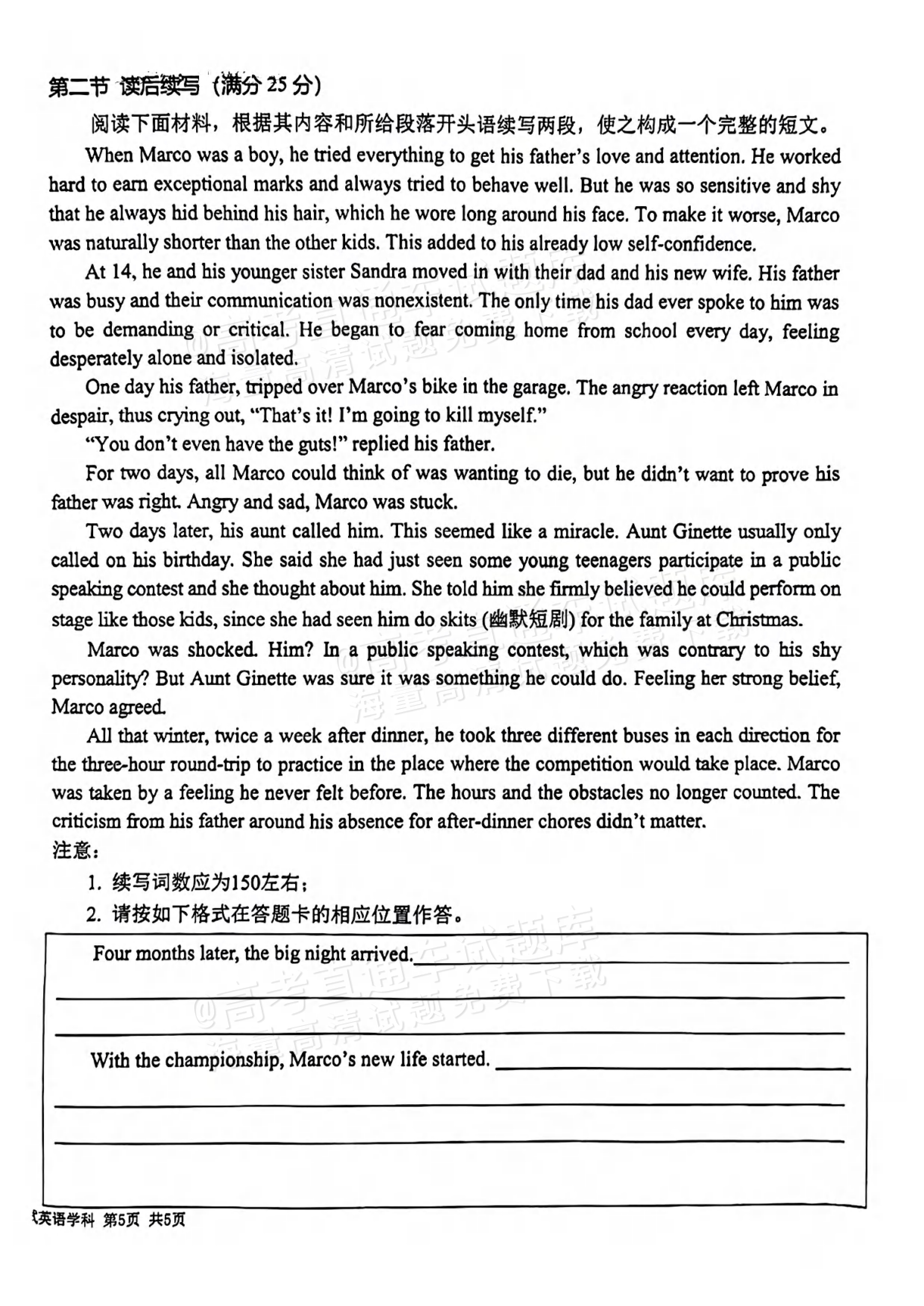
第二节 读后续写(满分25分)
阅读下面材料,根据其内容和所给段落开头语续写两段,使之构成一个完整的短文。
When Marco was a boy, he tried everything to get his father's love and attention. He worked hard to earn exceptional marks and always tried to behave well. But he was so sensitive and shy that he always hid behind his hair, which he wore long around his face. To make it worse, Marco was naturally shorter than the other kids. This added to his already low self-confidence.
At 14, he and his younger sister Sandra moved in with their dad and his new wife. His father was busy and their communication was nonexistent. The only time his dad ever spoke to him was to be demanding or critical. He began to fear coming home from school every day, feeling desperately alone and isolated.
One day his father, tripped over Marco's bike in the garage. The angry reaction left Marco in despair, thus crying out, "That's it! I'm going to kill myself."
"You don't even have the guts!" replied his father.
For two days, all Marco could think of was wanting to die, but he didn't want to prove his father was right. Angry and sad, Marco was stuck.
Two days later, his aunt called him. This seemed like a miracle. Aunt Ginette usually only called on his birthday. She said she had just seen some young teenagers participate in a public speaking contest and she thought about him. She told him she firmly believed he could perform on stage like those kids, since she had seen him do skits (幽默短剧) for the family at Christmas.
Marco was shocked. Him? In a public speaking contest, which was contrary to his shy personality? But Aunt Ginette was sure it was something he could do. Feeling her strong belief, Marco agreed.
All that winter, twice a week after dinner, he took three different buses in each direction for the three-hour round-trip to practice in the place where the competition would take place. Marco was taken by a feeling he never felt before. The hours and the obstacles no longer counted. The criticism from his father around his absence for after-dinner chores didn't matter.
注意:
1. 续写词数应为150左右;
2. 请按如下格式在答题卡的相应位置作答。
Four months later, the big night arrived._
With the championship, Marco's new life started. _
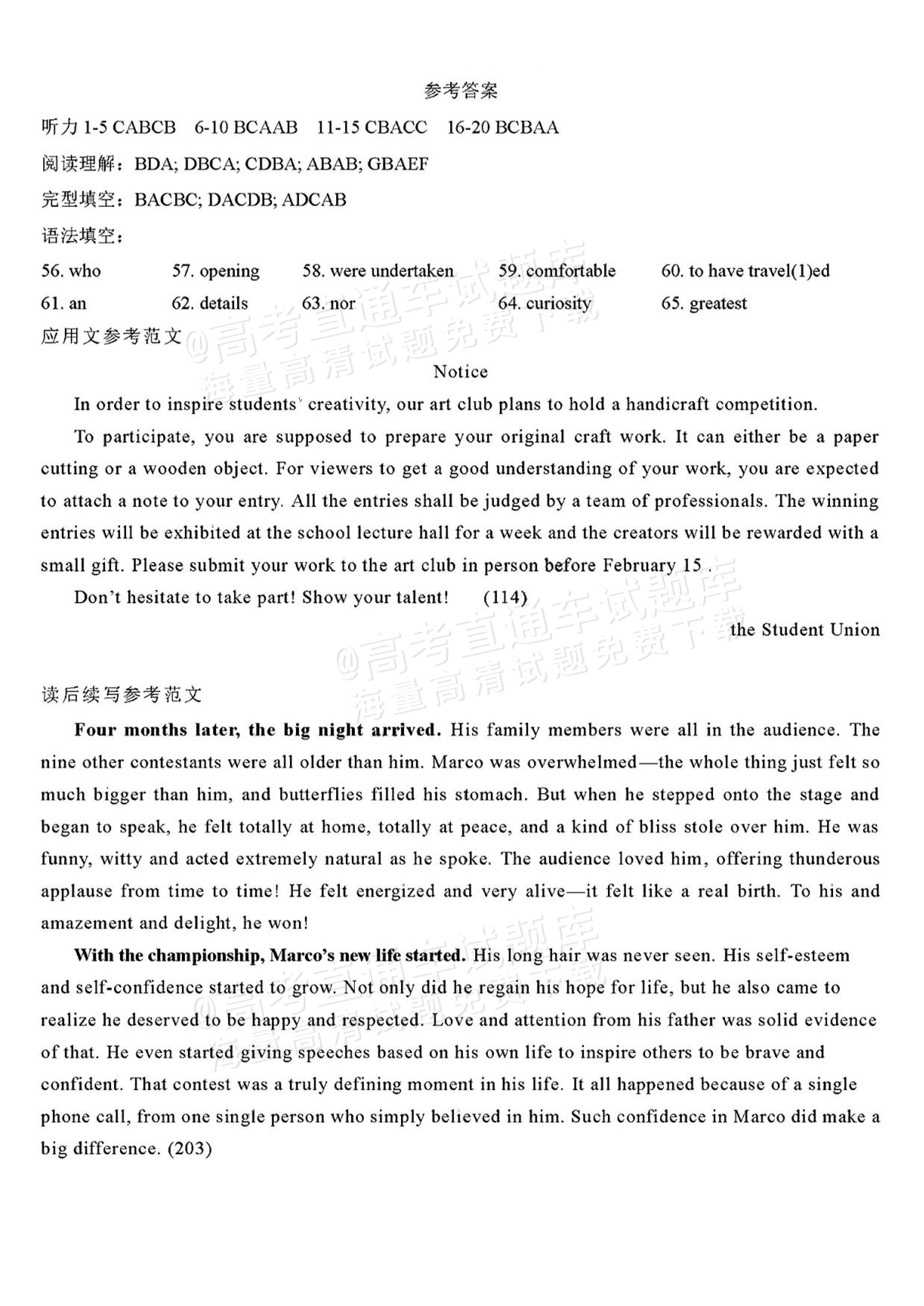
参考答案
听力1-5CABCB 6-10BCAAB 11-15CBACC 16-20BCBAA
阅读理解:BDA; DBCA; CDBA; ABAB; GBAEF
完型填空:BACBC; DACDB; ADCAB
语法填空:
56. who 57. opening 58. were undertaken 59. comfortable 60. to have travel(1)ed
64. curiosity
65. greatest
应用文参考范文
Notice
In order to inspire students creativity, our art club plans to hold a handicraft competition.
To participate, you are supposed to prepare your original craft work. It can either be a paper cutting or a wooden object. For viewers to get a good understanding of your work, you are expected to attach a note to your entry. All the entries shall be judged by a team of professionals. The winning entries will be exhibited at the school lecture hall for a week and the creators will be rewarded with a small gift. Please submit your work to the art club in person before February 15.
Don't hesitate to take part! Show your talent! (114)
the Student Union
读后续写参考范文
Four months later, the big night arrived. His family members were all in the audience. The nine other contestants were all older than him. Marco was overwhelmed—the whole thing just felt so much bigger than him, and butterflies filled his stomach. But when he stepped onto the stage and began to speak, he felt totally at home, totally at peace, and a kind of bliss stole over him. He was funny, witty and acted extremely natural as he spoke. The audience loved him, offering thunderous applause from time to time! He felt energized and very alive—it felt like a real birth. To his and amazement and delight, he won!
With the championship, Marco's new life started. His long hair was never seen. His self-esteem and self-confidence started to grow. Not only did he regain his hope for life, but he also came to realize he deserved to be happy and respected. Love and attention from his father was solid evidence of that. He even started giving speeches based on his own life to inspire others to be brave and confident. That contest was a truly defining moment in his life. It all happened because of a single phone call, from one single person who simply believed in him. Such confidence in Marco did make a big difference. (203)
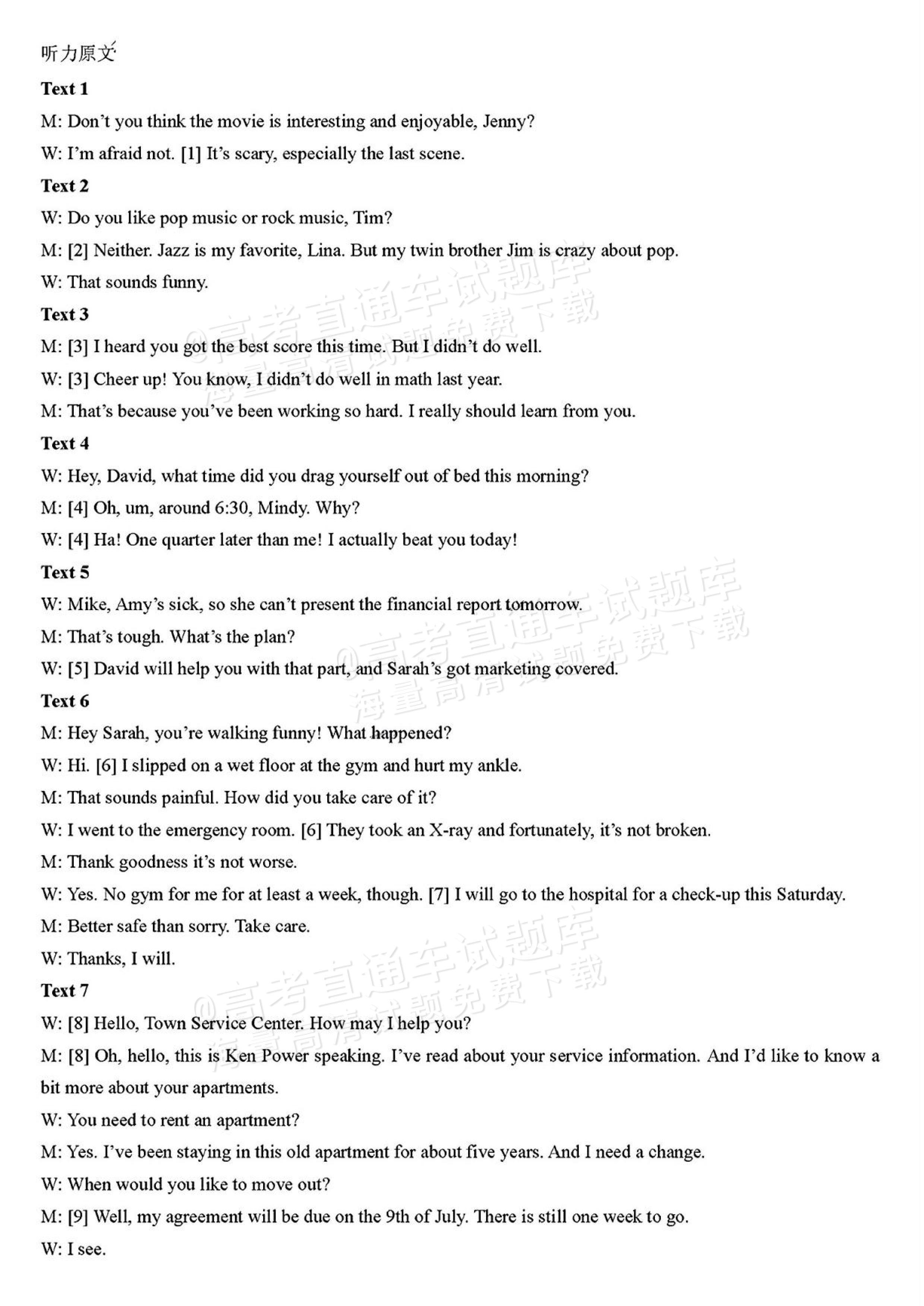
听力原文
Text 1
M: Don't you think the movie is interesting and enjoyable, Jenny?
W: I'm afraid not. [1] It's scary, especially the last scene.
Text 2
W: Do you like pop music or rock music, Tim?
M: [2] Neither. Jazz is my favorite, Lina. But my twin brother Jim is crazy about pop.
W: That sounds funny.
Text 3
M: [3] I heard you got the best score this time. But I didn't do well.
W: [3] Cheer up! You know, I didn't do well in math last year.
M: That's because you've been working so hard. I really should learn from you.
Text 4
W: Hey, David, what time did you drag yourself out of bed this morning?
M: [4] Oh, um, around 6:30, Mindy. Why?
Text 5
W: [4] Ha! One quarter later than me! I actually beat you today!
W: Mike, Amy's sick, so she can't present the financial report tomorrow.
M: That's tough. What's the plan?
W: [5] David will help you with that part, and Sarah's got marketing covered.
Text 6
M: Hey Sarah, you're walking funny! What happened?
W: Hi. [6] I slipped on a wet floor at the gym and hurt my ankle.
M: That sounds painful. How did you take care of it?
W: I went to the emergency room. [6] They took an X-ray and fortunately, it's not broken.
M: Thank goodness it's not worse.
W: Yes. No gym for me for at least a week, though. [7] I will go to the hospital for a check-up this Saturday.
M: Better safe than sorry. Take care.
W: Thanks, I will.
Text 7
W: [8] Hello, Town Service Center. How may I help you?
M: [8] Oh, hello, this is Ken Power speaking. I've read about your service information. And I'd like to know a
bit more about your apartments.
W: You need to rent an apartment?
M: Yes. I've been staying in this old apartment for about five years. And I need a change.
W: When would you like to move out?
M: [9] Well, my agreement will be due on the 9th of July. There is still one week to go.
W: I see.
M: Can I share the apartment with my friend?
W: Yes, you can.
M: Thanks.
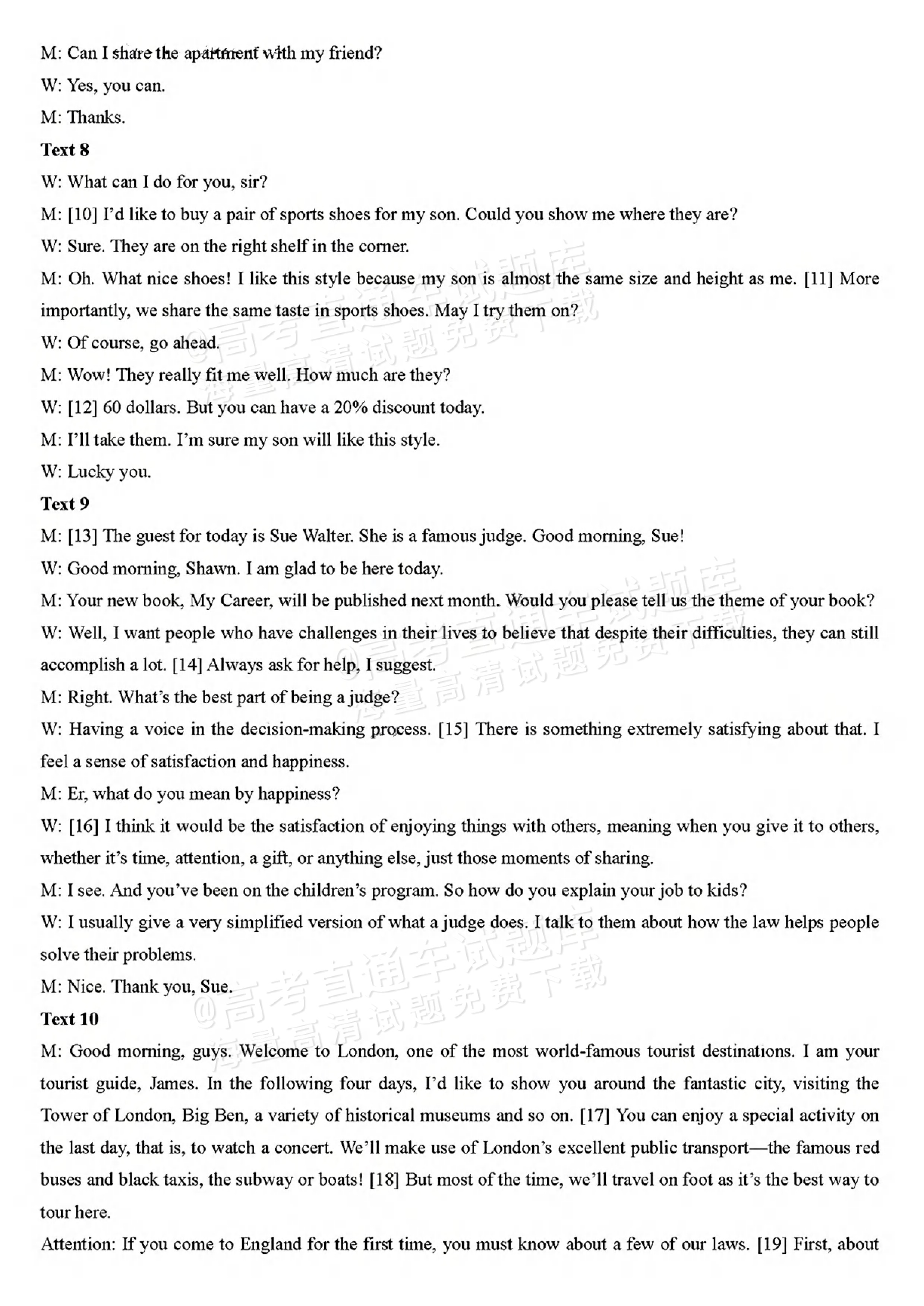
Text 8
W: What can I do for you, sir?
M: [10] I'd like to buy a pair of sports shoes for my son. Could you show me where they are?
W: Sure. They are on the right shelf in the corner.
M: Oh. What nice shoes! I like this style because my son is almost the same size and height as me. [11] More importantly, we share the same taste in sports shoes. May I try them on?
W: Of course, go ahead.
M: Wow! They really fit me well. How much are they?
W: [12] 60 dollars. But you can have a 20% discount today.
M: I'll take them. I'm sure my son will like this style.
W: Lucky you.
Text 9
M: [13] The guest for today is Sue Walter. She is a famous judge. Good morning, Sue!
W: Good morning, Shawn. I am glad to be here today.
M: Your new book, My Career, will be published next month. Would you please tell us the theme of your book?
W: Well, I want people who have challenges in their lives to believe that despite their difficulties, they can still accomplish a lot. [14] Always ask for help, I suggest.
M: Right. What's the best part of being a judge?
W: Having a voice in the decision-making process. [15] There is something extremely satisfying about that. I feel a sense of satisfaction and happiness.
M: Er, what do you mean by happiness?
W: [16] I think it would be the satisfaction of enjoying things with others, meaning when you give it to others, whether it's time, attention, a gift, or anything else, just those moments of sharing.
M: I see. And you've been on the children's program. So how do you explain your job to kids?
W: I usually give a very simplified version of what a judge does. I talk to them about how the law helps people solve their problems.
M: Nice. Thank you, Sue.
Text 10
M: Good morning, guys. Welcome to London, one of the most world-famous tourist destinations. I am your tourist guide, James. In the following four days, I'd like to show you around the fantastic city, visiting the Tower of London, Big Ben, a variety of historical museums and so on. [17] You can enjoy a special activity on the last day, that is, to watch a concert. We'll make use of London's excellent public transport—the famous red buses and black taxis, the subway or boats! [18] But most of the time, we'll travel on foot as it's the best way to tour here.
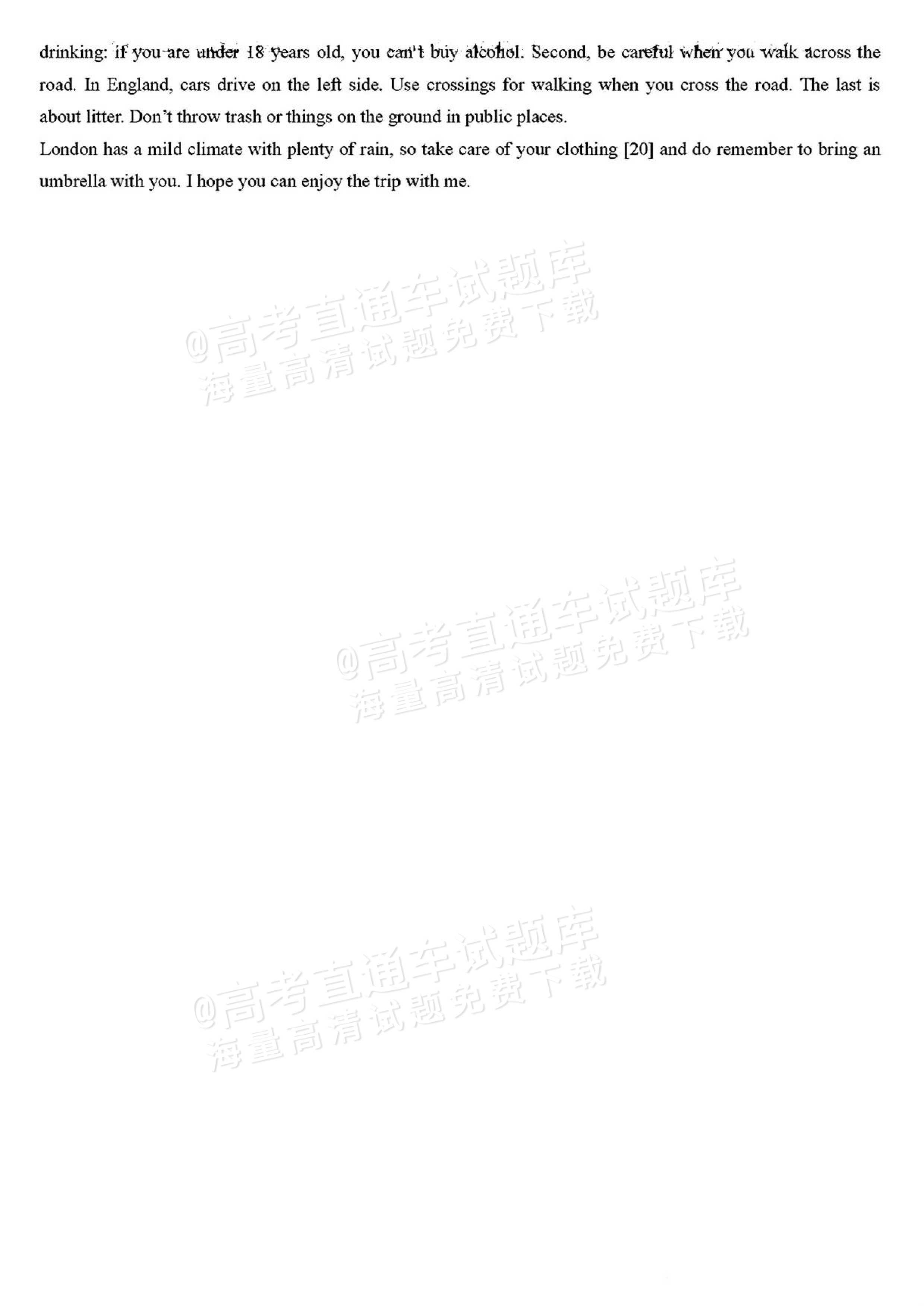
Attention: If you come to England for the first time, you must know about a few of our laws. [19] First, about
drinking: if you are under 18 years old, you can't buy alcohol. Second, be careful when you walk across the road. In England, cars drive on the left side. Use crossings for walking when you cross the road. The last is about litter. Don't throw trash or things on the ground in public places.
London has a mild climate with plenty of rain, so take care of your clothing [20] and do remember to bring an umbrella with you. I hope you can enjoy the trip with me.
快来评价一下难度吧~

 简单 0

 一般 0

 困难 0
你的预估分数是多少?拖动后可查看大家的估分统计哦~
估分统计
人数
相关推荐