





点击头像可查看其他用户上传的内容哦~

 优质
 车SS9fsL


参考答案
展开阅读全部
开通会员查看试卷全部内容
本文档由用户提供并上传,若内容存在侵权,请进行举报或认领
 版权异议

资源简介
展开▼
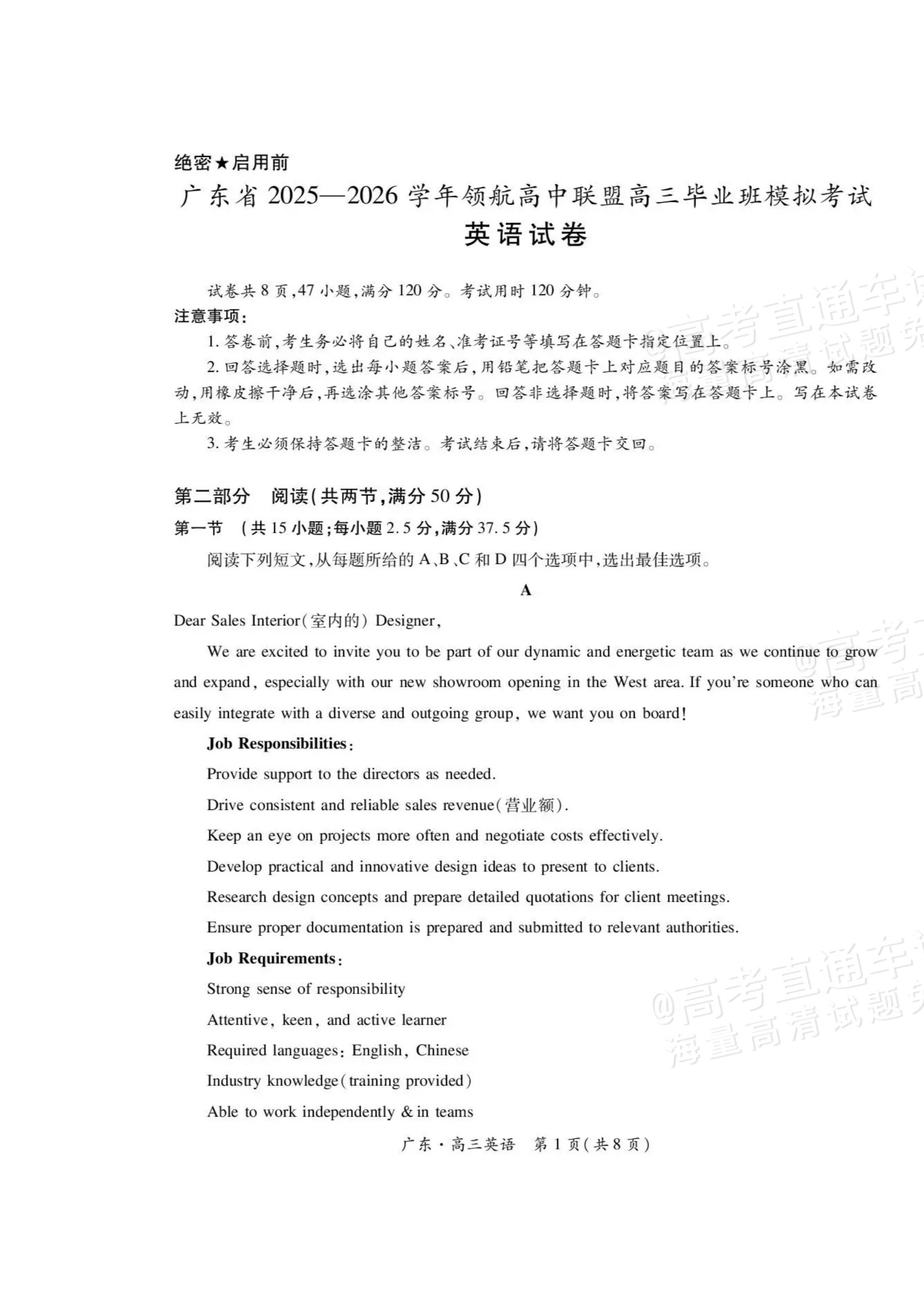
2026广东高三12月上进联考英语试题及参考答案(PDF版下载含详细解析)绝密★启用前
广东省2025一2026学年领航高中联盟高三毕业班模拟考试英语试卷
试卷共8页,47小题,满分120分。考试用时120分钟。
注意事项:
1. 答卷前,考生务必将自己的姓名、准考证号等填写在答题卡指定位置上。
2. 回答选择题时,选出每小题答案后,用铅笔把答题卡上对应题目的答案标号涂黑。如需改动,用橡皮擦干净后,再选涂其他答案标号。回答非选择题时,将答案写在答题卡上。写在本试卷上无效。
3. 考生必须保持答题卡的整洁。考试结束后,请将答题卡交回。
第二部分 阅读(共两节,满分50分)
第一节 (共15小题;每小题2.5分,满分37.5分)
阅读下列短文,从每题所给的A、B、C和D四个选项中,选出最佳选项。
A
Dear Sales Interior(室内的)Designer,
We are excited to invite you to be part of our dynamic and energetic team as we continue to grow and expand, especially with our new showroom opening in the West area. If you're someone who can easily integrate with a diverse and outgoing group, we want you on board!
Job Responsibilities:
Provide support to the directors as needed.
Drive consistent and reliable sales revenue(营业额).
Keep an eye on projects more often and negotiate costs effectively.
Develop practical and innovative design ideas to present to clients.
Research design concepts and prepare detailed quotations for client meetings.
Ensure proper documentation is prepared and submitted to relevant authorities.
Job Requirements:
Strong sense of responsibility
Attentive, keen, and active learner
Required languages: English, Chinese
Industry knowledge (training provided)
Able to work independently in teams
At least one year of working experience in related field Qualifications in architecture/interior design( preferred) Good working attitude, self-motivated and hard-working Knowledge of AutoCAD, SketchUp Photoshop( preferred) Able to use Microsoft Excel and other Microsoft applications
IMPORTANT NOTICE:
Strictly only Singaporeans may apply.
You can only get paid for selling goods and services.
Working hours are flexible but may include Saturday.
21. What should a sales interior designer do?
A. Select project workers. B. Train fresh colleagues.
C. Sell decorative materials. D. Monitor projects closely.
22. What is required for applicants?
A. Grasping specific softwares. B. Majoring in interior design.
C. Holding a Chinese passport. D. Gaining industry recognition.
23. What is a weakness of the job position?
A. It offers no fixed income. B. It requires working daily.
C. It asks for years of experience. D. It forbids working from home.
B
I'm Ellen. Whether I realized it or not, I have had a long-time passion for geography. My childhood was about watching stars, collecting leaves, and running around my family's orchards(果园). Born and raised in the same town for twenty-one years, I had a fascination and desire to stretch free of my all-too-familiar surroundings. I longed to breathe in new worlds, faces, and scenery.
In my house, breakfast time was reading time. My father kept a group of National Geographic magazines in the kitchen. Before I could understand the text, I stared at the images that enlarged my world. How inviting that frogs can be sky-blue, canary-yellow, and tomato-red—when we only have brown toads(蟾蜍)in Southern Illinois!On road trips I was handed an atlas(地图集),following interstate lines with my finger. After several adventures, this atlas eventually made its way into my heart. Taking a close look at the content of my stories and imaginative thoughts, it seems that I have always perceived my world through a geographic angle.
When time for college came, selecting an area of study was a hard task. I want to learn and try everything. Yet geography, a field that includes my curious nature, passion for Earth and people, and adventurous spirit, came to me easily. Fascinated by the complexities of this society and space, I have been devoted to geography study ever since.
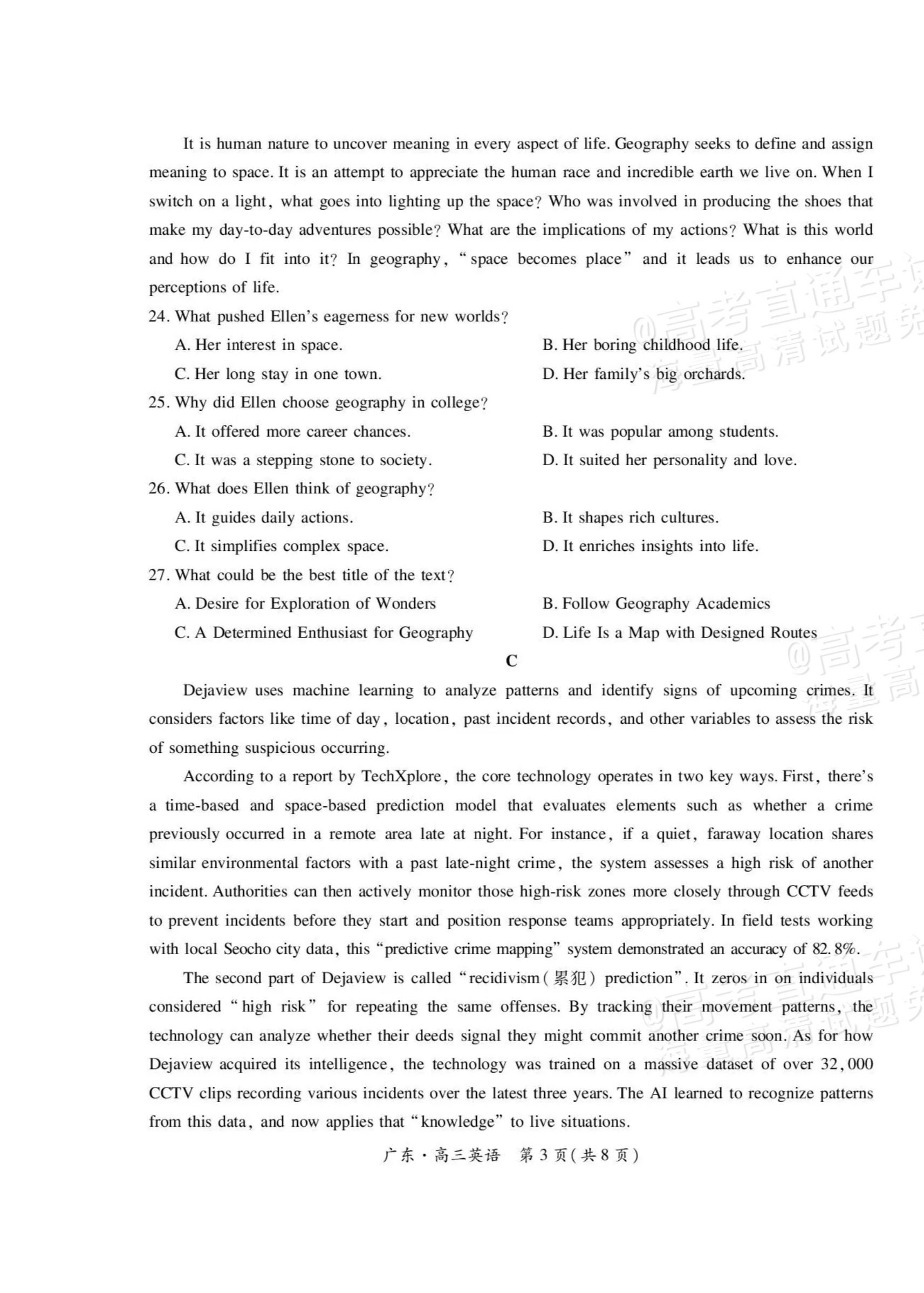
It is human nature to uncover meaning in every aspect of life. Geography seeks to define and assign meaning to space. It is an attempt to appreciate the human race and incredible earth we live on. When I switch on a light, what goes into lighting up the space? Who was involved in producing the shoes that make my day-to-day adventures possible? What are the implications of my actions? What is this world and how do I fit into it? In geography, "space becomes place" and it leads us to enhance our perceptions of life.
24. What pushed Ellen's eagerness for new worlds?
A. Her interest in space. B. Her boring childhood life.
C. Her long stay in one town. D. Her family's big orchards.
25. Why did Ellen choose geography in college?
A. It offered more career chances. B. It was popular among students.
C. It was a stepping stone to society. D. It suited her personality and love.
26. What does Ellen think of geography?
A. It guides daily actions. B. It shapes rich cultures.
C. It simplifies complex space. D. It enriches insights into life.
27. What could be the best title of the text?
A. Desire for Exploration of Wonders B. Follow Geography Academics
C. A Determined Enthusiast for Geography D. Life Is a Map with Designed Routes
C
Dejaview uses machine learning to analyze patterns and identify signs of upcoming crimes. It considers factors like time of day, location, past incident records, and other variables to assess the risk of something suspicious occurring.
According to a report by TechXplore, the core technology operates in two key ways. First, there's a time-based and space-based prediction model that evaluates elements such as whether a crime previously occurred in a remote area late at night. For instance, if a quiet, faraway location shares similar environmental factors with a past late-night crime, the system assesses a high risk of another incident. Authorities can then actively monitor those high-risk zones more closely through CCTV feeds to prevent incidents before they start and position response teams appropriately. In field tests working with local Seocho city data, this "predictive crime mapping" system demonstrated an accuracy of 82.8%.
The second part of Dejaview is called "recidivism(累犯) prediction". It zeros in on individuals considered "high risk" for repeating the same offenses. By tracking their movement patterns, the technology can analyze whether their deeds signal they might commit another crime soon. As for how Dejaview acquired its intelligence, the technology was trained on a massive dataset of over 32,000 CCTV clips recording various incidents over the latest three years. The AI learned to recognize patterns from this data, and now applies that "knowledge" to live situations.
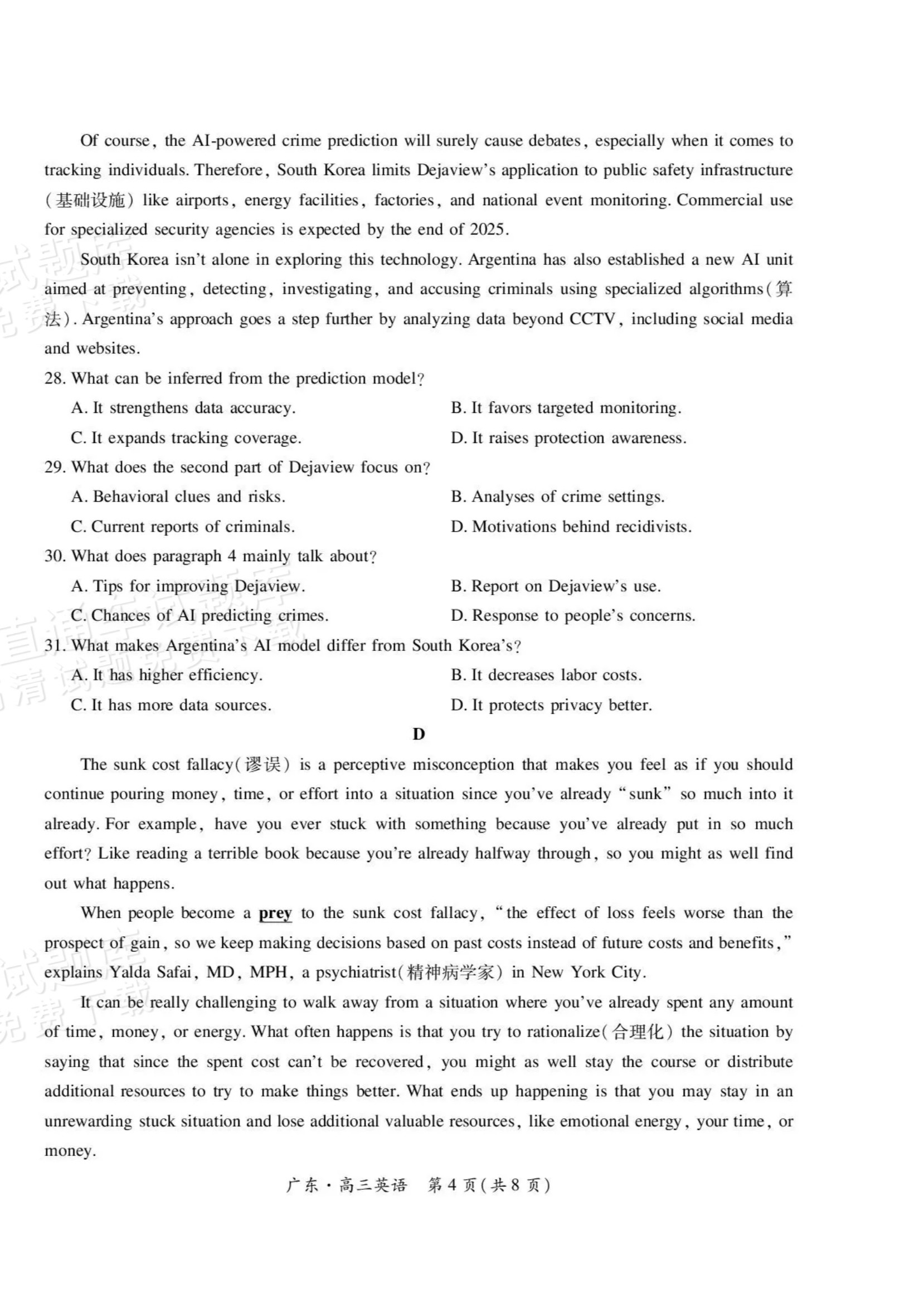
Of course, the AI-powered crime prediction will surely cause debates, especially when it comes to tracking individuals. Therefore, South Korea limits Dejaview's application to public safety infrastructure (基础设施)like airports, energy facilities, factories, and national event monitoring. Commercial use for specialized security agencies is expected by the end of 2025.
South Korea isn't alone in exploring this technology. Argentina has also established a new AI unit aimed at preventing, detecting, investigating, and accusing criminals using specialized algorithms(算法). Argentina's approach goes a step further by analyzing data beyond CCTV, including social media and websites.
28. What can be inferred from the prediction model?
A. It strengthens data accuracy. B. It favors targeted monitoring.
C. It expands tracking coverage. D. It raises protection awareness.
29. What does the second part of Dejaview focus on?
A. Behavioral clues and risks. B. Analyses of crime settings.
C. Current reports of criminals. D. Motivations behind recidivists.
30. What does paragraph 4 mainly talk about?
A. Tips for improving Dejaview. B. Report on Dejaview's use.
C. Chances of AI predicting crimes. D. Response to people's concerns.
31. What makes Argentina's AI model differ from South Korea's?
A. It has higher efficiency. B. It decreases labor costs.
C. It has more data sources. D. It protects privacy better.
D
The sunk cost fallacy(谬误)is a perceptive misconception that makes you feel as if you should continue pouring money, time, or effort into a situation since you've already "sunk" so much into it already. For example, have you ever stuck with something because you've already put in so much effort? Like reading a terrible book because you're already halfway through, so you might as well find out what happens.
When people become a prey to the sunk cost fallacy, "the effect of loss feels worse than the prospect of gain, so we keep making decisions based on past costs instead of future costs and benefits," explains Yalda Safai, MD, MPH, a psychiatrist (精神病学家) in New York City.
It can be really challenging to walk away from a situation where you've already spent any amount of time, money, or energy. What often happens is that you try to rationalize(合理化)the situation by saying that since the spent cost can't be recovered, you might as well stay the course or distribute additional resources to try to make things better. What ends up happening is that you may stay in an unrewarding stuck situation and lose additional valuable resources, like emotional energy, your time, or money.
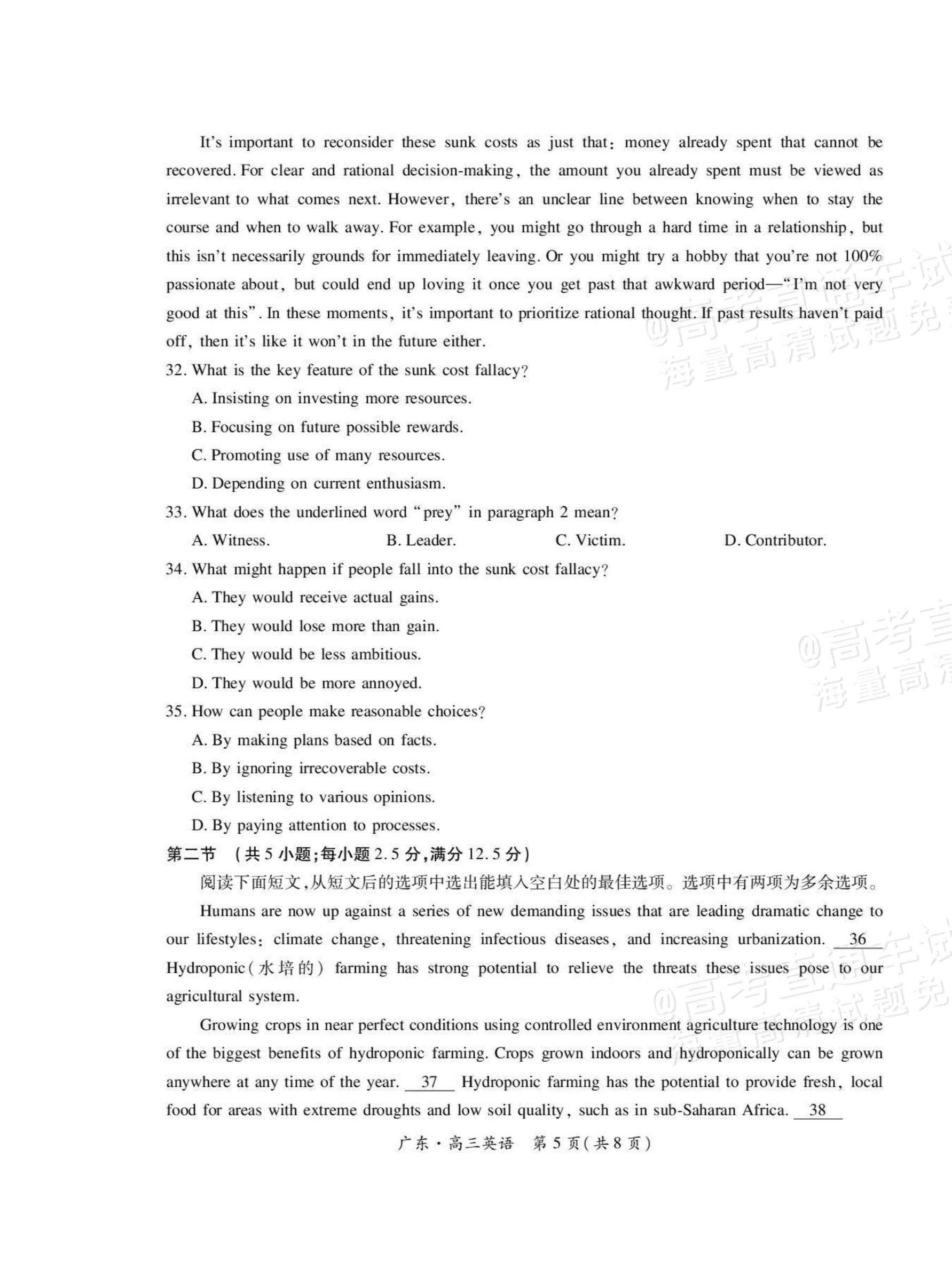
It's important to reconsider these sunk costs as just that: money already spent that cannot be recovered. For clear and rational decision-making, the amount you already spent must be viewed as irrelevant to what comes next. However, there's an unclear line between knowing when to stay the course and when to walk away. For example, you might go through a hard time in a relationship, but this isn't necessarily grounds for immediately leaving. Or you might try a hobby that you're not 100% passionate about, but could end up loving it once you get past that awkward period—"I'm not very good at this". In these moments, it's important to prioritize rational thought. If past results haven't paid off, then it's like it won't in the future either.
32. What is the key feature of the sunk cost fallacy?
A. Insisting on investing more resources.
B. Focusing on future possible rewards.
C. Promoting use of many resources.
D. Depending on current enthusiasm.
33. What does the underlined word "prey" in paragraph 2 mean?
A. Witness. B. Leader. C. Victim. D. Contributor.
34. What might happen if people fall into the sunk cost fallacy?
A. They would receive actual gains.
B. They would lose more than gain.
C. They would be less ambitious.
D. They would be more annoyed.
35. How can people make reasonable choices?
A. By making plans based on facts.
B. By ignoring irrecoverable costs.
C. By listening to various opinions.
D. By paying attention to processes.
第二节 (共5小题;每小题2.5分,满分12.5分)
阅读下面短文,从短文后的选项中选出能填入空白处的最佳选项。选项中有两项为多余选项。
Humans are now up against a series of new demanding issues that are leading dramatic change to our lifestyles: climate change, threatening infectious diseases, and increasing urbanization. 36 Hydroponic(水培的) farming has strong potential to relieve the threats these issues pose to our agricultural system.
Growing crops in near perfect conditions using controlled environment agriculture technology is one of the biggest benefits of hydroponic farming. Crops grown indoors and hydroponically can be grown anywhere at any time of the year. 37 Hydroponic farming has the potential to provide fresh, local food for areas with extreme droughts and low soil quality, such as in sub-Saharan Africa. 38
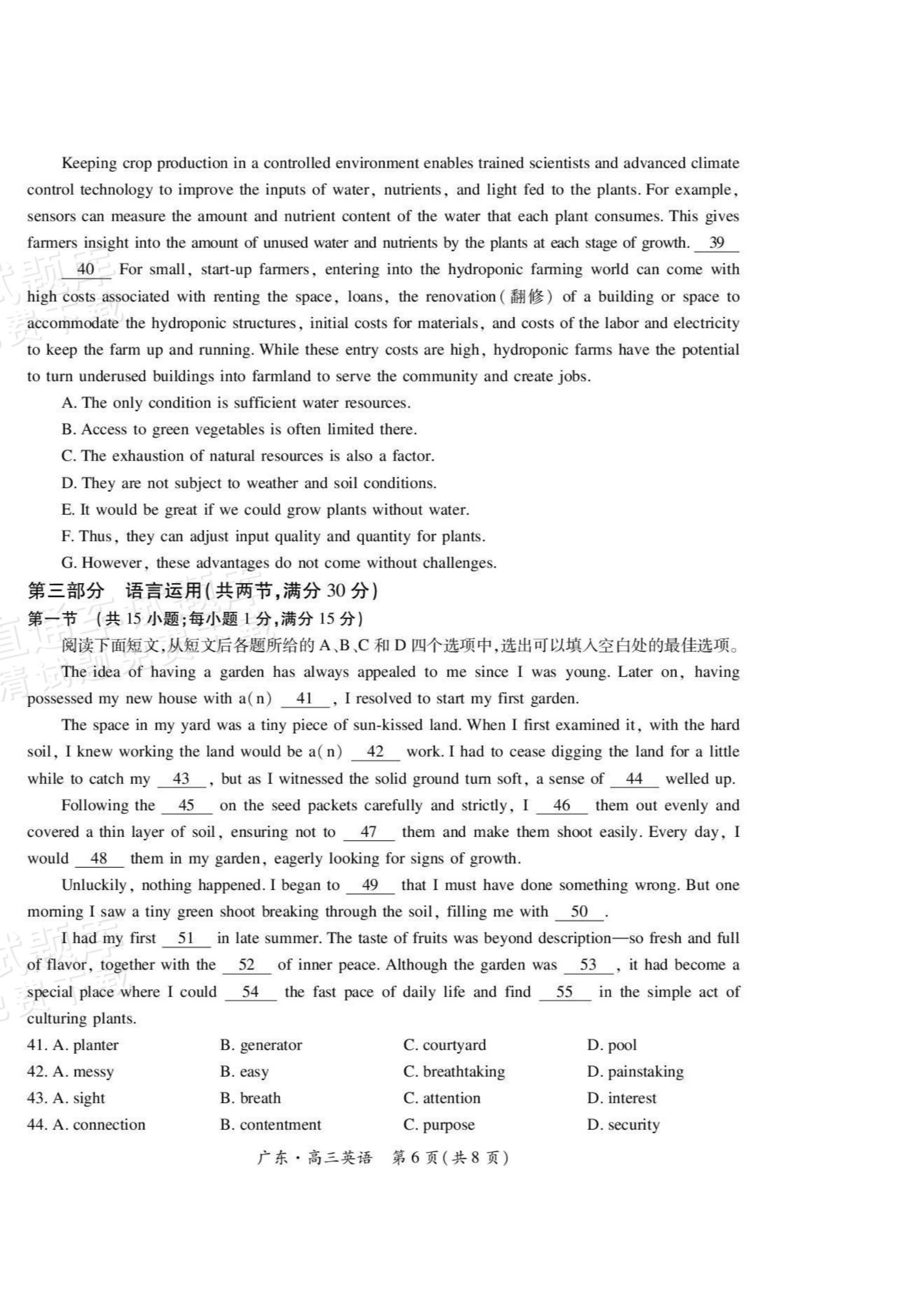
Keeping crop production in a controlled environment enables trained scientists and advanced climate control technology to improve the inputs of water, nutrients, and light fed to the plants. For example, sensors can measure the amount and nutrient content of the water that each plant consumes. This gives farmers insight into the amount of unused water and nutrients by the plants at each stage of growth. 39
40 For small, start-up farmers, entering into the hydroponic farming world can come with high costs associated with renting the space, loans, the renovation(翻修)of a building or space to accommodate the hydroponic structures, initial costs for materials, and costs of the labor and electricity to keep the farm up and running. While these entry costs are high, hydroponic farms have the potential to turn underused buildings into farmland to serve the community and create jobs.
A. The only condition is sufficient water resources.
B. Access to green vegetables is often limited there.
C. The exhaustion of natural resources is also a factor.
D. They are not subject to weather and soil conditions.
E. It would be great if we could grow plants without water.
F. Thus, they can adjust input quality and quantity for plants.
G. However, these advantages do not come without challenges.
第三部分 语言运用(共两节,满分30分)
第一节 (共15小题;每小题1分,满分15分)
阅读下面短文,从短文后各题所给的A、B、C和D四个选项中,选出可以填入空白处的最佳选项。
The idea of having a garden has always appealed to me since I was young. Later on, having possessed my new house with a(n) 41 , I resolved to start my first garden.
The space in my yard was a tiny piece of sun-kissed land. When I first examined it, with the hard soil, I knew working the land would be a(n) 42 work. I had to cease digging the land for a little while to catch my 43 , but as I witnessed the solid ground turn soft, a sense of 44 welled up.
Following the 45 on the seed packets carefully and strictly, I 46 them out evenly and covered a thin layer of soil, ensuring not to 47 them and make them shoot easily. Every day, I would 48 them in my garden, eagerly looking for signs of growth.
Unluckily, nothing happened. I began to 49 that I must have done something wrong. But one morning I saw a tiny green shoot breaking through the soil, filling me with 50.
I had my first 51 in late summer. The taste of fruits was beyond description—so fresh and full of flavor, together with the 52 of inner peace. Although the garden was 53, it had become a special place where I could 54 the fast pace of daily life and find 55 in the simple act of culturing plants.
41. A. planter B. generator C. courtyard D. pool
42. A. messy B. easy C. breathtaking D. painstaking
43. A. sight B. breath C. attention D. interest
44. A. connection B. contentment C. purpose D. security
45. A. instructions B. solutions C. schedules D. ingredients
46. A. took B. picked C. spaced D. worked
47. A. disturb B. secure C. spot D. bury
48. A. guard B. check C. cover D. collect
49. A. complain B. prove C. ignore D. worry
50. A. panic B. shame C. responsibility D. relief
51. A. harvest B. memory C. discovery D. pride
52. A. mystery B. test C. lesson D. reward
53. A. deserted B. small C. fruitful D. beautiful
54. A. dig into B. reflect on C. escape from D. adapt to
55. A. peace B. kindness C. freedom D. gratitude
第二节 (共10小题;每小题1.5分,满分15分)
阅读下面短文,在空白处填入1个适当的单词或括号内单词的正确形式。
Chinese is the native tongue of more people on Earth than any other language. So what happens when 1.3 billion Chinese speakers rush to learn English, the 56 ( globe) language of business? Actually there will be a happy integration!
Chinese and English words get mixed together 57 that the result is jokingly called "Chinglish". As a matter of fact, "Chinglish" is the linguistic (语言的) result of English language 58 (adapt) that are created and influenced by native Chinese speakers. You can't find these Chinglish words in any dictionary, but on your next China adventure, you will 59 (certain) encounter "Chinglish". As native Chinese speakers study English, they often generate phrases 60 means of direct translation. One common example is the phrase "Good good study, day day up" 61 (speak) by many studying English.
Other Chinglish can combine sounds and meanings 62 (create) humorous phrases. For instance, the popularity of the iPhone in China has led consumers to eagerly purchase one. That's 63 they have called iPhones "iFeng". Feng comes from the Chinese word for "crazy", which 64 (pronounce) as "feng".
Language is used for communicating ideas and culture. In Chinese culture, language is also 65 opportunity for wordplay, like the various uses of numbers in China. Take note and thus your next Beijing tour or Xizang travel will not leave you confused.
第四部分 写作(共两节,满分40分)
第一节 (满分15分)
假定你是李华,你获得了校英语演讲比赛一等奖,校英文报邀请你投稿分享获奖感受。请你写一篇短文,内容包括:
1. 准备过程;
2. 你的收获。
注意:
1. 写作词数应为80个左右;
2. 请按如下格式在答题纸的相应位置作答。
Hi, everyone! I'm Li Hua. _
第二节 (满分25分)
阅读下面材料,根据其内容和所给段落开头语续写两段,使之构成一篇完整的短文。
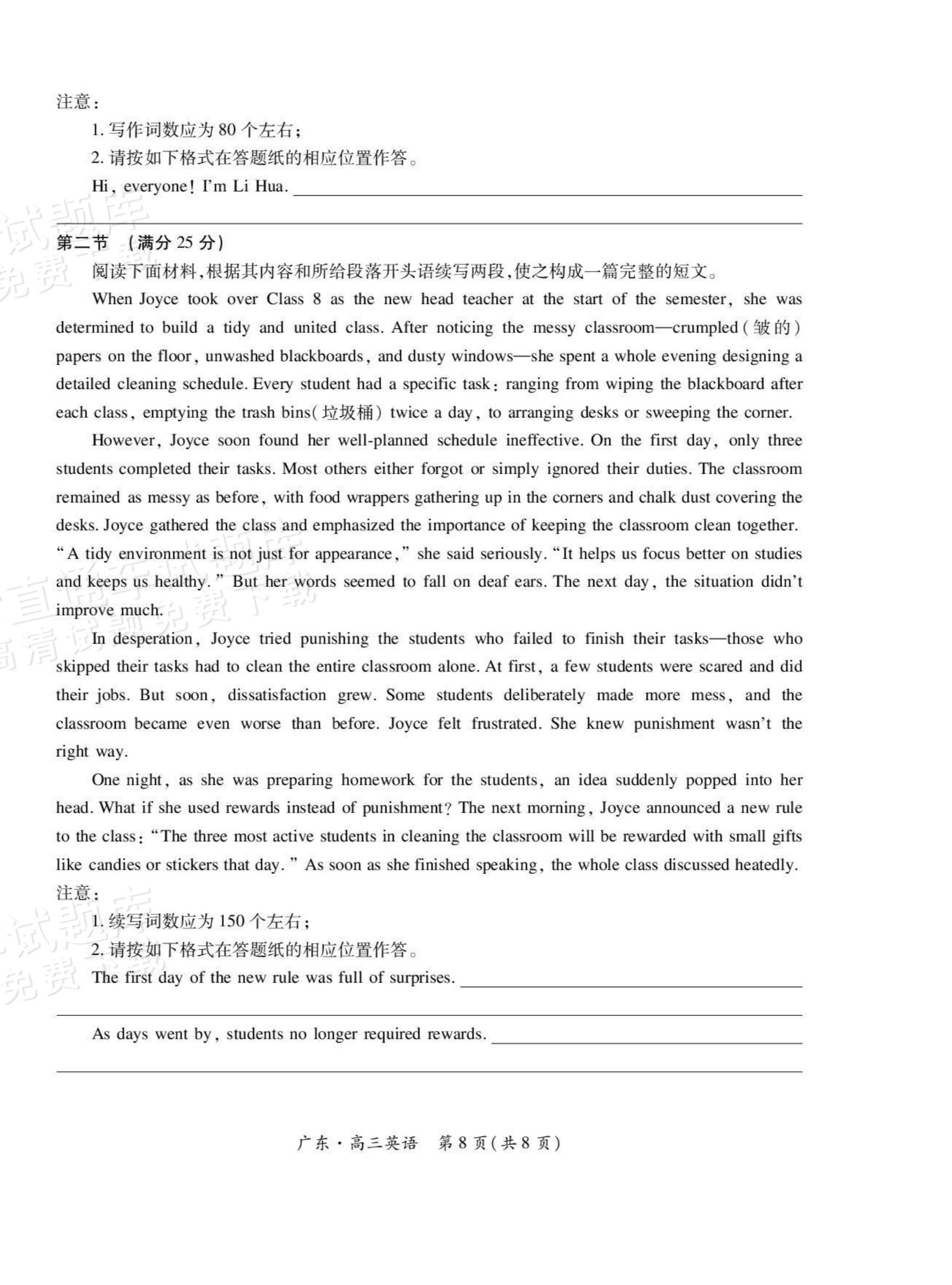
When Joyce took over Class 8 as the new head teacher at the start of the semester, she was determined to build a tidy and united class. After noticing the messy classroom—crumpled(皱的) papers on the floor, unwashed blackboards, and dusty windows—she spent a whole evening designing a detailed cleaning schedule. Every student had a specific task: ranging from wiping the blackboard after each class, emptying the trash bins(垃圾桶) twice a day, to arranging desks or sweeping the corner.
However, Joyce soon found her well-planned schedule ineffective. On the first day, only three students completed their tasks. Most others either forgot or simply ignored their duties. The classroom remained as messy as before, with food wrappers gathering up in the corners and chalk dust covering the desks. Joyce gathered the class and emphasized the importance of keeping the classroom clean together. "A tidy environment is not just for appearance," she said seriously. "It helps us focus better on studies and keeps us healthy." But her words seemed to fall on deaf ears. The next day, the situation didn't improve much.
In desperation, Joyce tried punishing the students who failed to finish their tasks—those who skipped their tasks had to clean the entire classroom alone. At first, a few students were scared and did their jobs. But soon, dissatisfaction grew. Some students deliberately made more mess, and the classroom became even worse than before. Joyce felt frustrated. She knew punishment wasn't the right way.
One night, as she was preparing homework for the students, an idea suddenly popped into her head. What if she used rewards instead of punishment? The next morning, Joyce announced a new rule to the class: "The three most active students in cleaning the classroom will be rewarded with small gifts like candies or stickers that day." As soon as she finished speaking, the whole class discussed heatedly. 注意:
1. 续写词数应为150个左右;
2. 请按如下格式在答题纸的相应位置作答。
The first day of the new rule was full of surprises. _
As days went by, students no longer required rewards. ___
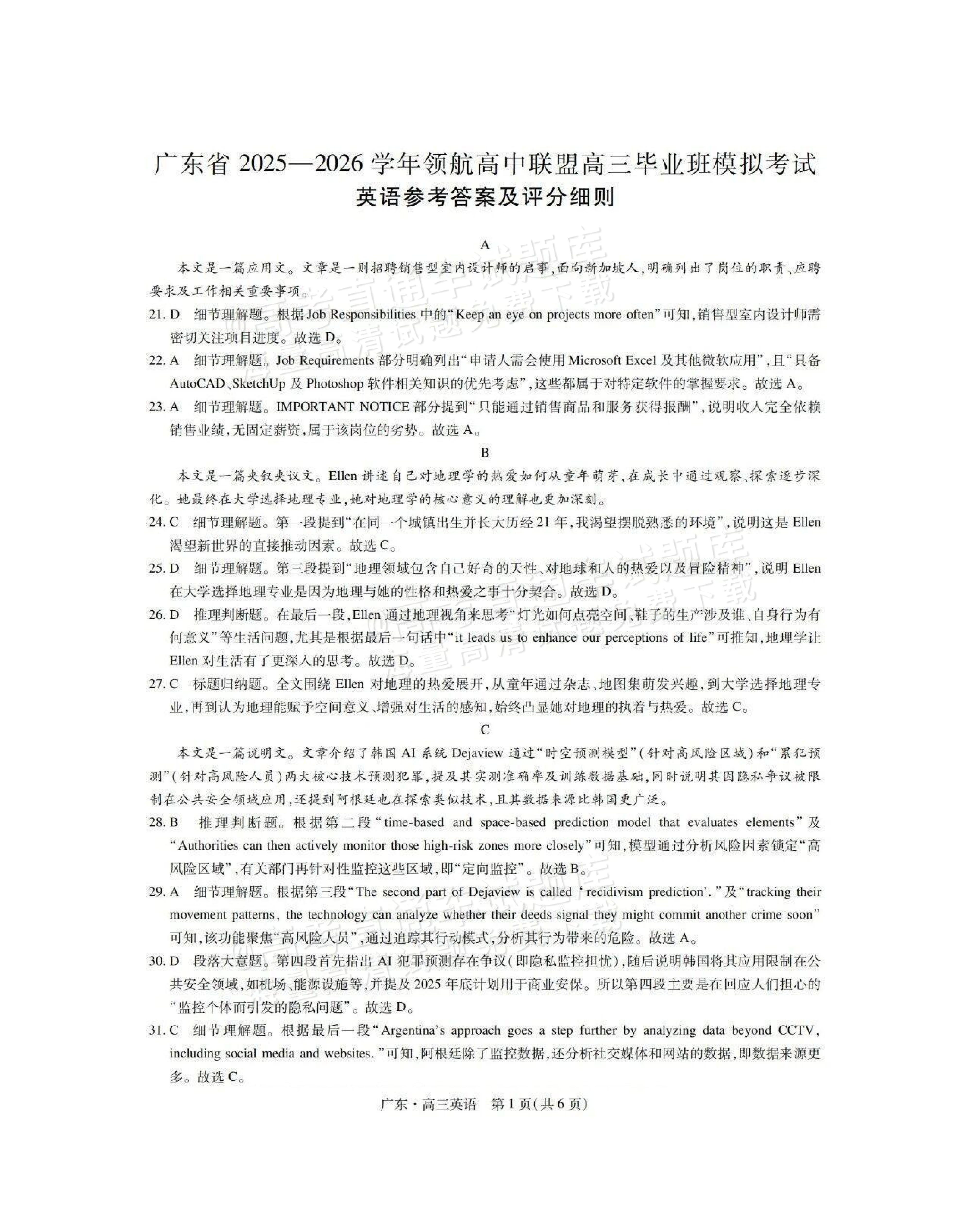
广东省2025一2026学年领航高中联盟高三毕业班模拟考试英语参考答案及评分细则
A
本文是一篇应用文。文章是一则招聘销售型室内设计师的启事,面向新加坡人,明确列出了岗位的职责、应聘要求及工作相关重要事项。
21. D 细节理解题。根据Job Responsibilities中的“Keep an eye on projects more often”可知,销售型室内设计师需密切关注项目进度。故选D。
22. A 细节理解题。Job Requirements部分明确列出“申请人需会使用Microsoft Excel及其他微软应用”,且“具备 AutoCAD、SketchUp及Photoshop软件相关知识的优先考虑”,这些都属于对特定软件的掌握要求。故选A。
23. A 细节理解题。IMPORTANT NOTICE部分提到“只能通过销售商品和服务获得报酬”,说明收入完全依赖销售业绩,无固定薪资,属于该岗位的劣势。故选A。
B
本文是一篇夹叙夹议文。Ellen讲述自己对地理学的热爱如何从童年萌芽,在成长中通过观察、探索逐步深化。她最终在大学选择地理专业,她对地理学的核心意义的理解也更加深刻。
24. C 细节理解题。第一段提到“在同一个城镇出生并长大历经21年,我渴望摆脱熟悉的环境”,说明这是Ellen渴望新世界的直接推动因素。故选C。
25. D 细节理解题。第三段提到“地理领域包含自己好奇的天性、对地球和人的热爱以及冒险精神”,说明Ellen在大学选择地理专业是因为地理与她的性格和热爱之事十分契合。故选D。
26. D 推理判断题。在最后一段,Ellen通过地理视角来思考“灯光如何点亮空间、鞋子的生产涉及谁、自身行为有何意义”等生活问题,尤其是根据最后一句话中“it leads us to enhance our perceptions of life”可推知,地理学让 Ellen对生活有了更深入的思考。故选D。
27. C 标题归纳题。全文围绕 Ellen 对地理的热爱展开,从童年通过杂志、地图集萌发兴趣,到大学选择地理专业,再到认为地理能赋予空间意义、增强对生活的感知,始终凸显她对地理的执着与热爱。故选 C。
C
本文是一篇说明文。文章介绍了韩国AI系统Dejaview通过“时空预测模型”(针对高风险区域)和“累犯预测”(针对高风险人员)两大核心技术预测犯罪,提及其实测准确率及训练数据基础,同时说明其因隐私争议被限制在公共安全领域应用,还提到阿根廷也在探索类似技术,且其数据来源比韩国更广泛。
28. B 推理判断题。根据第二段“time-based and space-based prediction model that evaluates elements”及“Authorities can then actively monitor those high-risk zones more closely”可知,模型通过分析风险因素锁定“高风险区域”,有关部门再针对性监控这些区域,即“定向监控”。故选B。
29. A 细节理解题。根据第三段“The second part of Dejaview is called 'recidivism prediction'.”及“tracking their movement patterns, the technology can analyze whether their deeds signal they might commit another crime soon”可知,该功能聚焦“高风险人员”,通过追踪其行动模式,分析其行为带来的危险。故选A。
30. D 段落大意题。第四段首先指出AI犯罪预测存在争议(即隐私监控担忧),随后说明韩国将其应用限制在公共安全领域,如机场、能源设施等,并提及2025年底计划用于商业安保。所以第四段主要是在回应人们担心的“监控个体而引发的隐私问题”。故选D。
31. C 细节理解题。根据最后一段“Argentina's approach goes a step further by analyzing data beyond CCTV, including social media and websites.”可知,阿根廷除了监控数据,还分析社交媒体和网站的数据,即数据来源更多。故选C。
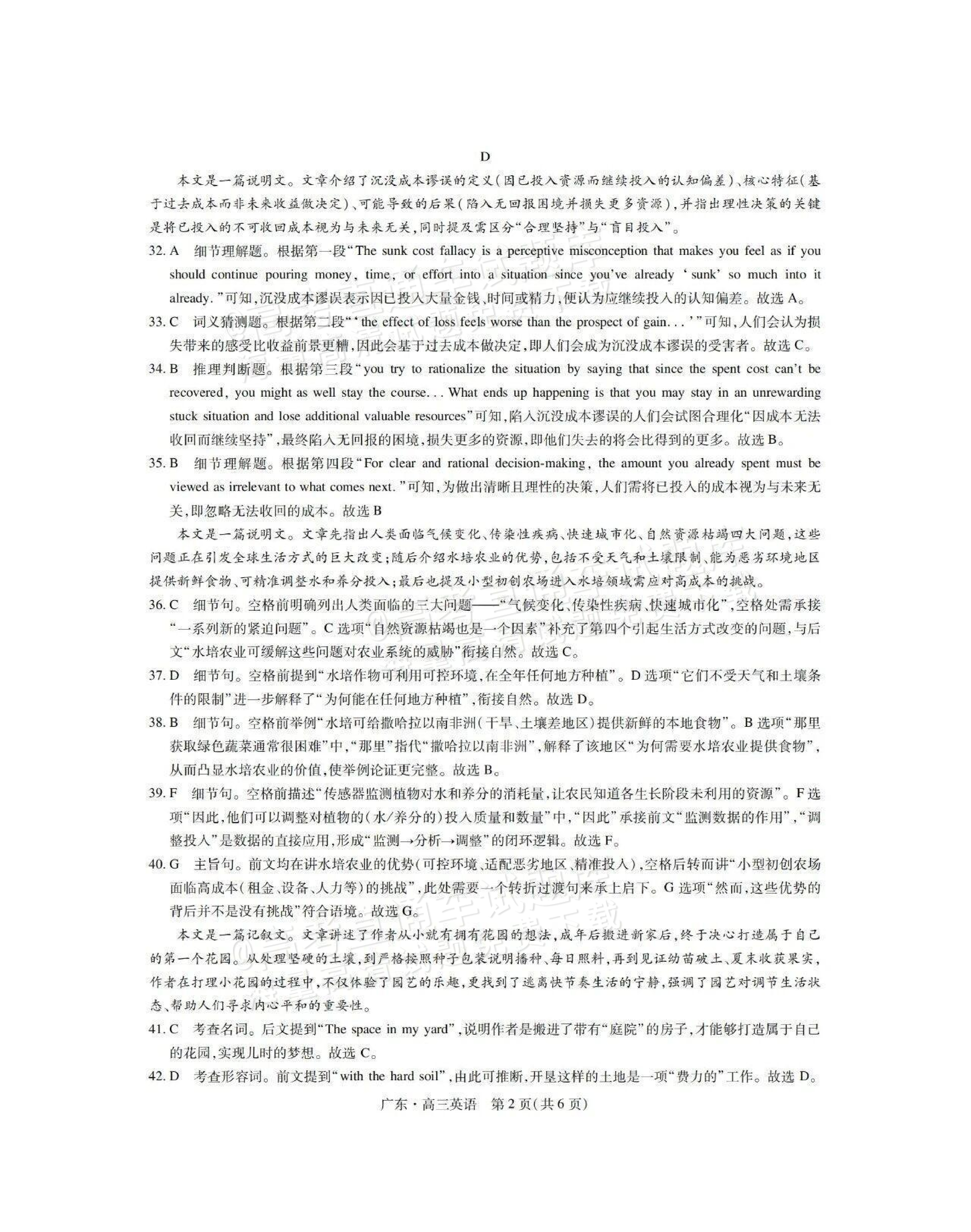
本文是一篇说明文。文章介绍了沉没成本谬误的定义(因已投入资源而继续投入的认知偏差)、核心特征(基于过去成本而非未来收益做决定)、可能导致的后果(陷入无回报困境并损失更多资源),并指出理性决策的关键是将已投入的不可收回成本视为与未来无关,同时提及需区分“合理坚持”与“盲目投入”。
32. A 细节理解题。根据第一段“The sunk cost fallacy is a perceptive misconception that makes you feel as if you should continue pouring money, time, or effort into a situation since you've already 'sunk' so much into it already.”可知,沉没成本谬误表示因已投入大量金钱、时间或精力,便认为应继续投入的认知偏差。故选A。
33. C 词义猜测题。根据第二段“‘the effect of loss feels worse than the prospect of gain...’”可知,人们会认为损失带来的感受比收益前景更糟,因此会基于过去成本做决定,即人们会成为沉没成本谬误的受害者。故选C。
34. B 推理判断题。根据第三段“you try to rationalize the situation by saying that since the spent cost can't be recovered, you might as well stay the course... What ends up happening is that you may stay in an unrewarding stuck situation and lose additional valuable resources”可知,陷入沉没成本谬误的人们会试图合理化“因成本无法收回而继续坚持”,最终陷入无回报的困境,损失更多的资源,即他们失去的将会比得到的更多。故选B。
35. B 细节理解题。根据第四段“For clear and rational decision-making,the amount you already spent must be viewed as irrelevant to what comes next.”可知,为做出清晰且理性的决策,人们需将已投入的成本视为与未来无关,即忽略无法收回的成本。故选B
本文是一篇说明文。文章先指出人类面临气候变化、传染性疾病、快速城市化、自然资源枯竭四大问题,这些问题正在引发全球生活方式的巨大改变;随后介绍水培农业的优势,包括不受天气和土壤限制、能为恶劣环境地区提供新鲜食物、可精准调整水和养分投入;最后也提及小型初创农场进入水培领域需应对高成本的挑战。
36. C 细节句。空格前明确列出人类面临的三大问题——“气候变化、传染性疾病、快速城市化”,空格处需承接“一系列新的紧迫问题”。C选项“自然资源枯竭也是一个因素”补充了第四个引起生活方式改变的问题,与后文“水培农业可缓解这些问题对农业系统的威胁”衔接自然。故选C。
37. D 细节句。空格前提到“水培作物可利用可控环境,在全年任何地方种植”。D选项“它们不受天气和土壤条件的限制”进一步解释了“为何能在任何地方种植”,衔接自然。故选D。
38. B 细节句。空格前举例“水培可给撒哈拉以南非洲(干旱、土壤差地区)提供新鲜的本地食物”。B选项“那里获取绿色蔬菜通常很困难”中,“那里”指代“撒哈拉以南非洲”,解释了该地区“为何需要水培农业提供食物”,从而凸显水培农业的价值,使举例论证更完整。故选B。
39. F 细节句。空格前描述“传感器监测植物对水和养分的消耗量,让农民知道各生长阶段未利用的资源”。F选项“因此,他们可以调整对植物的(水/养分的)投入质量和数量”中,“因此”承接前文“监测数据的作用”,“调整投入”是数据的直接应用,形成“监测 → 分析 → 调整”的闭环逻辑。故选F。
40. G 主旨句。前文均在讲水培农业的优势(可控环境、适配恶劣地区、精准投入),空格后转而讲“小型初创农场面临高成本(租金、设备、人力等)的挑战”,此处需要一个转折过渡句来承上启下。G选项“然而,这些优势的背后并不是没有挑战”符合语境。故选G。
本文是一篇记叙文。文章讲述了作者从小就有拥有花园的想法,成年后搬进新家后,终于决心打造属于自己的第一个花园。从处理坚硬的土壤,到严格按照种子包装说明播种、每日照料,再到见证幼苗破土、夏末收获果实,作者在打理小花园的过程中,不仅体验了园艺的乐趣,更找到了逃离快节奏生活的宁静,强调了园艺对调节生活状态、帮助人们寻求内心平和的重要性。
41. C 考查名词。后文提到“The space in my yard”,说明作者是搬进了带有“庭院”的房子,才能够打造属于自己的花园,实现儿时的梦想。故选C。
42. D 考查形容词。前文提到“with the hard soil”,由此可推断,开垦这样的土地是一项“费力的”工作。故选 D。
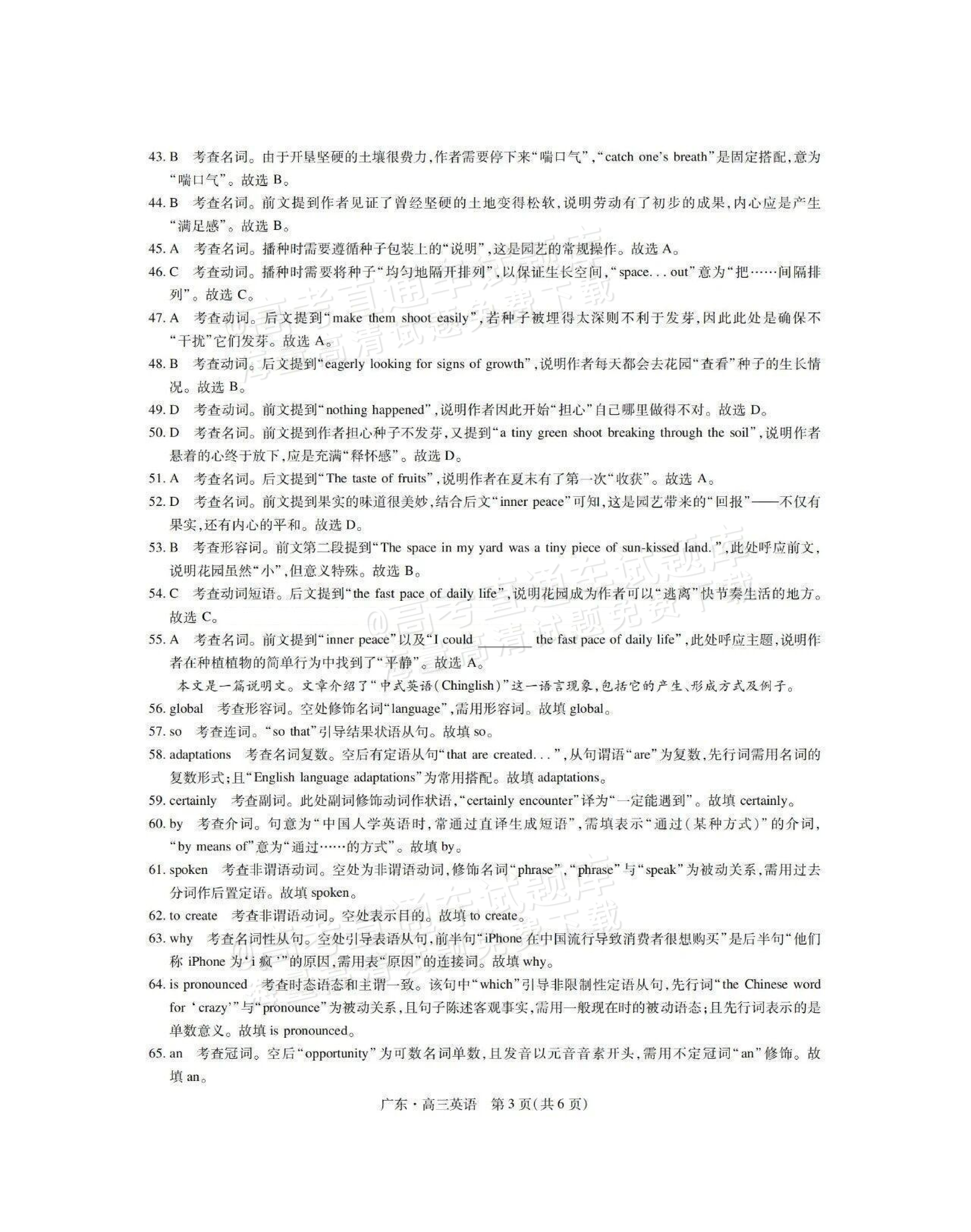
43. B 考查名词。由于开垦坚硬的土壤很费力,作者需要停下来“喘口气”,“catch one's breath”是固定搭配,意为 “喘口气”。故选B。
44. B 考查名词。前文提到作者见证了曾经坚硬的土地变得松软,说明劳动有了初步的成果,内心应是产生 “满足感”。故选B。
45. A 考查名词。播种时需要遵循种子包装上的“说明”,这是园艺的常规操作。故选A。
46. C 考查动词。播种时需要将种子“均匀地隔开排列”,以保证生长空间,“space...out”意为“把···间隔排列”。故选C。
47. A 考查动词。后文提到“make them shoot easily”,若种子被埋得太深则不利于发芽,因此此处是确保不 “干扰”它们发芽。故选A。
48. B 考查动词。后文提到“eagerly looking for signs of growth”,说明作者每天都会去花园“查看”种子的生长情况。故选B。
49. D 考查动词。前文提到“nothing happened”,说明作者因此开始“担心”自己哪里做得不对。故选D。
50. D 考查名词。前文提到作者担心种子不发芽,又提到“a tiny green shoot breaking through the soil”,说明作者悬着的心终于放下,应是充满“释怀感”。故选D。
51. A 考查名词。后文提到“The taste of fruits”,说明作者在夏末有了第一次“收获”。故选 A。
52. D 考查名词。前文提到果实的味道很美妙,结合后文“inner peace”可知,这是园艺带来的“回报”——不仅有果实,还有内心的平和。故选D。
53. B 考查形容词。前文第二段提到“The space in my yard was a tiny piece of sun-kissed land. ”,此处呼应前文,说明花园虽然“小”,但意义特殊。故选B。
54. C 考查动词短语。后文提到“the fast pace of daily life”,说明花园成为作者可以“逃离”快节奏生活的地方。故选C。
55. A 考查名词。前文提到“inner peace”以及“I could ___the fast pace of daily life”,此处呼应主题,说明作者在种植植物的简单行为中找到了“平静”。故选 A。
本文是一篇说明文。文章介绍了“中式英语(Chinglish)”这一语言现象,包括它的产生、形成方式及例子。
56. global 考查形容词。空处修饰名词“language”,需用形容词。故填 global。
57. so 考查连词。“so that”引导结果状语从句。故填 so。
58. adaptations 考查名词复数。空后有定语从句“that are created...”,从句谓语“are”为复数,先行词需用名词的复数形式;且“English language adaptations”为常用搭配。故填 adaptations。
59. certainly 考查副词。此处副词修饰动词作状语,“certainly encounter”译为“一定能遇到”。故填 certainly。
60. by 考查介词。句意为“中国人学英语时,常通过直译生成短语”,需填表示“通过(某种方式)”的介词,“by means of”意为“通过……的方式”。故填by。
61. spoken 考查非谓语动词。空处为非谓语动词,修饰名词“phrase”,“phrase”与“speak”为被动关系,需用过去分词作后置定语。故填 spoken。
62. to create 考查非谓语动词。空处表示目的。故填 to create。
63. why 考查名词性从句。空处引导表语从句,前半句“iPhone在中国流行导致消费者很想购买”是后半句“他们称iPhone为‘i疯’”的原因,需用表“原因”的连接词。故填why。
64. is pronounced 考查时态语态和主谓一致。该句中“which”引导非限制性定语从句,先行词“the Chinese word for ‘crazy’”与“pronounce”为被动关系,且句子陈述客观事实,需用一般现在时的被动语态;且先行词表示的是单数意义。故填 is pronounced。
65. an 考查冠词。空后“opportunity”为可数名词单数,且发音以元音音素开头,需用不定冠词“an”修饰。故填an。
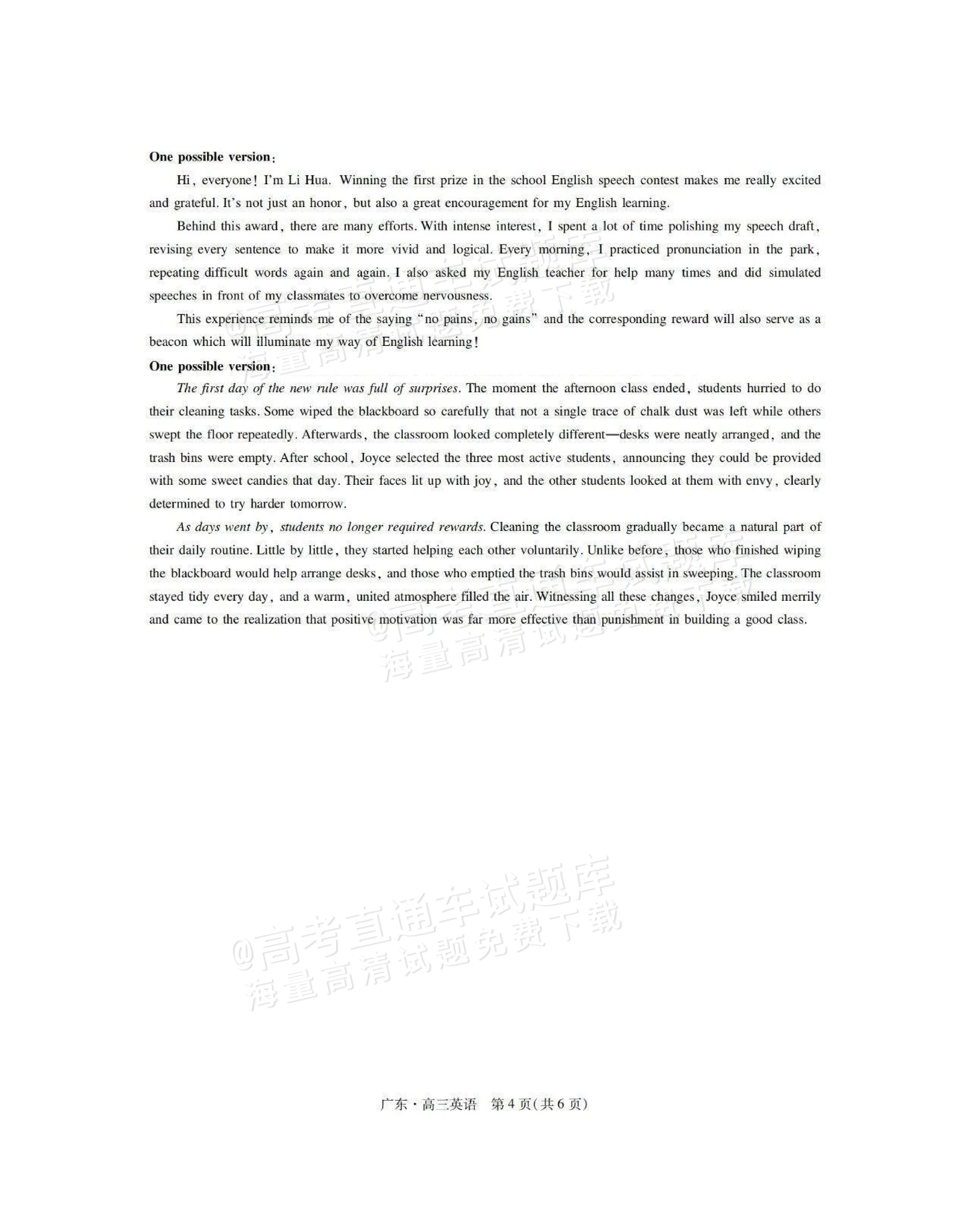
One possible version:
Hi, everyone! I'm Li Hua. Winning the first prize in the school English speech contest makes me really excited and grateful. It's not just an honor, but also a great encouragement for my English learning.
Behind this award, there are many efforts. With intense interest, I spent a lot of time polishing my speech draft, revising every sentence to make it more vivid and logical. Every morning, I practiced pronunciation in the park, repeating difficult words again and again. I also asked my English teacher for help many times and did simulated speeches in front of my classmates to overcome nervousness.
This experience reminds me of the saying "no pains, no gains" and the corresponding reward will also serve as a beacon which will illuminate my way of English learning!
One possible version:
The first day of the new rule was full of surprises. The moment the afternoon class ended, students hurried to do their cleaning tasks. Some wiped the blackboard so carefully that not a single trace of chalk dust was left while others swept the floor repeatedly. Afterwards, the classroom looked completely different-desks were neatly arranged, and the trash bins were empty. After school, Joyce selected the three most active students, announcing they could be provided with some sweet candies that day. Their faces lit up with joy, and the other students looked at them with envy, clearly determined to try harder tomorrow.
As days went by, students no longer required rewards. Cleaning the classroom gradually became a natural part of their daily routine. Little by little, they started helping each other voluntarily. Unlike before, those who finished wiping the blackboard would help arrange desks, and those who emptied the trash bins would assist in sweeping. The classroom stayed tidy every day, and a warm, united atmosphere filled the air. Witnessing all these changes, Joyce smiled merrily and came to the realization that positive motivation was far more effective than punishment in building a good class.
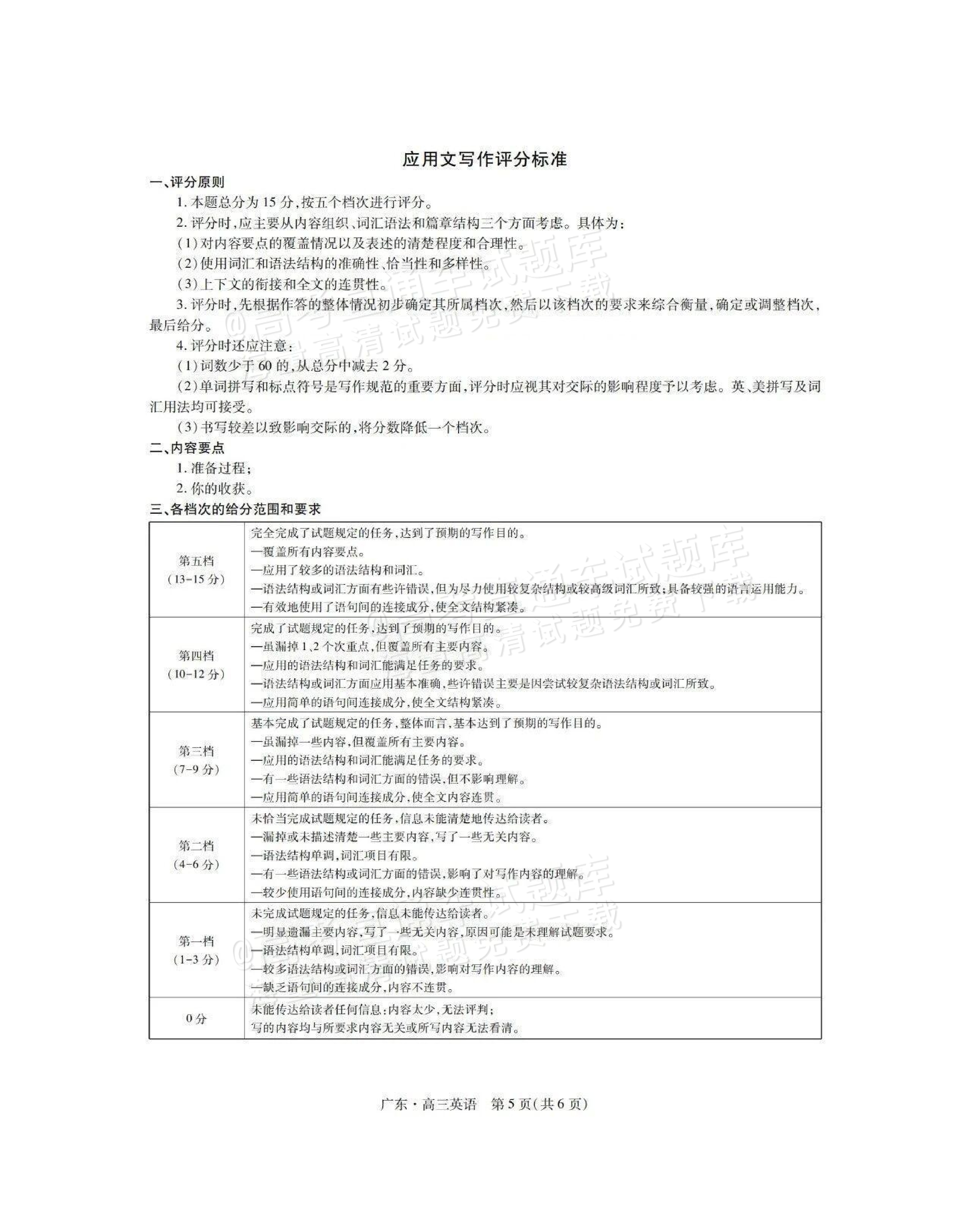
应用文写作评分标准
一、评分原则
1. 本题总分为15分,按五个档次进行评分。
2. 评分时,应主要从内容组织、词汇语法和篇章结构三个方面考虑。具体为:
(1) 对内容要点的覆盖情况以及表述的清楚程度和合理性。
(2) 使用词汇和语法结构的准确性、恰当性和多样性。
(3) 上下文的衔接和全文的连贯性。
3. 评分时,先根据作答的整体情况初步确定其所属档次,然后以该档次的要求来综合衡量,确定或调整档次,最后给分。
4. 评分时还应注意:
(1) 词数少于60的,从总分中减去2分。
(2) 单词拼写和标点符号是写作规范的重要方面,评分时应视其对交际的影响程度予以考虑。英、美拼写及词汇用法均可接受。
(3) 书写较差以致影响交际的,将分数降低一个档次。
二、内容要点
1. 准备过程;
2. 你的收获。
三、各档次的给分范围和要求
第五档(13-15分)完全完成了试题规定的任务,达到了预期的写作目的。
一覆盖所有内容要点。
一应用了较多的语法结构和词汇。
一语法结构或词汇方面有些许错误,但为尽力使用较复杂结构或较高级词汇所致;具备较强的语言运用能力。
一有效地使用了语句间的连接成分,使全文结构紧凑。第四档(10-12分)完成了试题规定的任务,达到了预期的写作目的。
一虽漏掉1.2个次重点,但覆盖所有主要内容。
一应用的语法结构和词汇能满足任务的要求。
一语法结构或词汇方面应用基本准确,些许错误主要是因尝试较复杂语法结构或词汇所致。
一应用简单的语句间连接成分,使全文结构紧凑。第三档(7-9分)基本完成了试题规定的任务,整体而言,基本达到了预期的写作目的。
一虽漏掉一些内容,但覆盖所有主要内容。
一应用的语法结构和词汇能满足任务的要求。
一有一些语法结构和词汇方面的错误,但不影响理解。
一应用简单的语句间连接成分,使全文内容连贯。第二档(4-6分)未恰当完成试题规定的任务,信息未能清楚地传达给读者。
一漏掉或未描述清楚一些主要内容,写了一些无关内容。
一语法结构单调,词汇项目有限。
一有一些语法结构或词汇方面的错误,影响了对写作内容的理解。
一较少使用语句间的连接成分,内容缺少连贯性。第一档(1-3分)未完成试题规定的任务,信息未能传达给读者。
一明显遗漏主要内容,写了一些无关内容,原因可能是未理解试题要求。
一语法结构单调,词汇项目有限。
一较多语法结构或词汇方面的错误,影响对写作内容的理解。
一缺乏语句间的连接成分,内容不连贯。0分未能传达给读者任何信息:内容太少,无法评判;
写的内容均与所要求内容无关或所写内容无法看清。
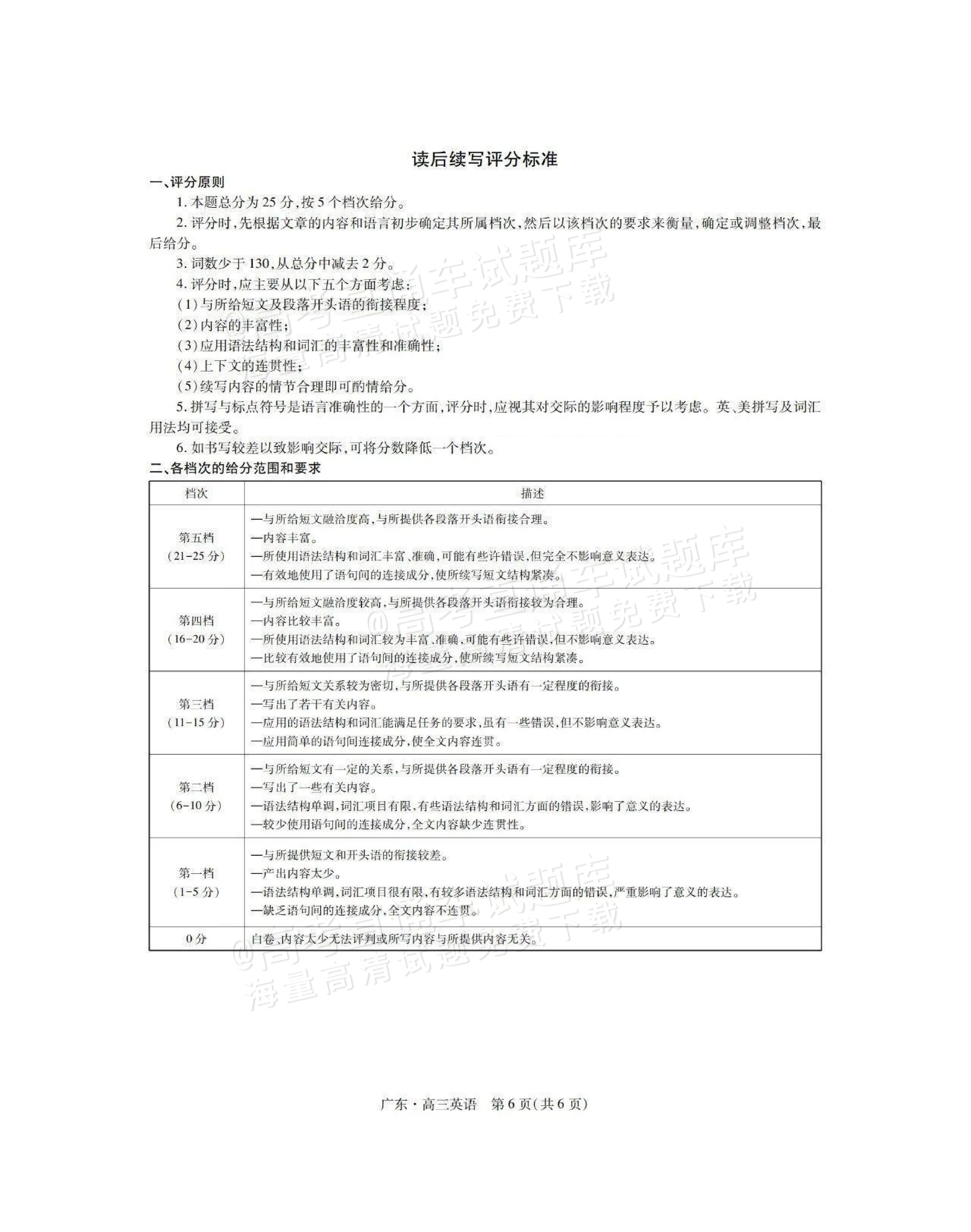
读后续写评分标准
一、评分原则
1. 本题总分为25分,按5个档次给分。
2. 评分时,先根据文章的内容和语言初步确定其所属档次,然后以该档次的要求来衡量,确定或调整档次,最后给分。
3. 词数少于130,从总分中减去2分。
4. 评分时,应主要从以下五个方面考虑:
(1) 与所给短文及段落开头语的衔接程度;
(2) 内容的丰富性;
(3) 应用语法结构和词汇的丰富性和准确性;
(4) 上下文的连贯性;
(5) 续写内容的情节合理即可酌情给分。
5. 拼写与标点符号是语言准确性的一个方面,评分时,应视其对交际的影响程度予以考虑。英、美拼写及词汇用法均可接受。
6. 如书写较差以致影响交际,可将分数降低一个档次。
二、各档次的给分范围和要求
档次描述第五档(21-25分)一与所给短文融洽度高,与所提供各段落开头语衔接合理。
一内容丰富。
一所使用语法结构和词汇丰富、准确,可能有些许错误,但完全不影响意义表达。
一有效地使用了语句间的连接成分,使所续写短文结构紧凑。第四档(16-20分)一与所给短文融洽度较高,与所提供各段落开头语衔接较为合理。
一内容比较丰富。
一所使用语法结构和词汇较为丰富、准确,可能有些许错误,但不影响意义表达。
一比较有效地使用了语句间的连接成分,使所续写短文结构紧凑。第三档(11-15分)一与所给短文关系较为密切,与所提供各段落开头语有一定程度的衔接。
一写出了若干有关内容。
一应用的语法结构和词汇能满足任务的要求,虽有一些错误,但不影响意义表达。
一应用简单的语句间连接成分,使全文内容连贯。第二档(6-10分)一与所给短文有一定的关系,与所提供各段落开头语有一定程度的衔接。
一写出了一些有关内容。
一语法结构单调,词汇项目有限,有些语法结构和词汇方面的错误,影响了意义的表达。
一较少使用语句间的连接成分,全文内容缺少连贯性。第一档(1-5分)一与所提供短文和开头语的衔接较差。
一产出内容太少。
一语法结构单调,词汇项目很有限,有较多语法结构和词汇方面的错误,严重影响了意义的表达。
一缺乏语句间的连接成分,全文内容不连贯。0分白卷、内容太少无法评判或所写内容与所提供内容无关。
快来评价一下难度吧~

 简单 0

 一般 0

 困难 0
你的预估分数是多少?拖动后可查看大家的估分统计哦~
估分统计
人数