2026广东省普通高中学业水平1月考试标准预测(四)英语试题及参考答案
资源简介
2026广东省普通高中学业水平1月考试标准预测(四)英语试题及参考答案(PDF版下载)广东省普通高中学业水平考试标准预测试卷
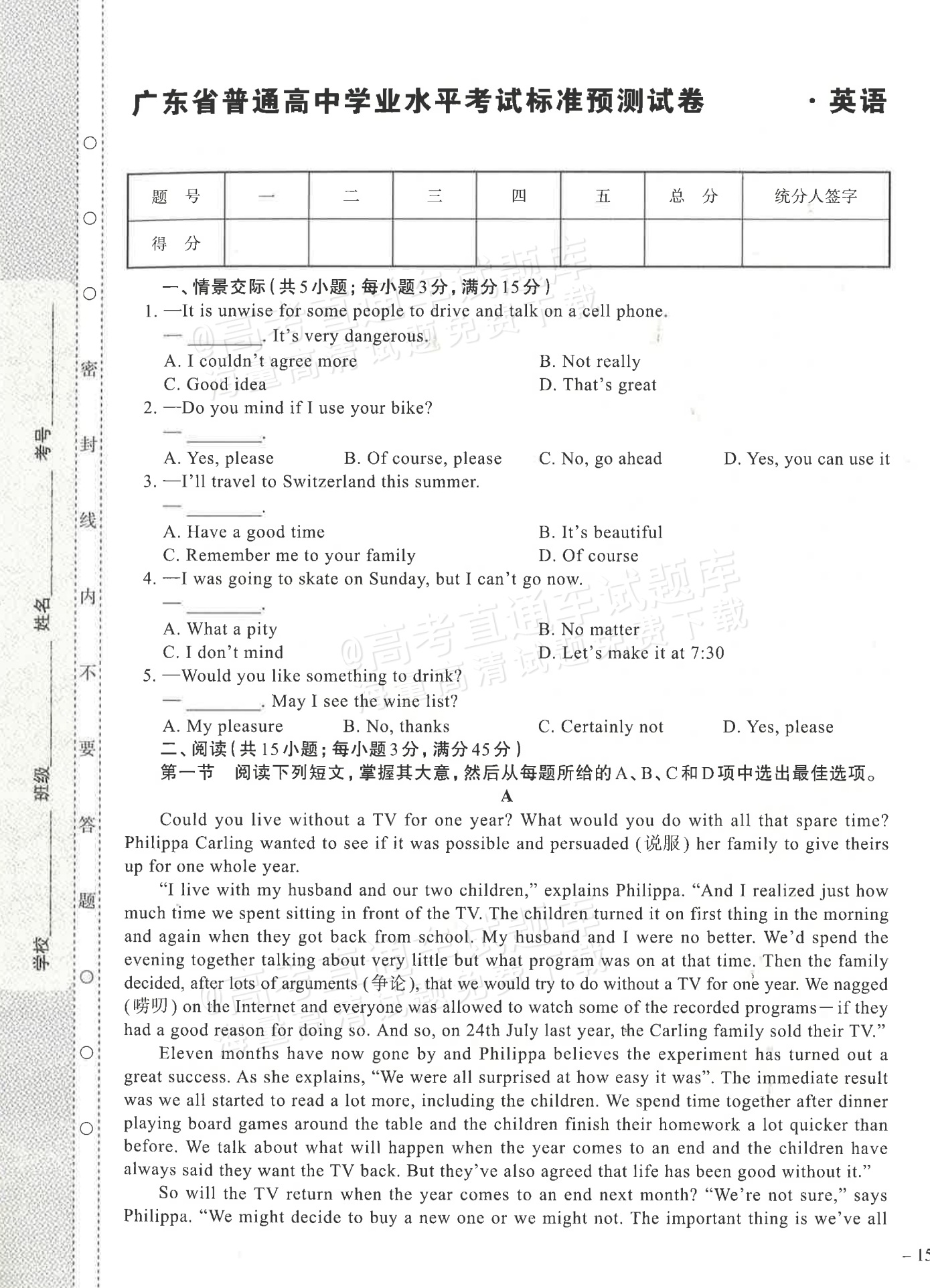
题号一二三四五总分统分人签字得分
一、情景交际(共5小题;每小题3分,满分15分)
1. —It is unwise for some people to drive and talk on a cell phone.
—_. It's very dangerous.
A. I couldn't agree more B. Not really
C. Good idea D. That's great
2. —Do you mind if I use your bike?
一_.
A. Yes, please B. Of course, please C. No, go ahead D. Yes, you can use it
3. —I'll travel to Switzerland this summer.
—_.
A. Have a good time B. It's beautiful
C. Remember me to your family D. Of course
4. —I was going to skate on Sunday, but I can't go now.
—_.
A. What a pity B. No matter
C. I don't mind D. Let's make it at 7:30
5. —Would you like something to drink?
—___. May I see the wine list?
A. My pleasure B. No, thanks C. Certainly not D. Yes, please
二、阅读(共15小题;每小题3分,满分45分)
第一节 阅读下列短文,掌握其大意,然后从每题所给的A、B、C和D项中选出最佳选项。
A
Could you live without a TV for one year? What would you do with all that spare time? Philippa Carling wanted to see if it was possible and persuaded (说服) her family to give theirs up for one whole year.
"I live with my husband and our two children," explains Philippa. "And I realized just how much time we spent sitting in front of the TV. The children turned it on first thing in the morning and again when they got back from school. My husband and I were no better. We'd spend the evening together talking about very little but what program was on at that time. Then the family decided, after lots of arguments (争论), that we would try to do without a TV for one year. We nagged (唠叨) on the Internet and everyone was allowed to watch some of the recorded programs—if they had a good reason for doing so. And so, on 24th July last year, the Carling family sold their TV."
Eleven months have now gone by and Philippa believes the experiment has turned out a great success. As she explains, "We were all surprised at how easy it was". The immediate result was we all started to read a lot more, including the children. We spend time together after dinner playing board games around the table and the children finish their homework a lot quicker than before. We talk about what will happen when the year comes to an end and the children have always said they want the TV back. But they've also agreed that life has been good without it."
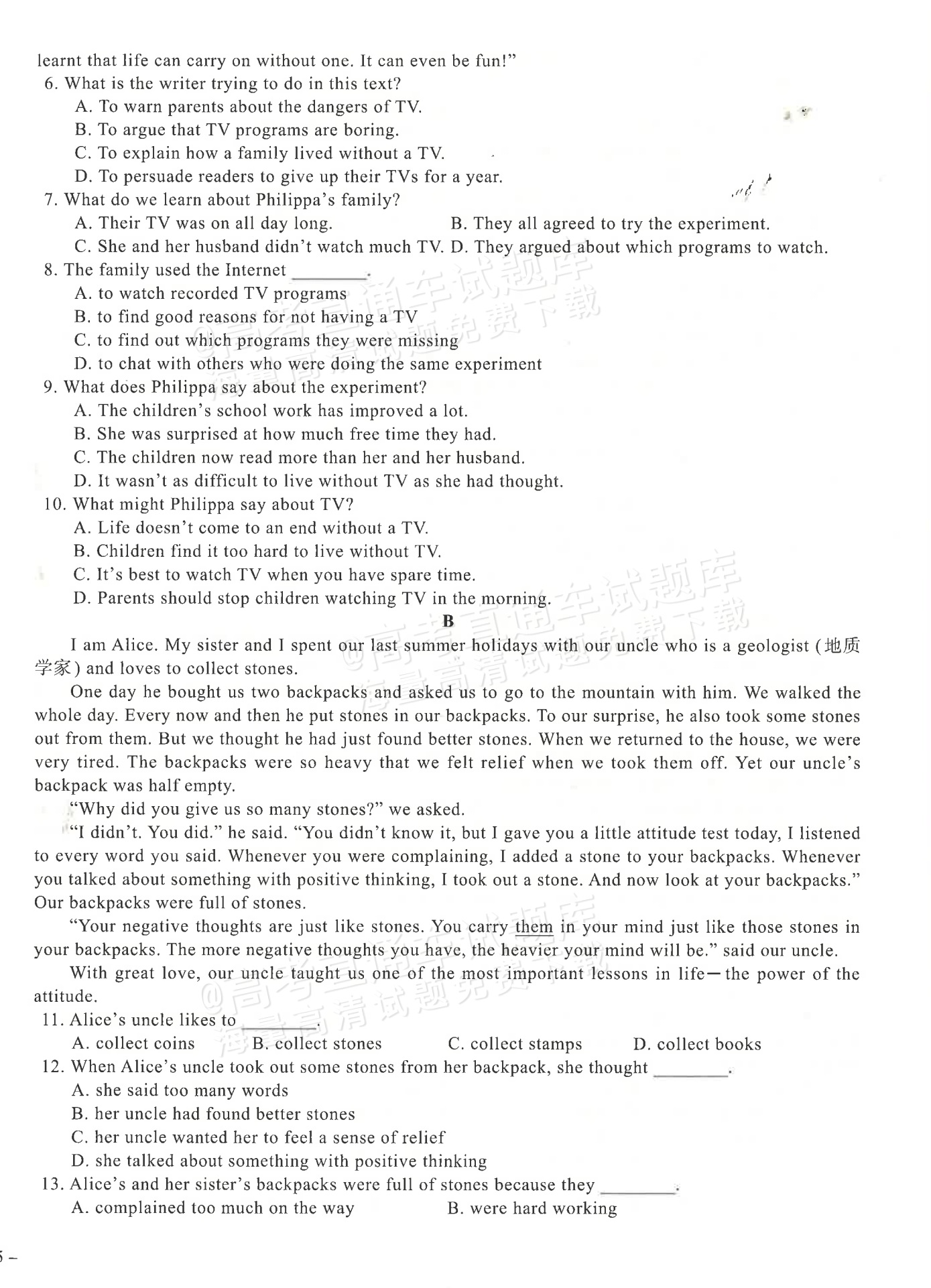
So will the TV return when the year comes to an end next month? "We're not sure," says Philippa. "We might decide to buy a new one or we might not. The important thing is we've all
learnt that life can carry on without one. It can even be fun!"
6. What is the writer trying to do in this text?
A. To warn parents about the dangers of TV.
B. To argue that TV programs are boring.
C. To explain how a family lived without a TV.
D. To persuade readers to give up their TVs for a year.
7. What do we learn about Philippa's family?
A. Their TV was on all day long. B. They all agreed to try the experiment.
C. She and her husband didn't watch much TV. D. They argued about which programs to watch.
8. The family used the Internet _.
A. to watch recorded TV programs
B. to find good reasons for not having a TV
C. to find out which programs they were missing
D. to chat with others who were doing the same experiment
9. What does Philippa say about the experiment?
A. The children's school work has improved a lot.
B. She was surprised at how much free time they had.
C. The children now read more than her and her husband.
D. It wasn't as difficult to live without TV as she had thought.
10. What might Philippa say about TV?
A. Life doesn't come to an end without a TV.
B. Children find it too hard to live without TV.
C. It's best to watch TV when you have spare time.
D. Parents should stop children watching TV in the morning.
B
I am Alice. My sister and I spent our last summer holidays with our uncle who is a geologist (地质学家) and loves to collect stones.
One day he bought us two backpacks and asked us to go to the mountain with him. We walked the whole day. Every now and then he put stones in our backpacks. To our surprise, he also took some stones out from them. But we thought he had just found better stones. When we returned to the house, we were very tired. The backpacks were so heavy that we felt relief when we took them off. Yet our uncle's backpack was half empty.
"Why did you give us so many stones?" we asked.
"I didn't. You did." he said. "You didn't know it, but I gave you a little attitude test today, I listened to every word you said. Whenever you were complaining, I added a stone to your backpacks. Whenever you talked about something with positive thinking, I took out a stone. And now look at your backpacks." Our backpacks were full of stones.
"Your negative thoughts are just like stones. You carry them in your mind just like those stones in your backpacks. The more negative thoughts you have, the heavier your mind will be." said our uncle.
With great love, our uncle taught us one of the most important lessons in life-the power of the attitude.
11. Alice's uncle likes to _.
A. collect coins B. collect stones C. collect stamps D. collect books
12. When Alice's uncle took out some stones from her backpack, she thought _.
A. she said too many words
B. her uncle had found better stones
C. her uncle wanted her to feel a sense of relief
D. she talked about something with positive thinking
13. Alice's and her sister's backpacks were full of stones because they _.
A. complained too much on the way B. were hard working
C. enjoyed collecting stones very much D. chose wrong backpacks to carry the stones
14. The underlined word "them" refers to "_" in the passage.
A. the stones B. the backpacks
C. the positive thoughts D. the negative thoughts
15. The writer wrote this passage to encourage us to _.
A. be pleased to take others' advice B. have a positive attitude towards life
C. make a plan before doing something D. help people in trouble
第二节 阅读下列短文,从短文后的选项中选出可以填入空白处的最佳选项。
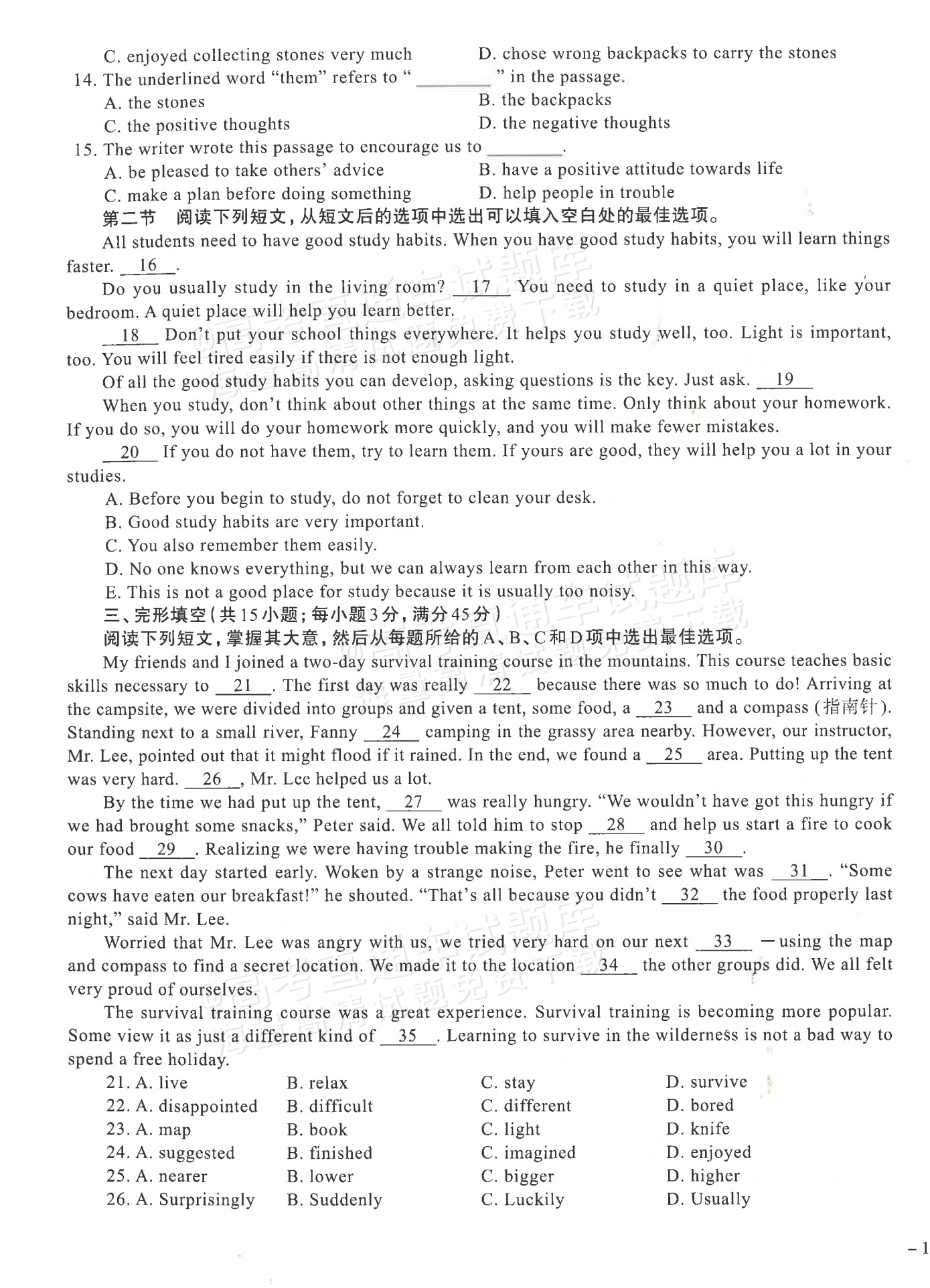
All students need to have good study habits. When you have good study habits, you will learn things faster. 16.
Do you usually study in the living room? 17 You need to study in a quiet place, like your bedroom. A quiet place will help you learn better.
18 Don't put your school things everywhere. It helps you study well, too. Light is important, too. You will feel tired easily if there is not enough light.
Of all the good study habits you can develop, asking questions is the key. Just ask. 19
When you study, don't think about other things at the same time. Only think about your homework. If you do so, you will do your homework more quickly, and you will make fewer mistakes.
20 If you do not have them, try to learn them. If yours are good, they will help you a lot in your studies.
A. Before you begin to study, do not forget to clean your desk.
B. Good study habits are very important.
C. You also remember them easily.
D. No one knows everything, but we can always learn from each other in this way.
E. This is not a good place for study because it is usually too noisy.
三、完形填空(共15小题;每小题3分,满分45分)
阅读下列短文,掌握其大意,然后从每题所给的A、B、C和D项中选出最佳选项。
My friends and I joined a two-day survival training course in the mountains. This course teaches basic skills necessary to 21. The first day was really 22 because there was so much to do! Arriving at the campsite, we were divided into groups and given a tent, some food, a 23 and a compass (指南针). Standing next to a small river, Fanny 24 camping in the grassy area nearby. However, our instructor, Mr. Lee, pointed out that it might flood if it rained. In the end, we found a 25 area. Putting up the tent was very hard. 26, Mr. Lee helped us a lot.
By the time we had put up the tent, 27 was really hungry. "We wouldn't have got this hungry if we had brought some snacks," Peter said. We all told him to stop 28 and help us start a fire to cook our food 29. Realizing we were having trouble making the fire, he finally 30.
The next day started early. Woken by a strange noise, Peter went to see what was 31. "Some cows have eaten our breakfast!" he shouted. "That's all because you didn't 32 the food properly last night," said Mr. Lee.
Worried that Mr. Lee was angry with us, we tried very hard on our next 33 - using the map and compass to find a secret location. We made it to the location 34 the other groups did. We all felt very proud of ourselves.
The survival training course was a great experience. Survival training is becoming more popular. Some view it as just a different kind of 35. Learning to survive in the wilderness is not a bad way to spend a free holiday.
21. A. live B. relax C. stay D. survive
22. A. disappointed B. difficult C. different D. bored
23. A. map B. book C. light D. knife
24. A. suggested B. finished C. imagined D. enjoyed
25. A. nearer B. lower C. bigger D. higher
26. A. Surprisingly B. Suddenly C. Luckily D. Usually
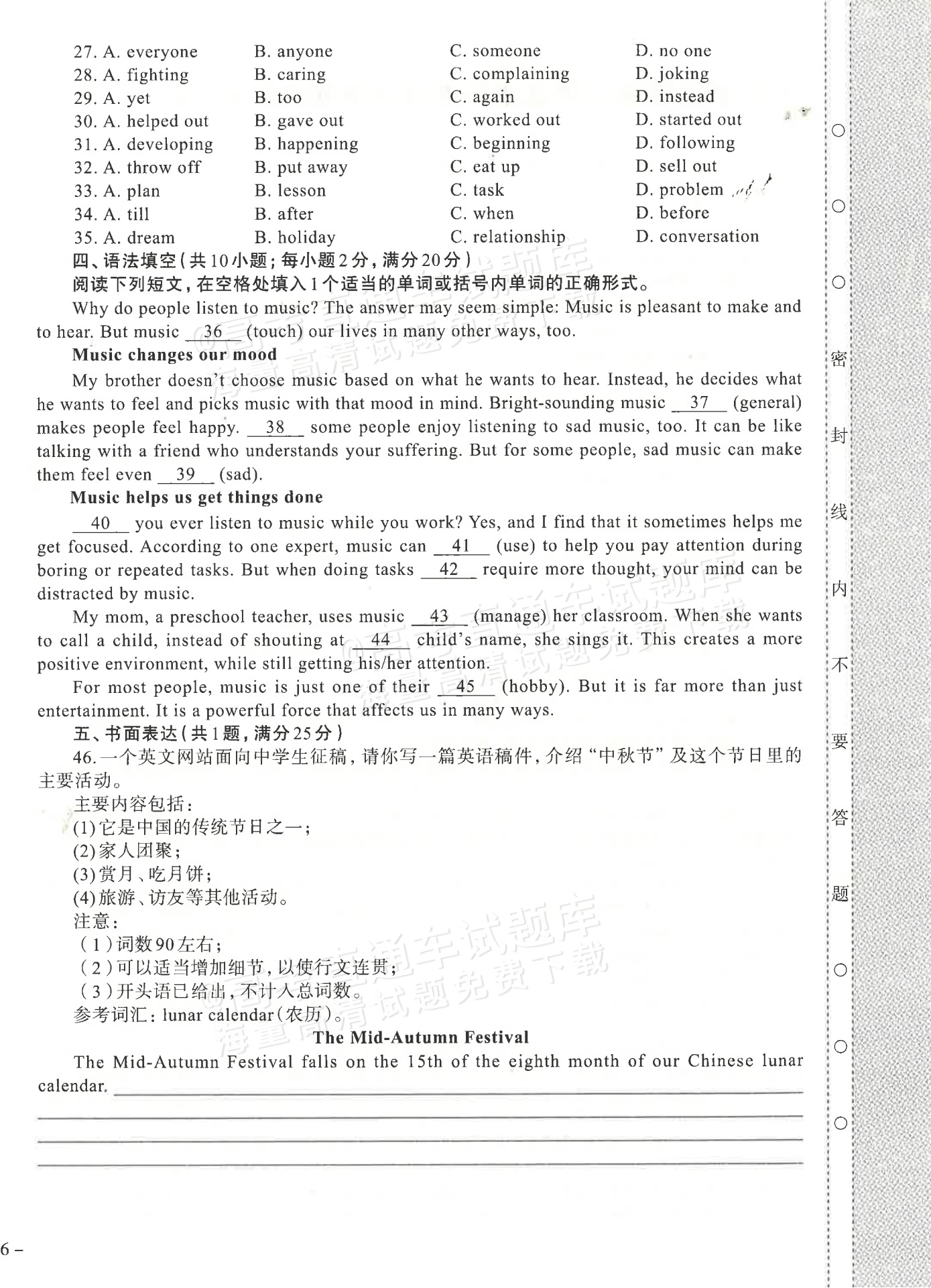
27. A. everyone B. anyone C. someone D. no one
28. A. fighting B. caring C. complaining D. joking
29. A. yet B. too C. again D. instead
30. A. helped out B. gave out C. worked out D. started out
31. A. developing B. happening C. beginning D. following
32. A. throw off B. put away C. eat up D. sell out
33. A. plan B. lesson C. task D. problem
34. A. till B. after C. when D. before
35. A. dream B. holiday C. relationship D. conversation
四、语法填空(共10小题;每小题2分,满分20分)
阅读下列短文,在空格处填入1个适当的单词或括号内单词的正确形式。
Why do people listen to music? The answer may seem simple: Music is pleasant to make and to hear. But music 36 (touch) our lives in many other ways, too.
Music changes our mood
My brother doesn't choose music based on what he wants to hear. Instead, he decides what he wants to feel and picks music with that mood in mind. Bright-sounding music 37 (general) makes people feel happy. 38 some people enjoy listening to sad music, too. It can be like talking with a friend who understands your suffering. But for some people, sad music can make them feel even 39 (sad).
Music helps us get things done
40 you ever listen to music while you work? Yes, and I find that it sometimes helps me get focused. According to one expert, music can 41 (use) to help you pay attention during boring or repeated tasks. But when doing tasks 42 require more thought, your mind can be distracted by music.
My mom, a preschool teacher, uses music 43 (manage) her classroom. When she wants to call a child, instead of shouting at 44 child's name, she sings it. This creates a more positive environment, while still getting his/her attention.
For most people, music is just one of their 45 (hobby). But it is far more than just entertainment. It is a powerful force that affects us in many ways.
五、书面表达(共1题,满分25分)
46. 一个英文网站面向中学生征稿,请你写一篇英语稿件,介绍“中秋节”及这个节日里的主要活动。
主要内容包括:
(1) 它是中国的传统节日之一;
(2) 家人团聚;
(3) 赏月、吃月饼;
(4) 旅游、访友等其他活动。
注意:
(1) 词数90左右;
(2) 可以适当增加细节,以使行文连贯;
(3) 开头语已给出,不计入总词数。
参考词汇:lunar calendar(农历)。
The Mid-Autumn Festival
The Mid-Autumn Festival falls on the 15th of the eighth month of our Chinese lunar calendar. ___
广东省普通高中学业水平考试标准预测试卷
英语
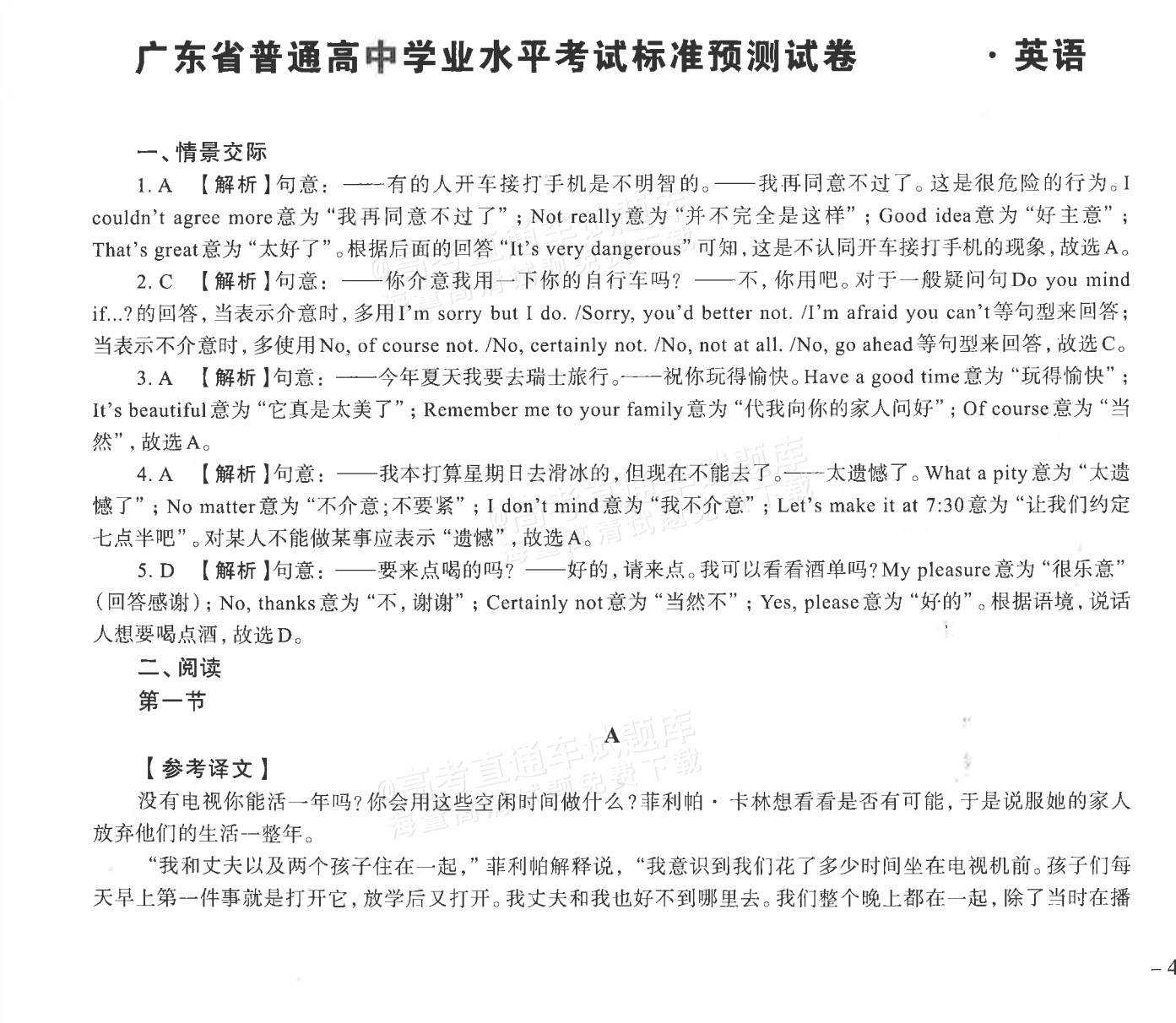
一、情景交际
1. A 【解析】句意:——有的人开车接打手机是不明智的。——我再同意不过了。这是很危险的行为。我 couldn't agree more意为“我再同意不过了”;Not really意为“并不完全是这样”;Good idea意为“好主意”;That's great意为“太好了”。根据后面的回答“It's very dangerous”可知,这是不认同开车接打手机的现象,故选A。
2. C 【解析】句意:——你介意我用一下你的自行车吗?——不,你用吧。对于一般疑问句Do you mind if...?的回答,当表示介意时,多用I'm sorry but I do. /Sorry, you'd better not. /I'm afraid you can't等句型来回答;当表示不介意时,多使用No, of course not. /No, certainly not. /No, not at all. /No, go ahead等句型来回答,故选C。
3. A 【解析】句意:——今年夏天我要去瑞士旅行。——祝你玩得愉快。Have a good time意为“玩得愉快”; It's beautiful意为“它真是太美了”; Remember me to your family意为“代我向你的家人问好”; Of course意为“当然”,故选A。
4. A 【解析】句意:——我本打算星期日去滑冰的,但现在不能去了。——太遗憾了。What a pity意为“太遗憾了”;No matter意为“不介意;不要紧”;I don't mind意为“我不介意”;Let's make it at 7:30意为“让我们约定七点半吧”。对某人不能做某事应表示“遗憾”,故选A。
5. D 【解析】句意:——要来点喝的吗?——好的,请来点。我可以看看酒单吗?My pleasure意为“很乐意”(回答感谢);No, thanks意为“不,谢谢”;Certainly not意为“当然不”;Yes, please意为“好的”。根据语境,说话人想要喝点酒,故选D。
二、阅读
第一节
A
【参考译文】
没有电视你能活一年吗?你会用这些空闲时间做什么?菲利帕·卡林想看看是否有可能,于是说服她的家人放弃他们的生活一整年。
“我和丈夫以及两个孩子住在一起,”菲利帕解释说,“我意识到我们花了多少时间坐在电视机前。孩子们每天早上第一件事就是打开它,放学后又打开。我丈夫和我也好不到哪里去。我们整个晚上都在一起,除了当时在播
什么节目,几乎什么都不谈。后来,经过多次争论,我们全家决定,我们要试着过一年没有电视的日子。我们在互联网上唠叨,每个人都被允许观看一些录制的节目——如果他们有充分的理由这样做的话。因此,去年7月24日,卡林一家卖掉了他们的电视机。”
11个月过去了,菲利帕相信这个实验取得了巨大的成功。正如她解释的那样,“我们都惊讶于这是多么容易”。直接的结果是我们都开始读更多的书,包括孩子们。晚饭后我们聚在一起围着桌子玩棋盘游戏,孩子们完成作业比以前快了很多。我们谈论年底会发生什么,孩子们总是说他们想要回电视。但他们也一致认为,没有它,生活也很好。
那么下个月年底的时候,电视还会回归吗?“我们不确定,”菲利帕说,“我们可能决定买一个新的,也可能不买。重要的是,我们都知道,没有电视,生活照样可以继续。它甚至可以很有趣!”
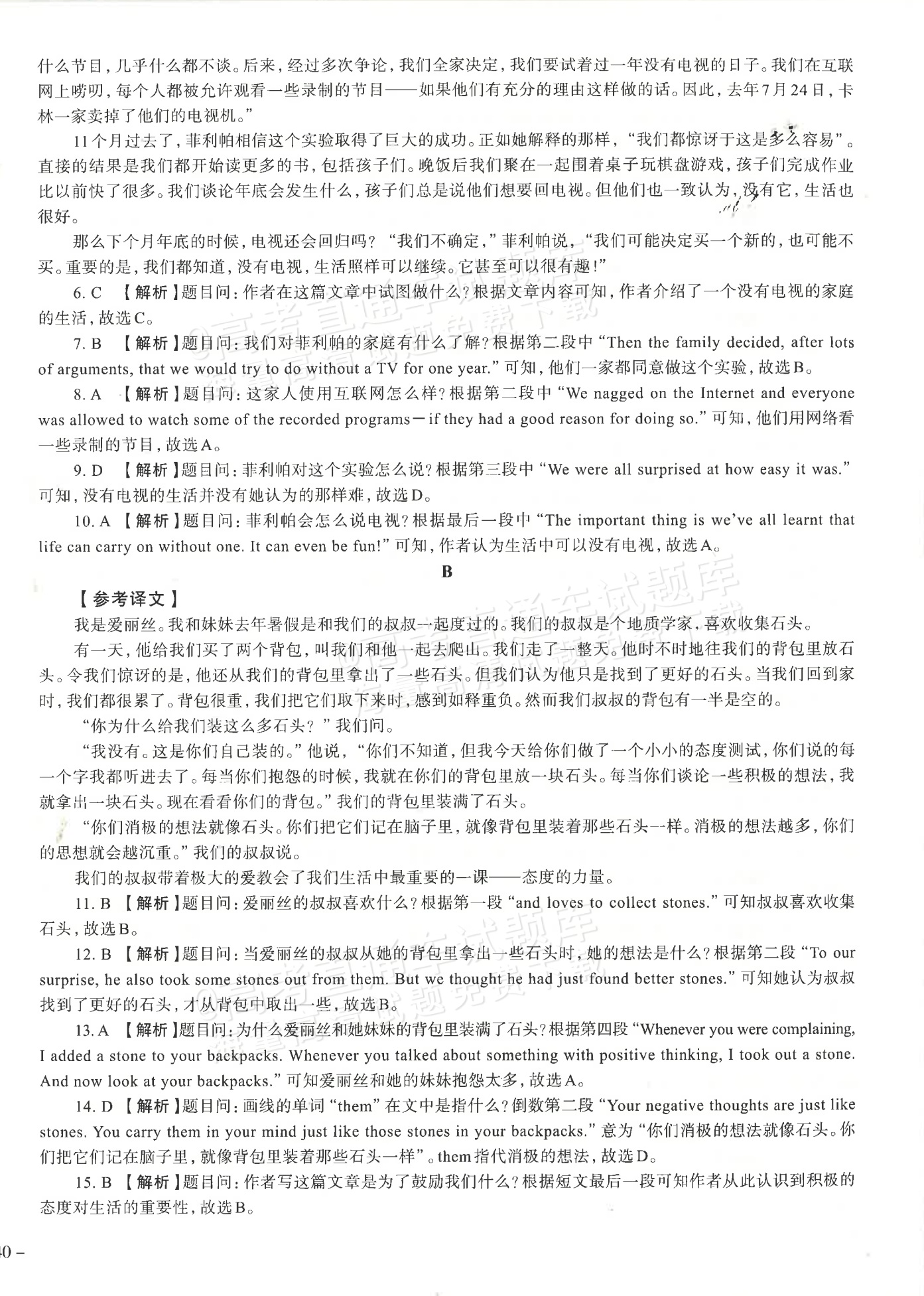
6. C 【解析】题目问:作者在这篇文章中试图做什么?根据文章内容可知,作者介绍了一个没有电视的家庭的生活,故选C。
7. B 【解析】题目问:我们对菲利帕的家庭有什么了解?根据第二段中“Then the family decided, after lots of arguments, that we would try to do without a TV for one year.”可知,他们一家都同意做这个实验,故选B。
8. A. 【解析】题目问:这家人使用互联网怎么样?根据第二段中“We nagged on the Internet and everyone was allowed to watch some of the recorded programs—if they had a good reason for doing so.”可知,他们用网络看一些录制的节目,故选A。
9. D 【解析】题目问:菲利帕对这个实验怎么说?根据第三段中“We were all surprised at how easy it was.”可知,没有电视的生活并没有她认为的那样难,故选D。
10. A【解析】题目问:菲利帕会怎么说电视?根据最后一段中“The important thing is we've all learnt that life can carry on without one. It can even be fun!”可知,作者认为生活中可以没有电视,故选A。
B
【参考译文】
我是爱丽丝。我和妹妹去年暑假是和我们的叔叔一起度过的。我们的叔叔是个地质学家,喜欢收集石头。
有一天,他给我们买了两个背包,叫我们和他一起去爬山。我们走了一整天。他时不时地往我们的背包里放石头。令我们惊讶的是,他还从我们的背包里拿出了一些石头。但我们认为他只是找到了更好的石头。当我们回到家时,我们都很累了。背包很重,我们把它们取下来时,感到如释重负。然而我们叔叔的背包有一半是空的。
“你为什么给我们装这么多石头?”我们问。
“我没有。这是你们自己装的。”他说,“你们不知道,但我今天给你们做了一个小小的态度测试,你们说的每一个字我都听进去了。每当你们抱怨的时候,我就在你们的背包里放一块石头。每当你们谈论一些积极的想法,我就拿出一块石头。现在看看你们的背包。”我们的背包里装满了石头。
“你们消极的想法就像石头。你们把它们记在脑子里,就像背包里装着那些石头一样。消极的想法越多,你们的思想就会越沉重。”我们的叔叔说。
我们的叔叔带着极大的爱教会了我们生活中最重要的一课——态度的力量。
11. B 【解析】题目问:爱丽丝的叔叔喜欢什么?根据第一段“and loves to collect stones.”可知叔叔喜欢收集石头,故选B。
12. B【解析】题目问:当爱丽丝的叔叔从她的背包里拿出一些石头时,她的想法是什么?根据第二段“To our surprise, he also took some stones out from them. But we thought he had just found better stones.”可知她认为叔叔找到了更好的石头,才从背包中取出一些,故选B。
13. A 【解析】题目问:为什么爱丽丝和她妹妹的背包里装满了石头?根据第四段“Whenever you were complaining, I added a stone to your backpacks. Whenever you talked about something with positive thinking, I took out a stone. And now look at your backpacks.”可知爱丽丝和她的妹妹抱怨太多,故选A。
14. D【解析】题目问:画线的单词“them”在文中是指什么?倒数第二段“Your negative thoughts are just like stones. You carry them in your mind just like those stones in your backpacks.”意为“你们消极的想法就像石头。你们把它们记在脑子里,就像背包里装着那些石头一样”。them指代消极的想法,故选D。
15. B【解析】题目问:作者写这篇文章是为了鼓励我们什么?根据短文最后一段可知作者从此认识到积极的态度对生活的重要性,故选B。
第二节
【参考译文】
所有的学生都需要有良好的学习习惯。当你有良好的学习习惯时,你会学得更快。你也很容易记住它们。
你通常在客厅学习吗?这不是一个学习的好地方,因为它通常太吵了。你需要在一个安静的地方学习,比如你的卧室。一个安静的地方会帮助你更好地学习。
在你开始学习之前,不要忘记打扫你的桌子。不要把你的学习用品到处乱放。这也能帮助你好好学习。光线也很重要。如果没有足够的光线,你会很容易感到疲劳。
在你能养成的所有好的学习习惯中,提问是关键。去问吧。没有人是无所不知的,但我们总是可以通过这种方式相互学习。
当你学习的时候,不要同时想着其他的事情。只考虑你的家庭作业。如果你这样做,你会做作业更快,犯更少的错误。
良好的学习习惯非常重要。如果你没有,试着去学习。如果你的习惯很好,它们会对你的学习有很大的帮助。
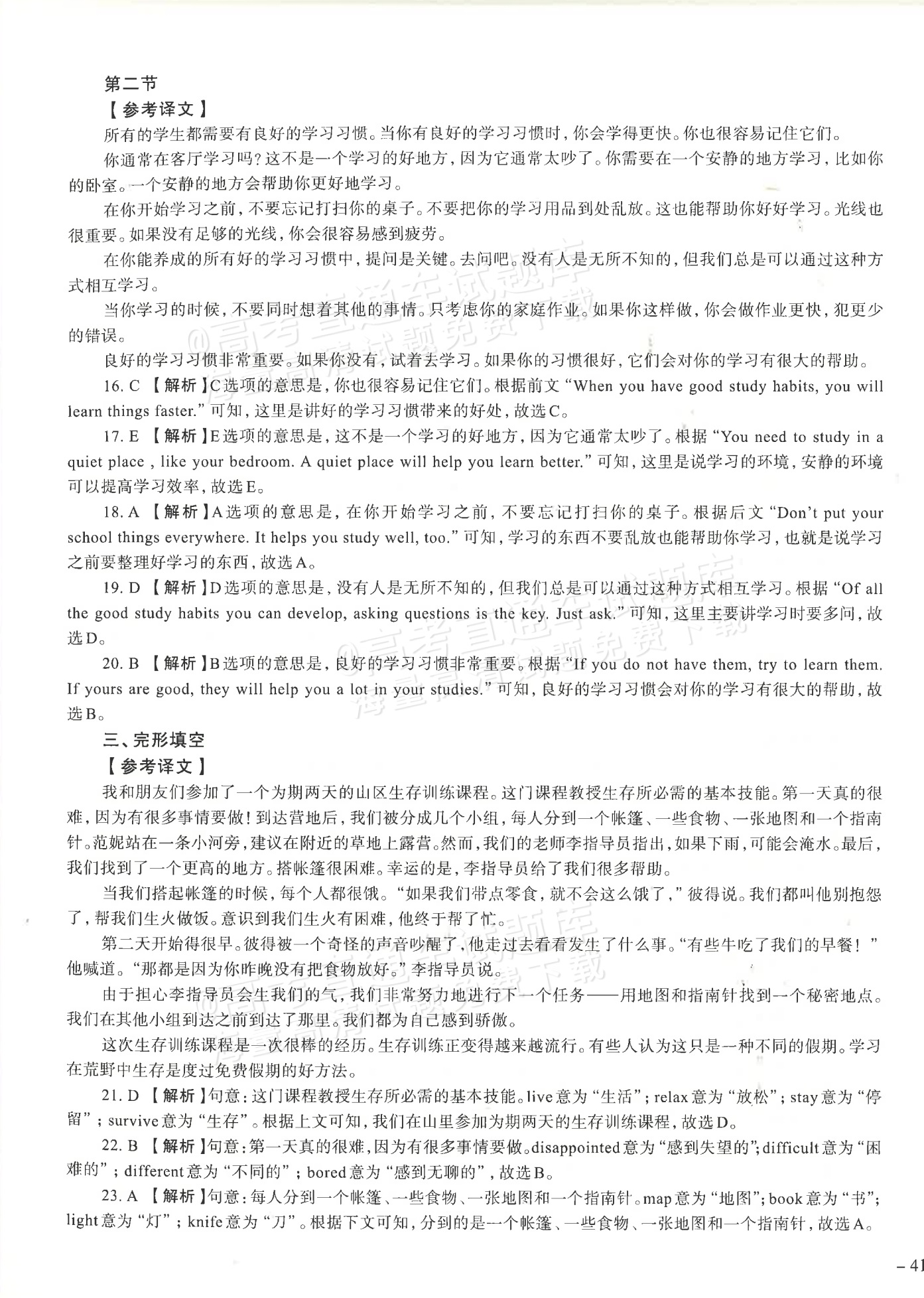
16. C【解析】C选项的意思是,你也很容易记住它们。根据前文“When you have good study habits, you will learn things faster.”可知,这里是讲好的学习习惯带来的好处,故选C。
17. E【解析】E选项的意思是,这不是一个学习的好地方,因为它通常太吵了。根据“You need to study in a quiet place, like your bedroom. A quiet place will help you learn better.”可知,这里是说学习的环境,安静的环境可以提高学习效率,故选E。
18. A【解析】A选项的意思是,在你开始学习之前,不要忘记打扫你的桌子。根据后文“Don't put your school things everywhere. It helps you study well, too.”可知,学习的东西不要乱放也能帮助你学习,也就是说学习之前要整理好学习的东西,故选A。
19. D【解析】D选项的意思是,没有人是无所不知的,但我们总是可以通过这种方式相互学习。根据“Of all the good study habits you can develop, asking questions is the key. Just ask.”可知,这里主要讲学习时要多问,故选D。
20. B【解析】B选项的意思是,良好的学习习惯非常重要。根据“If you do not have them, try to learn them. If yours are good, they will help you a lot in your studies.”可知,良好的学习习惯会对你的学习有很大的帮助,故选B。
三、完形填空
【参考译文】
我和朋友们参加了一个为期两天的山区生存训练课程。这门课程教授生存所必需的基本技能。第一天真的很难,因为有很多事情要做!到达营地后,我们被分成几个小组,每人分到一个帐篷、一些食物、一张地图和一个指南针。范妮站在一条小河旁,建议在附近的草地上露营。然而,我们的老师李指导员指出,如果下雨,可能会淹水。最后,我们找到了一个更高的地方。搭帐篷很困难。幸运的是,李指导员给了我们很多帮助。
当我们搭起帐篷的时候,每个人都很饿。“如果我们带点零食,就不会这么饿了,”彼得说。我们都叫他别抱怨了,帮我们生火做饭。意识到我们生火有困难,他终于帮了忙。
第二天开始得很早。彼得被一个奇怪的声音吵醒了,他走过去看看发生了什么事。“有些牛吃了我们的早餐!”他喊道。“那都是因为你昨晚没有把食物放好。”李指导员说。
由于担心李指导员会生我们的气,我们非常努力地进行下一个任务——用地图和指南针找到一个秘密地点。我们在其他小组到达之前到达了那里。我们都为自己感到骄傲。
这次生存训练课程是一次很棒的经历。生存训练正变得越来越流行。有些人认为这只是一种不同的假期。学习在荒野中生存是度过免费假期的好方法。
21. D【解析】句意:这门课程教授生存所必需的基本技能。live意为“生活”;relax意为“放松”;stay意为“停留”;survive意为“生存”。根据上文可知,我们在山里参加为期两天的生存训练课程,故选D。
22. B【解析】句意:第一天真的很难,因为有很多事情要做。disappointed意为“感到失望的”;difficult意为“困难的”;different意为“不同的”;bored意为“感到无聊的”,故选B。
23. A【解析】句意:每人分到一个帐篷、一些食物、一张地图和一个指南针。map意为“地图”;book意为“书”;light意为“灯”;knife意为“刀”。根据下文可知,分到的是一个帐篷、一些食物、一张地图和一个指南针,故选A。
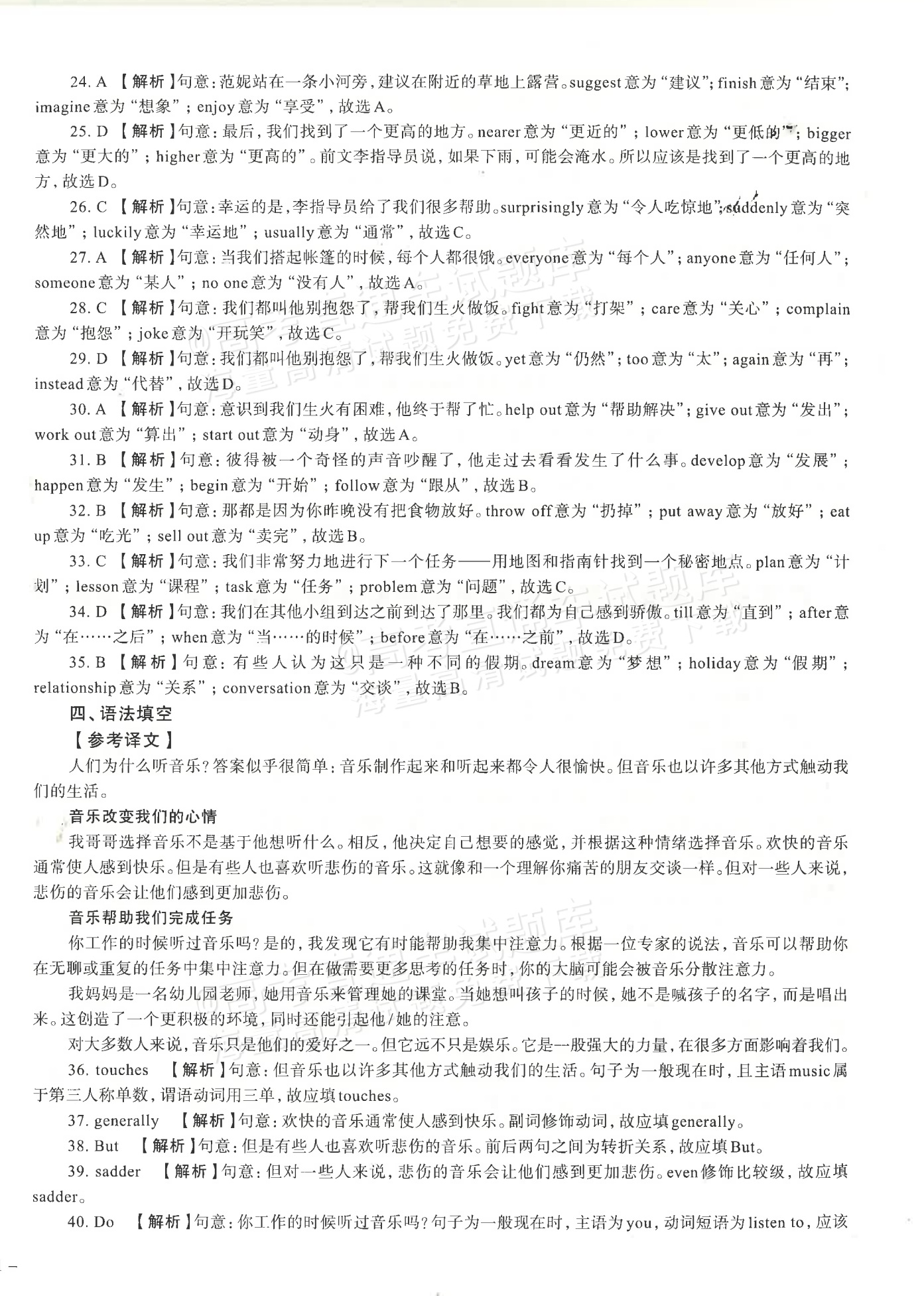
24. A【解析】句意:范妮站在一条小河旁,建议在附近的草地上露营。suggest意为“建议”;finish意为“结束”; imagine意为“想象”;enjoy意为“享受”,故选A。
25. D【解析】句意:最后,我们找到了一个更高的地方。nearer意为“更近的”;lower意为“更低的”;bigger意为“更大的”;higher意为“更高的”。前文李指导员说,如果下雨,可能会淹水。所以应该是找到了一个更高的地方,故选D。
26. C【解析】句意:幸运的是,李指导员给了我们很多帮助。surprisingly意为“令人吃惊地”;suddenly意为“突然地”;luckily意为“幸运地”;usually意为“通常”,故选C。
27. A【解析】句意:当我们搭起帐篷的时候,每个人都很饿。everyone意为“每个人”;anyone意为“任何人”;someone意为“某人”;no one意为“没有人”,故选A。
28. C【解析】句意:我们都叫他别抱怨了,帮我们生火做饭。fight意为“打架”;care意为“关心”;complain意为“抱怨”;joke意为“开玩笑”,故选C。
29. D【解析】句意:我们都叫他别抱怨了,帮我们生火做饭.yet意为“仍然”;too意为“太”;again意为“再”; instead意为“代替”,故选D。
30. A 【解析】句意:意识到我们生火有困难,他终于帮了忙。help out意为“帮助解决”;give out意为“发出”; work out意为“算出”;start out意为“动身”,故选A。
31. B【解析】句意:彼得被一个奇怪的声音吵醒了,他走过去看看发生了什么事。develop意为“发展”; happen意为“发生”;begin意为“开始”;follow意为“跟从”,故选B。
32. B【解析】句意:那都是因为你昨晚没有把食物放好。throw off意为“扔掉”;put away意为“放好”;eat up意为“吃光”;sell out意为“卖完”,故选B。
33. C【解析】句意:我们非常努力地进行下一个任务——用地图和指南针找到一个秘密地点。plan意为“计划”;lesson意为“课程”;task意为“任务”;problem意为“问题”,故选C。
34. D【解析】句意:我们在其他小组到达之前到达了那里。我们都为自己感到骄傲。till意为“直到”;after意为“在……之后”;when意为“当……的时候”;before意为“在……之前”,故选D。
35. B【解析】句意:有些人认为这只是一种不同的假期。dream意为“梦想”;holiday意为“假期”;relationship意为“关系”;conversation意为“交谈”,故选B。
四、语法填空
【参考译文】
人们为什么听音乐?答案似乎很简单:音乐制作起来和听起来都令人很愉快。但音乐也以许多其他方式触动我们的生活。
音乐改变我们的心情
我哥哥选择音乐不是基于他想听什么。相反,他决定自己想要的感觉,并根据这种情绪选择音乐。欢快的音乐通常使人感到快乐。但是有些人也喜欢听悲伤的音乐。这就像和一个理解你痛苦的朋友交谈一样。但对一些人来说,悲伤的音乐会让他们感到更加悲伤。
音乐帮助我们完成任务
你工作的时候听过音乐吗?是的,我发现它有时能帮助我集中注意力。根据一位专家的说法,音乐可以帮助你在无聊或重复的任务中集中注意力。但在做需要更多思考的任务时,你的大脑可能会被音乐分散注意力。
我妈妈是一名幼儿园老师,她用音乐来管理她的课堂。当她想叫孩子的时候,她不是喊孩子的名字,而是唱出来。这创造了一个更积极的环境,同时还能引起他/她的注意。
对大多数人来说,音乐只是他们的爱好之一。但它远不只是娱乐。它是一股强大的力量,在很多方面影响着我们。
36. touches 【解析】句意:但音乐也以许多其他方式触动我们的生活。句子为一般现在时,且主语music属于第三人称单数,谓语动词用三单,故应填touches。
37. generally 【解析】句意:欢快的音乐通常使人感到快乐。副词修饰动词,故应填generally。
38. But 【解析】句意:但是有些人也喜欢听悲伤的音乐。前后两句之间为转折关系,故应填But。
39. sadder 【解析】句意:但对一些人来说,悲伤的音乐会让他们感到更加悲伤。even修饰比较级,故应填sadder。
40. Do 【解析】句意:你工作的时候听过音乐吗?句子为一般现在时,主语为you,动词短语为listen to,应该
用助动词do来构成一般疑问句,故应填Do。
41. be used 【解析】句意:音乐可以帮助你在无聊或重复的任务中集中注意力。music和use之间是被动关系,用被动语态,故应填be used。
42. which 【解析】句意:但在做需要更多思考的任务时,你的大脑可能会被音乐分散注意力。本句为定语从句,先行词tasks在require more thought中作主语,所以用关系代词which引导定语从句,故应填which。
43. to manage 【解析】句意:我妈妈是一名幼儿园老师,她用音乐来管理她的课堂。用动词不定式作为 music的宾语补足语,故应填to manage。
44. the 【解析】句意:当她想叫孩子的时候,她不是喊孩子的名字,而是唱出来。这里指的是上文提到的孩子,用定冠词表特指,故应填the。
45. hobbies 【解析】句意:对大多数人来说,音乐只是他们的爱好之一。hobby是可数名词,此处用复数形式,故应填hobbies。
五、书面表达
The Mid-Autumn Festival
The Mid-Autumn Festival falls on the 15th of the eighth month of our Chinese lunar calendar. It is one of the traditional festivals in China. It used to be as important as Spring Festival. This festival is to celebrate the harvest and to enjoy the beautiful moon light. On this day, people usually get together with their families and have a nice meal. After that, people always eat delicious moon cakes, and watch the moon. The moon is always very round on that day. Some people will travel and visit their friends or relatives. It is a day of pleasure and happiness.
高考直通车APP
展开▼
资源详情
参考答案