2026南充一诊英语试题及参考答案
资源简介
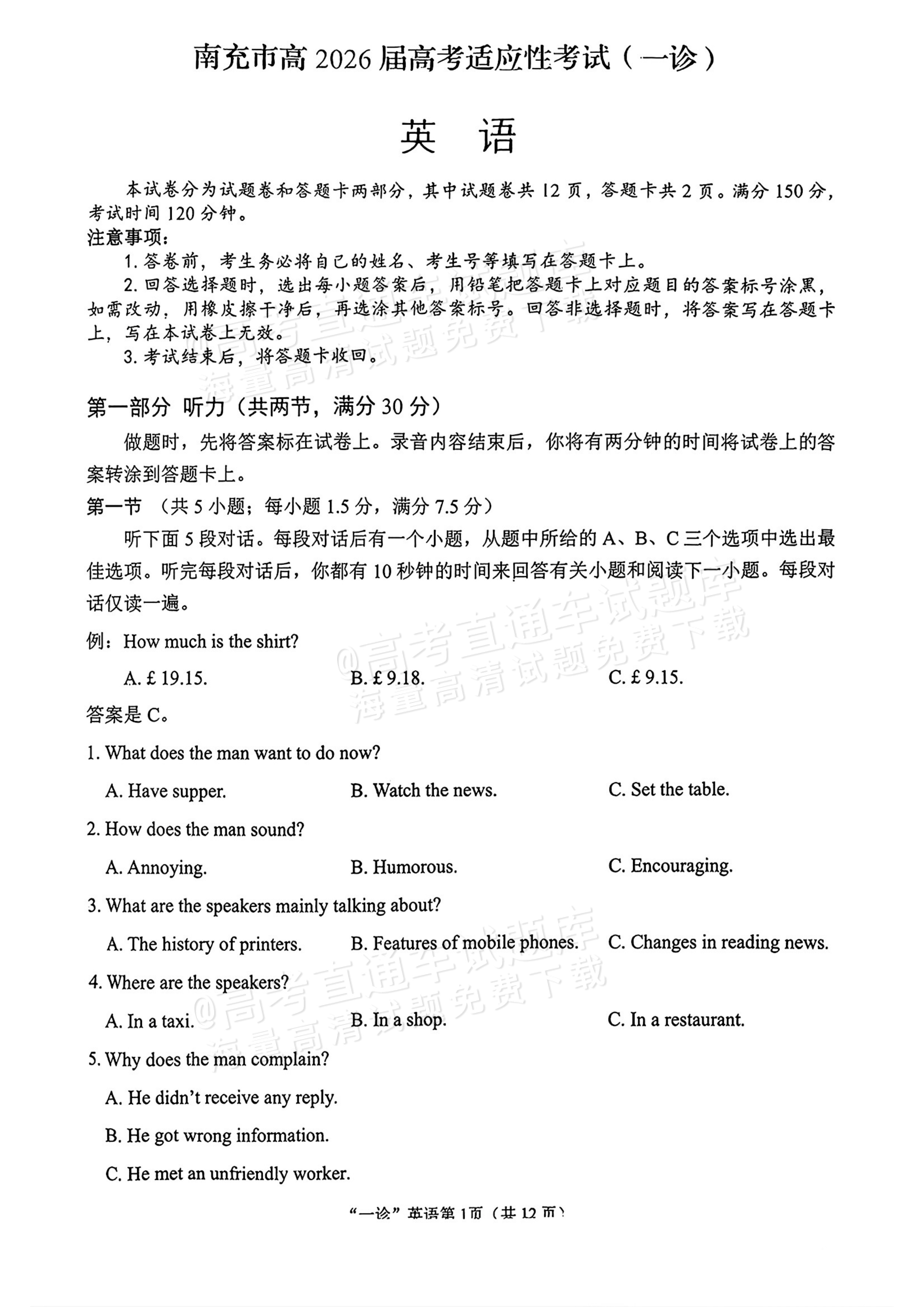
2026南充一诊英语试题及参考答案(PDF版下载含详细解析)南充市高2026届高考适应性考试(一诊)
英 语
本试卷分为试题卷和答题卡两部分,其中试题卷共12页,答题卡共2页。满分150分,考试时间120分钟。
注意事项:
1. 答卷前,考生务必将自己的姓名、考生号等填写在答题卡上。
2. 回答选择题时,选出每小题答案后,用铅笔把答题卡上对应题目的答案标号涂黑,如需改动,用橡皮擦干净后,再选涂其他答案标号。回答非选择题时,将答案写在答题卡上,写在本试卷上无效。
3. 考试结束后,将答题卡收回。
第一部分 听力(共两节,满分30分)
做题时,先将答案标在试卷上。录音内容结束后,你将有两分钟的时间将试卷上的答案转涂到答题卡上。
第一节 (共5小题;每小题1.5分,满分7.5分)
听下面5段对话。每段对话后有一个小题,从题中所给的A、B、C三个选项中选出最佳选项。听完每段对话后,你都有10秒钟的时间来回答有关小题和阅读下一小题。每段对话仅读一遍。
例:How much is the shirt?
A. £19.15. B. £9.18. C. £9.15.
答案是C。
1. What does the man want to do now?
A. Have supper. B. Watch the news. C. Set the table.
2. How does the man sound?
A. Annoying. B. Humorous. C. Encouraging.
3. What are the speakers mainly talking about?
A. The history of printers. B. Features of mobile phones. C. Changes in reading news.
4. Where are the speakers?
A. In a taxi. B. In a shop. C. In a restaurant.
5. Why does the man complain?
A. He didn't receive any reply.
B. He got wrong information.
C. He met an unfriendly worker.
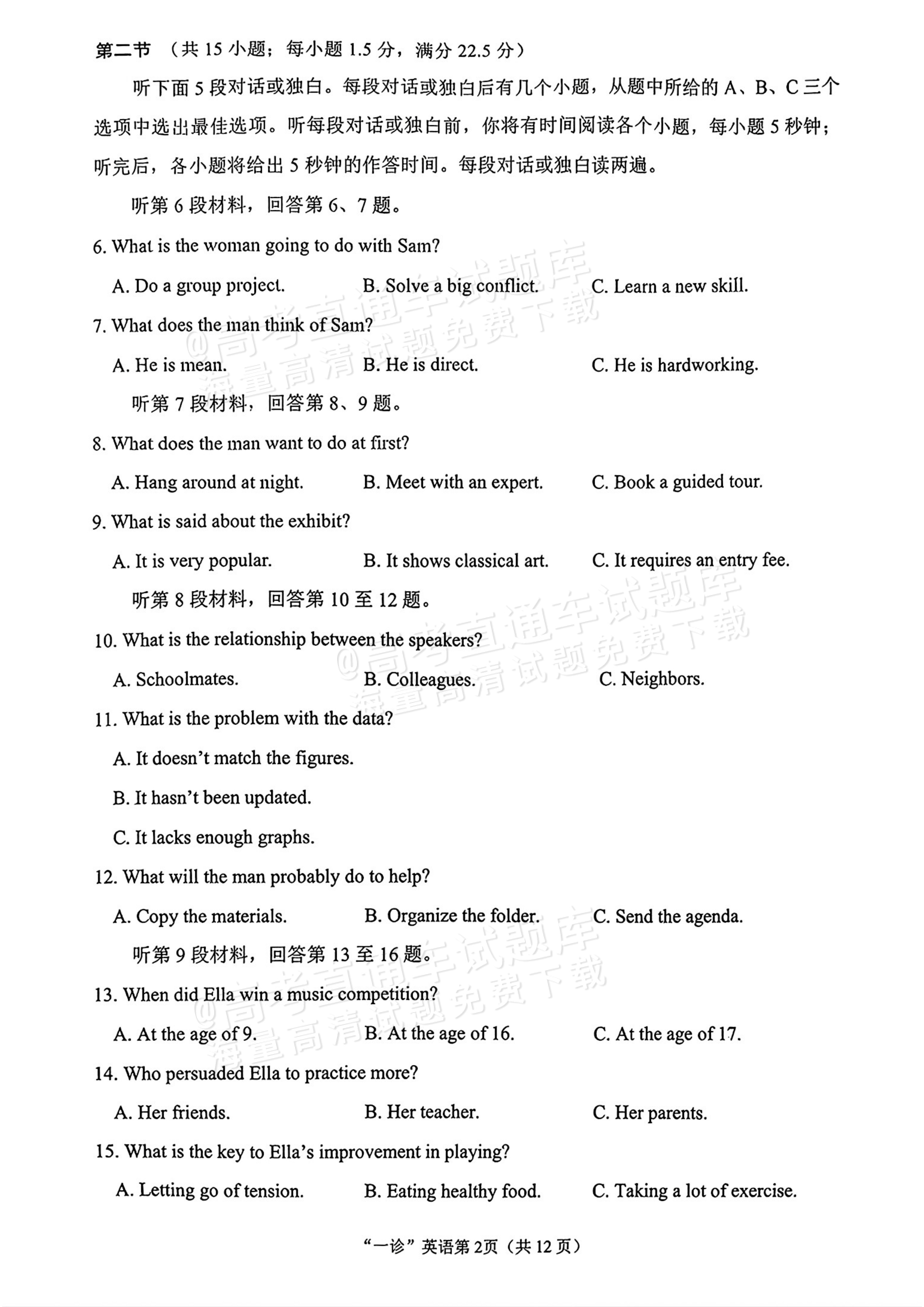
第二节 (共15小题;每小题1.5分,满分22.5分)
听下面5段对话或独白。每段对话或独白后有几个小题,从题中所给的A、B、C三个选项中选出最佳选项。听每段对话或独白前,你将有时间阅读各个小题,每小题5秒钟;听完后,各小题将给出5秒钟的作答时间。每段对话或独白读两遍。
听第6段材料,回答第6、7题。
6. What is the woman going to do with Sam?
A. Do a group project. B. Solve a big conflict. C. Learn a new skill.
7. What does the man think of Sam?
A. He is mean. B. He is direct. C. He is hardworking.
8. What does the man want to do at first?
A. Hang around at night. B. Meet with an expert. C. Book a guided tour.
9. What is said about the exhibit?
A. It is very popular. B. It shows classical art. C. It requires an entry fee.
听第8段材料,回答第10至12题。
10. What is the relationship between the speakers?
A. Schoolmates. B. Colleagues. C. Neighbors.
11. What is the problem with the data?
A. It doesn't match the figures.
B. It hasn't been updated.
C. It lacks enough graphs.
12. What will the man probably do to help?
A. Copy the materials. B. Organize the folder. C. Send the agenda.
听第9段材料,回答第13至16题。
13. When did Ella win a music competition?
A. At the age of 9. B. At the age of 16. C. At the age of 17.
14. Who persuaded Ella to practice more?
A. Her friends. B. Her teacher. C. Her parents.
15. What is the key to Ella's improvement in playing?
A. Letting go of tension. B. Eating healthy food. C. Taking a lot of exercise.
16. What does Ella want teenagers to do about classical music?
A. Learn to play it regularly. B. Listen to it more. C. Be more open-minded.
听第10段材料,回答第17至20题。
17. Where is the talk given?
A. In the library. B. In the Student Center. C. In the Administration Building.
18. Who should the students turn to if they need a part-time job?
A. Mrs. Khramer. B. Gina. C. Mary.
19. What is Daniel responsible for?
A. Keeping all the books in order.
B. Making sure the computers work.
C. Assisting with research and paper-writing.
20. What does the speaker remind the students to do?
A. Keep quiet in the library.
B. Study in the Student Center.
C. Invite their parents to the library.
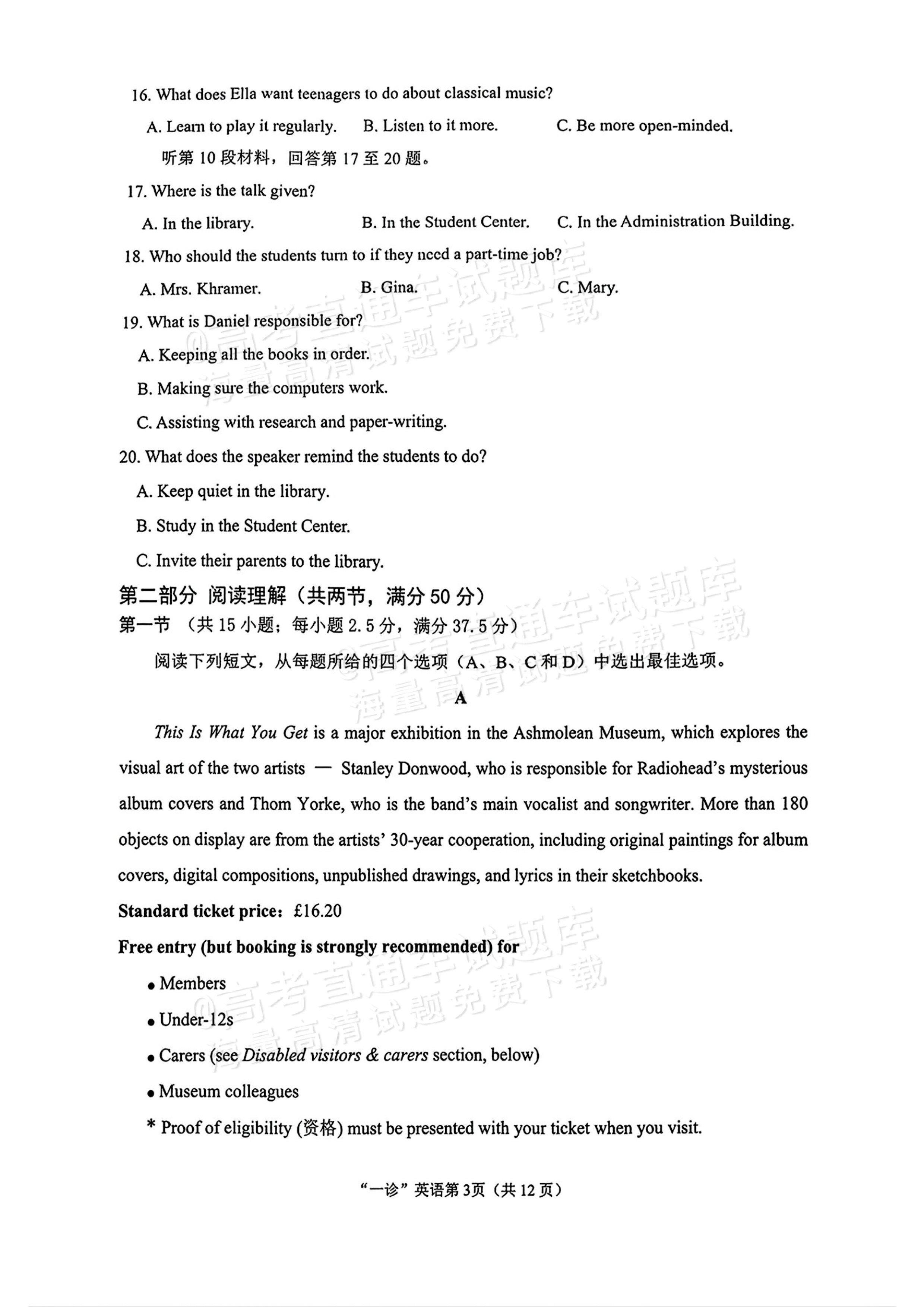
第二部分 阅读理解(共两节,满分50分)
第一节 (共15小题;每小题2.5分,满分37.5分)
阅读下列短文,从每题所给的四个选项(A、B、C和D)中选出最佳选项。
A
This Is What You Get is a major exhibition in the Ashmolean Museum, which explores the visual art of the two artists Stanley Donwood, who is responsible for Radiohead's mysterious album covers and Thom Yorke, who is the band's main vocalist and songwriter. More than 180 objects on display are from the artists' 30-year cooperation, including original paintings for album covers, digital compositions, unpublished drawings, and lyrics in their sketchbooks.
Standard ticket price: £16.20
Free entry (but booking is strongly recommended) for
Members
Under-12s
Carers (see Disabled visitors carers section, below)
Museum colleagues
Proof of eligibility (资格) must be presented with your ticket when you visit.
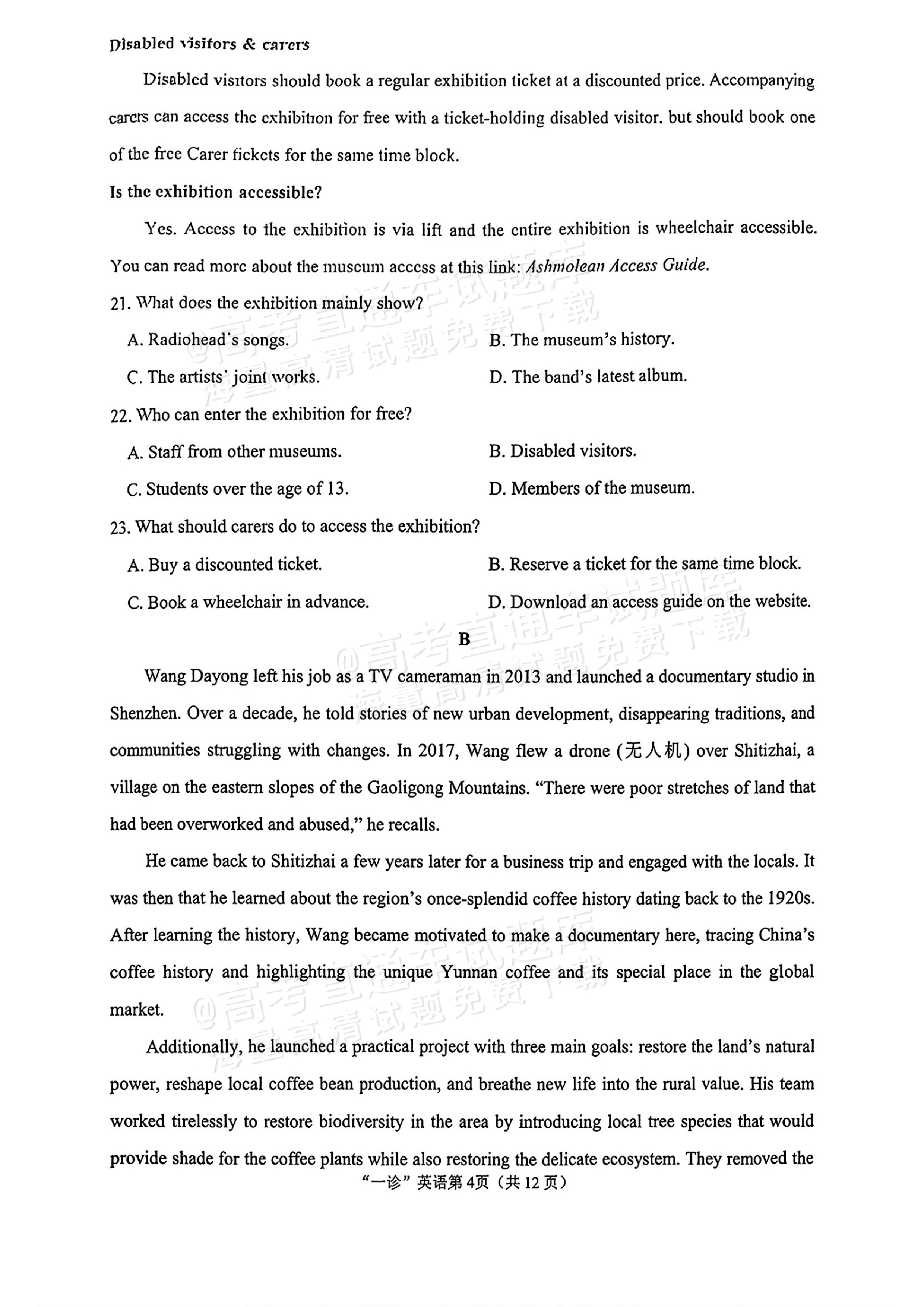
Disabled visitors should book a regular exhibition ticket at a discounted price. Accompanying carers can access the exhibition for free with a ticket-holding disabled visitor. but should book one of the free Carer fickets for the same time block.
Is the exhibition accessible?
Yes. Access to the exhibition is via lift and the entire exhibition is wheelchair accessible. You can read more about the museum access at this link: Ashmolean Access Guide.
21. What does the exhibition mainly show?
A. Radiohead's songs. B. The museum's history.
C. The artists' joint works. D. The band's latest album.
22. Who can enter the exhibition for free?
A. Staff from other museums. B. Disabled visitors.
C. Students over the age of 13. D. Members of the museum.
23. What should carers do to access the exhibition?
A. Buy a discounted ticket. B. Reserve a ticket for the same time block.
C. Book a wheelchair in advance. D. Download an access guide on the website.
B
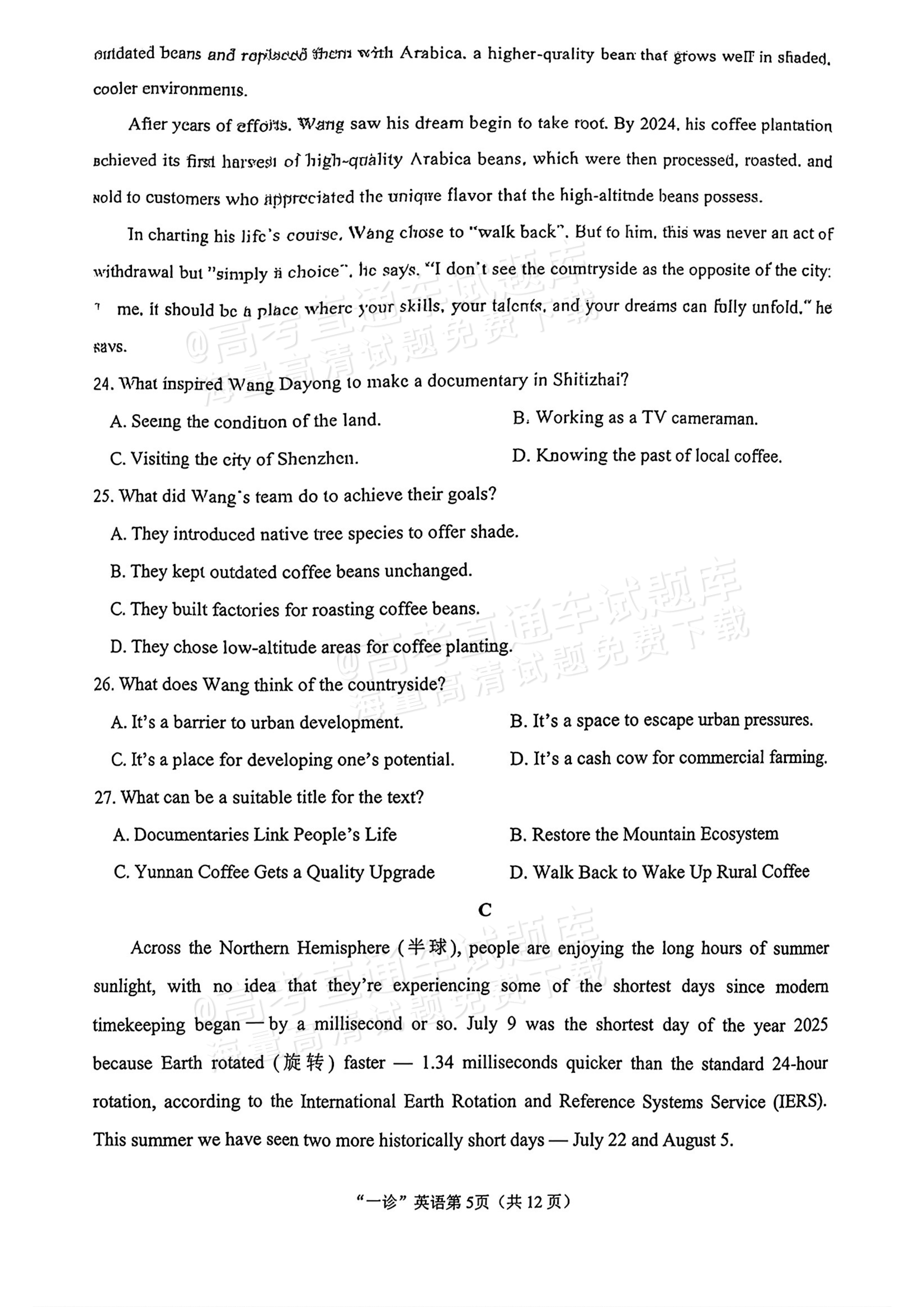
Wang Dayong left his job as a TV cameraman in 2013 and launched a documentary studio in Shenzhen. Over a decade, he told stories of new urban development, disappearing traditions, and communities struggling with changes. In 2017, Wang flew a drone (无人机) over Shitizhai, a village on the eastern slopes of the Gaoligong Mountains. "There were poor stretches of land that had been overworked and abused," he recalls.
He came back to Shitizhai a few years later for a business trip and engaged with the locals. It was then that he learned about the region's once-splendid coffee history dating back to the 1920s. After learning the history, Wang became motivated to make a documentary here, tracing China's coffee history and highlighting the unique Yunnan coffee and its special place in the global market.
Additionally, he launched a practical project with three main goals: restore the land's natural power, reshape local coffee bean production, and breathe new life into the rural value. His team worked tirelessly to restore biodiversity in the area by introducing local tree species that would provide shade for the coffee plants while also restoring the delicate ecosystem. They removed the
oilidated beans and replaced them with Arabica, a higher-quality bean that grows well in shaded cooler environments.
After years of efforts. Wang saw his dream begin to take root. By 2024, his coffee plantation achieved its first harvest of high-quality Arabica beans, which were then processed, roasted, and sold to customers who appreciated the unique flavor that the high-altitude beans possess.
In charting his life's course, Wang chose to "walk back". But to him, this was never an act of withdrawal but "simply a choice", he says. "I don't see the countryside as the opposite of the city: me, it should be a place where your skills, your talents, and your dreams can fully unfold," he savs.
24. What inspired Wang Dayong to make a documentary in Shitizhai?
A. Seeing the condition of the land. B. Working as a TV cameraman.
C. Visiting the city of Shenzhen. D. Knowing the past of local coffee.
25. What did Wang's team do to achieve their goals?
A. They introduced native tree species to offer shade.
B. They kept outdated coffee beans unchanged.
C. They built factories for roasting coffee beans.
D. They chose low-altitude areas for coffee planting.
26. What does Wang think of the countryside?
A. It's a barrier to urban development. B. It's a space to escape urban pressures.
C. It's a place for developing one's potential. D. It's a cash cow for commercial farming.
27. What can be a suitable title for the text?
A. Documentaries Link People's Life B. Restore the Mountain Ecosystem
C. Yunnan Coffee Gets a Quality Upgrade D. Walk Back to Wake Up Rural Coffee
C
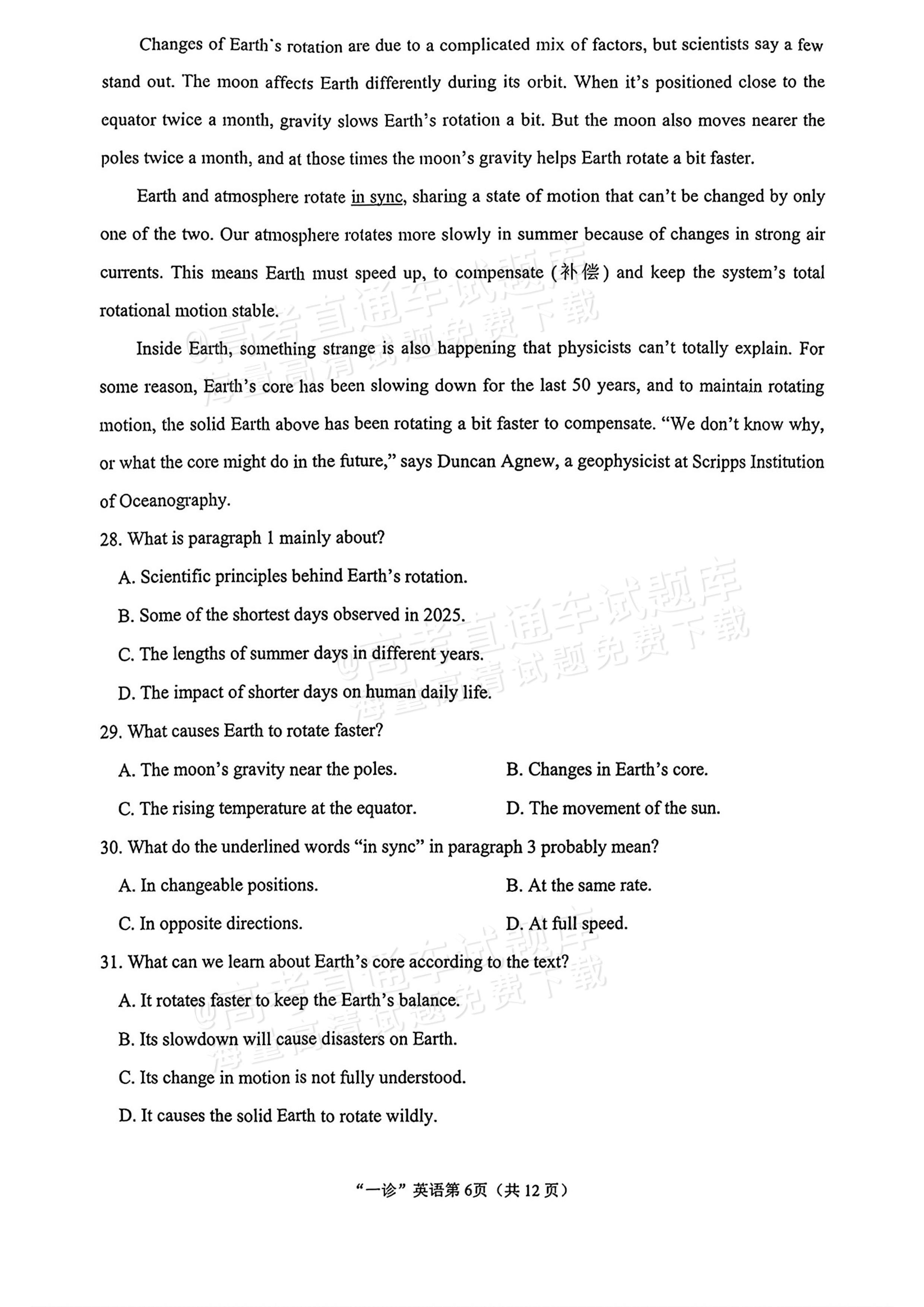
Across the Northern Hemisphere (半球), people are enjoying the long hours of summer sunlight, with no idea that they're experiencing some of the shortest days since modern timekeeping began — by a millisecond or so. July 9 was the shortest day of the year 2025 because Earth rotated (旋转) faster — 1.34 milliseconds quicker than the standard 24-hour rotation, according to the International Earth Rotation and Reference Systems Service (IERS). This summer we have seen two more historically short days — July 22 and August 5.
Changes of Earth's rotation are due to a complicated mix of factors, but scientists say a few stand out. The moon affects Earth differently during its orbit. When it's positioned close to the equator twice a month, gravity slows Earth's rotation a bit. But the moon also moves nearer the poles twice a month, and at those times the moon's gravity helps Earth rotate a bit faster.
Earth and atmosphere rotate in sync, sharing a state of motion that can't be changed by only one of the two. Our atmosphere rotates more slowly in summer because of changes in strong air currents. This means Earth must speed up, to compensate (补偿) and keep the system's total rotational motion stable.
Inside Earth, something strange is also happening that physicists can't totally explain. For some reason, Earth's core has been slowing down for the last 50 years, and to maintain rotating motion, the solid Earth above has been rotating a bit faster to compensate. "We don't know why, or what the core might do in the future," says Duncan Agnew, a geophysicist at Scripps Institution of Oceanography.
28. What is paragraph 1 mainly about?
A. Scientific principles behind Earth's rotation.
B. Some of the shortest days observed in 2025.
C. The lengths of summer days in different years.
D. The impact of shorter days on human daily life.
29. What causes Earth to rotate faster?
A. The moon's gravity near the poles. B. Changes in Earth's core.
C. The rising temperature at the equator. D. The movement of the sun.
30. What do the underlined words "in sync" in paragraph 3 probably mean?
A. In changeable positions. B. At the same rate.
C. In opposite directions. D. At full speed.
31. What can we learn about Earth's core according to the text?
A. It rotates faster to keep the Earth's balance.
B. Its slowdown will cause disasters on Earth.
C. Its change in motion is not fully understood.
D. It causes the solid Earth to rotate wildly.
D
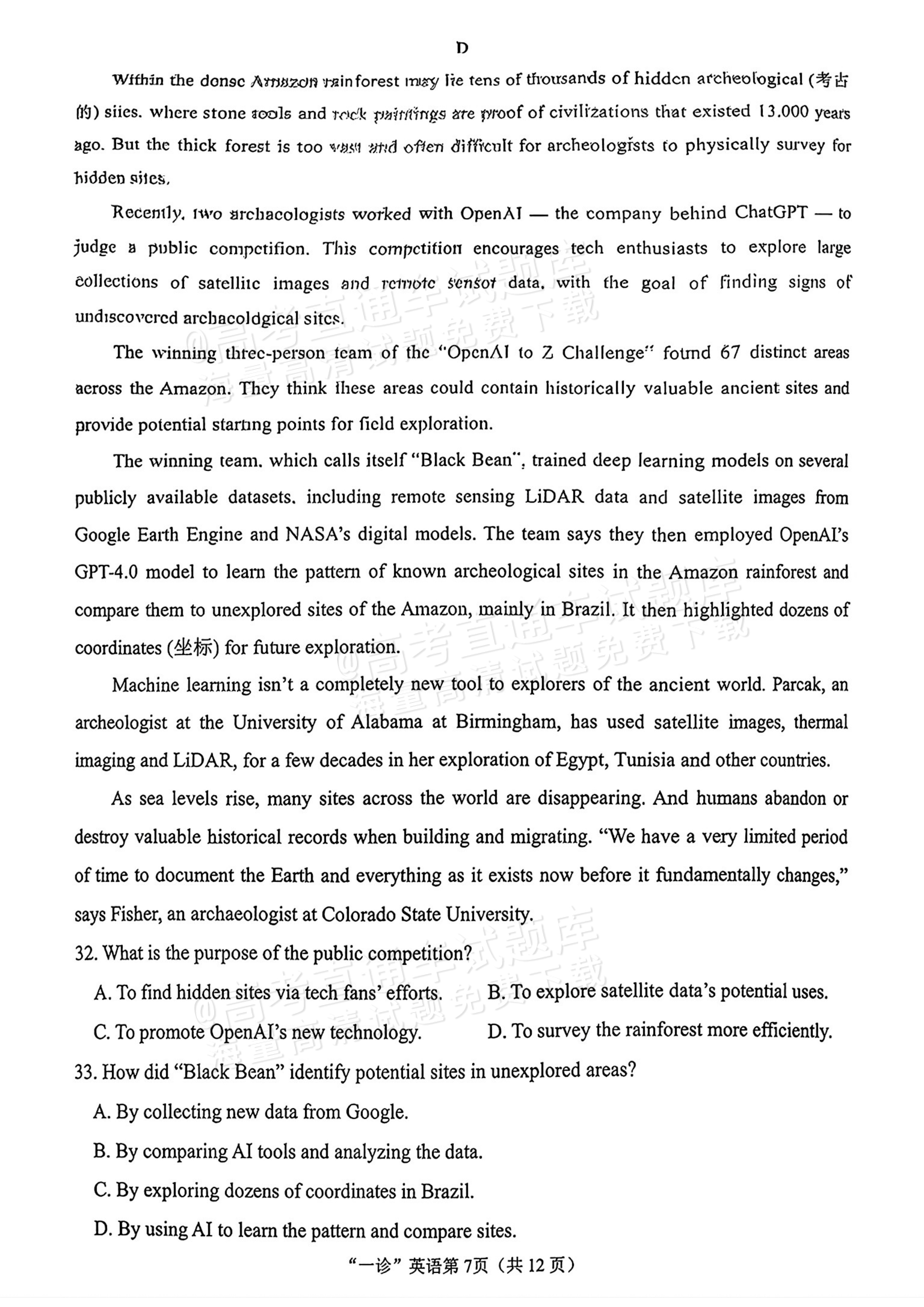
Within the dense Amazon rainforest may lie tens of thousands of hidden archeological (考古的) sites. where stone tools and rock paintings are proof of civilizations that existed 13.000 years ago. But the thick forest is too vast and often difficult for archeologists to physically survey for hidden sites.
Recently, two archaeologists worked with OpenAI the company behind ChatGPT to judge a public competition. This competition encourages tech enthusiasts to explore large collections of satellite images and remote sensor data, with the goal of finding signs of undiscovered archaeological sites.
The winning three-person team of the "OpenAI to Z Challenge" found 67 distinct areas across the Amazon. They think these areas could contain historically valuable ancient sites and provide potential starting points for field exploration.
The winning team, which calls itself "Black Bean", trained deep learning models on several publicly available datasets, including remote sensing LiDAR data and satellite images from Google Earth Engine and NASA's digital models. The team says they then employed OpenAI's GPT-4.0 model to learn the pattern of known archeological sites in the Amazon rainforest and compare them to unexplored sites of the Amazon, mainly in Brazil. It then highlighted dozens of coordinates (坐标) for future exploration.
Machine learning isn't a completely new tool to explorers of the ancient world. Parcak, an archeologist at the University of Alabama at Birmingham, has used satellite images, thermal imaging and LiDAR, for a few decades in her exploration of Egypt, Tunisia and other countries.
As sea levels rise, many sites across the world are disappearing. And humans abandon or destroy valuable historical records when building and migrating. "We have a very limited period of time to document the Earth and everything as it exists now before it fundamentally changes," says Fisher, an archaeologist at Colorado State University.
32. What is the purpose of the public competition?
A. To find hidden sites via tech fans' efforts. B. To explore satellite data's potential uses.
C. To promote OpenAI's new technology. D. To survey the rainforest more efficiently.
33. How did "Black Bean" identify potential sites in unexplored areas?
A. By collecting new data from Google.
B. By comparing AI tools and analyzing the data.
C. By exploring dozens of coordinates in Brazil.
D. By using AI to learn the pattern and compare sites.
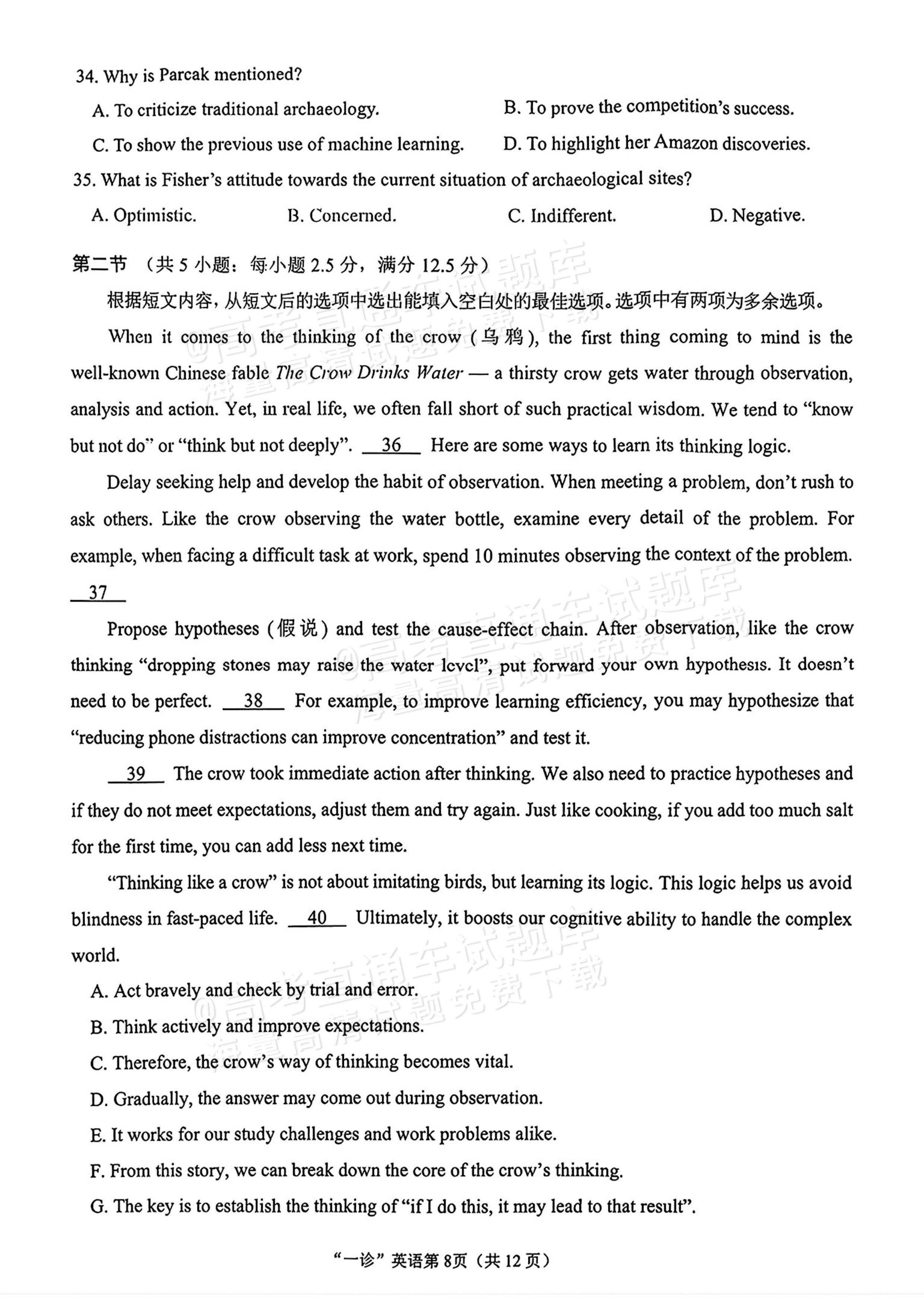
34. Why is Parcak mentioned?
A. To criticize traditional archaeology. B. To prove the competition's success.
C. To show the previous use of machine learning. D. To highlight her Amazon discoveries.
35. What is Fisher's attitude towards the current situation of archaeological sites?
A. Optimistic. B. Concerned. C. Indifferent. D. Negative.
第二节 (共5小题:每小题2.5分,满分12.5分)
根据短文内容,从短文后的选项中选出能填入空白处的最佳选项。选项中有两项为多余选项。
When it comes to the thinking of the crow (乌鸦), the first thing coming to mind is the well-known Chinese fable The Crow Drinks Water a thirsty crow gets water through observation, analysis and action. Yet, in real life, we often fall short of such practical wisdom. We tend to "know but not do" or "think but not deeply". 36 Here are some ways to learn its thinking logic.
Delay seeking help and develop the habit of observation. When meeting a problem, don't rush to ask others. Like the crow observing the water bottle, examine every detail of the problem. For example, when facing a difficult task at work, spend 10 minutes observing the context of the problem. 37
Propose hypotheses (假说) and test the cause-effect chain. After observation, like the crow thinking "dropping stones may raise the water level", put forward your own hypothesis. It doesn't need to be perfect. 38 For example, to improve learning efficiency, you may hypothesize that "reducing phone distractions can improve concentration" and test it.
39 The crow took immediate action after thinking. We also need to practice hypotheses and if they do not meet expectations, adjust them and try again. Just like cooking, if you add too much salt for the first time, you can add less next time.
“Thinking like a crow” is not about imitating birds, but learning its logic. This logic helps us avoid blindness in fast-paced life. 40 Ultimately, it boosts our cognitive ability to handle the complex world.
A. Act bravely and check by trial and error.
B. Think actively and improve expectations.
C. Therefore, the crow's way of thinking becomes vital.
D. Gradually, the answer may come out during observation.
E. It works for our study challenges and work problems alike.
F. From this story, we can break down the core of the crow's thinking.
G. The key is to establish the thinking of "if I do this, it may lead to that result".
第三部分 语言运用(共两节,满分30分)
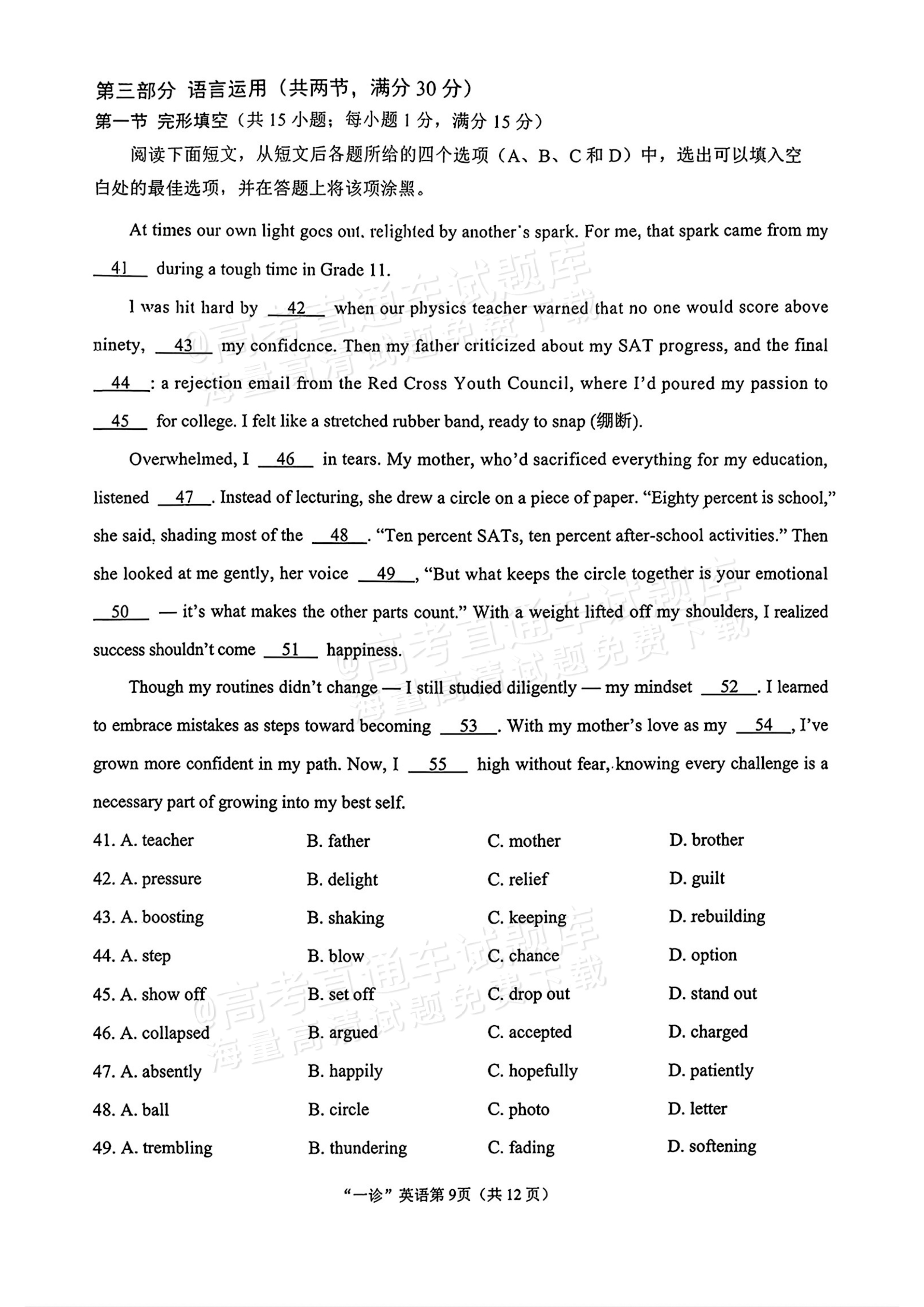
第一节 完形填空(共15小题;每小题1分,满分15分)
阅读下面短文,从短文后各题所给的四个选项(A、B、C和D)中,选出可以填入空白处的最佳选项,并在答题上将该项涂黑。
At times our own light goes out, relighted by another's spark. For me, that spark came from my 41 during a tough time in Grade 11.
I was hit hard by 42 when our physics teacher warned that no one would score above ninety, 43 my confidence. Then my father criticized about my SAT progress, and the final 44: a rejection email from the Red Cross Youth Council, where I'd poured my passion to 45 for college. I felt like a stretched rubber band, ready to snap (绷断).
Overwhelmed, I 46 in tears. My mother, who'd sacrificed everything for my education, listened 47. Instead of lecturing, she drew a circle on a piece of paper. "Eighty percent is school," she said, shading most of the 48. "Ten percent SATs, ten percent after-school activities." Then she looked at me gently, her voice 49, "But what keeps the circle together is your emotional 50 — it's what makes the other parts count." With a weight lifted off my shoulders, I realized success shouldn't come 51 happiness.
Though my routines didn't change — I still studied diligently — my mindset 52. I learned to embrace mistakes as steps toward becoming 53. With my mother's love as my 54, I've grown more confident in my path. Now, I 55 high without fear, knowing every challenge is a necessary part of growing into my best self.
41. A. teacher B. father C. mother D. brother
42. A. pressure B. delight C. relief D. guilt
43. A. boosting B. shaking C. keeping D. rebuilding
44. A. step B. blow C. chance D. option
45. A. show off B. set off C. drop out D. stand out
46. A. collapsed B. argued C. accepted D. charged
47. A. absently B. happily C. hopefully D. patiently
48. A. ball B. circle C. photo D. letter
49. A. trembling B. thundering C. fading D. softening
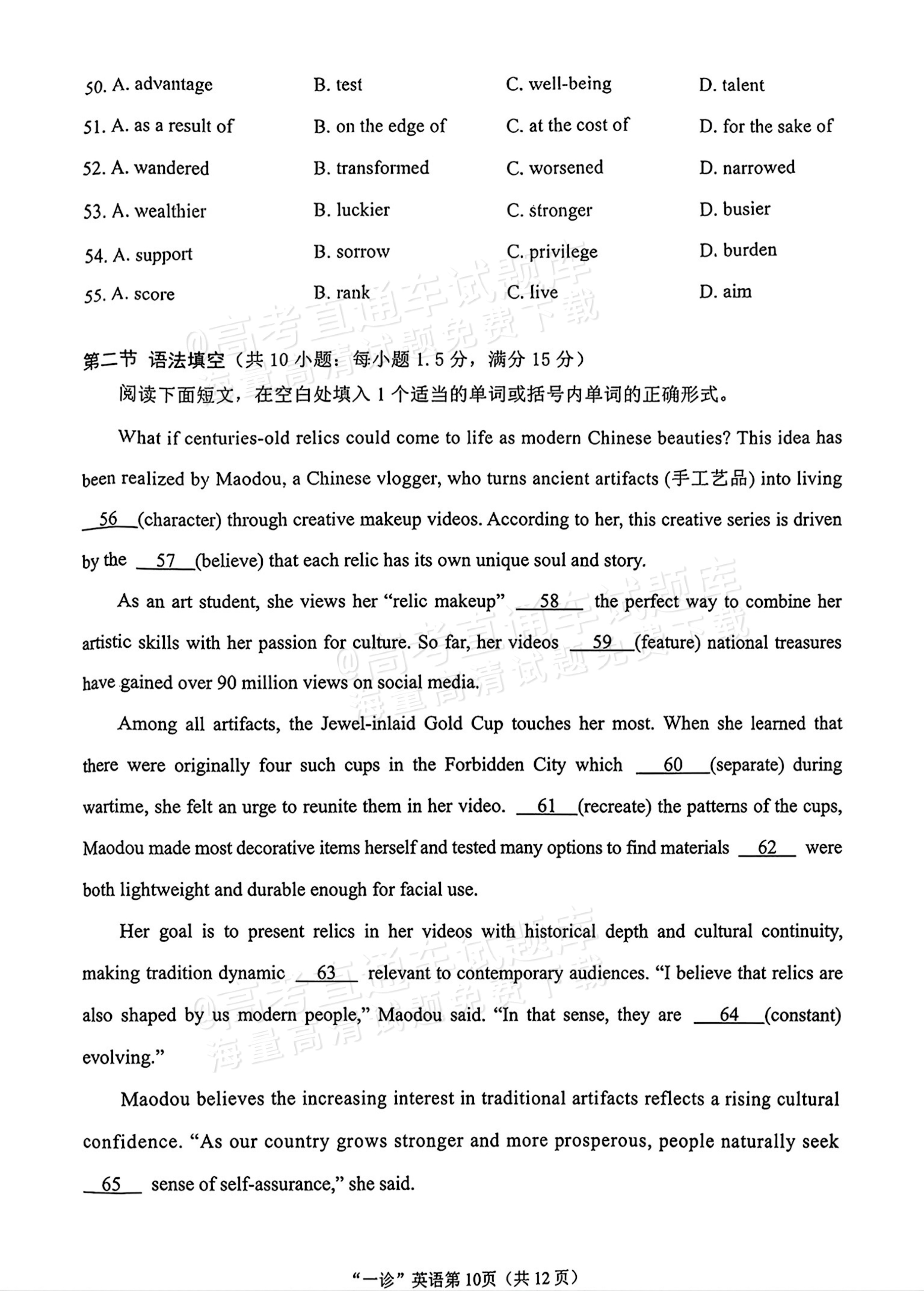
50. A. advantage B. test C. well-being D. talent
51. A. as a result of B. on the edge of C. at the cost of D. for the sake of
52. A. wandered B. transformed C. worsened D. narrowed
53. A. wealthier B. luckier C. stronger D. busier
54. A. support B. sorrow C. privilege D. burden
55. A. score B. rank C. live D. aim
第二节 语法填空(共10小题:每小题1.5分,满分15分)
阅读下面短文,在空白处填入1个适当的单词或括号内单词的正确形式。
What if centuries-old relics could come to life as modern Chinese beauties? This idea has been realized by Maodou, a Chinese vlogger, who turns ancient artifacts (手工艺品) into living 56 (character) through creative makeup videos. According to her, this creative series is driven by the 57 (believe) that each relic has its own unique soul and story.
As an art student, she views her "relic makeup" 58 the perfect way to combine her artistic skills with her passion for culture. So far, her videos 59 (feature) national treasures have gained over 90 million views on social media.
Among all artifacts, the Jewel-inlaid Gold Cup touches her most. When she learned that there were originally four such cups in the Forbidden City which 60 (separate) during wartime, she felt an urge to reunite them in her video. 61 (recreate) the patterns of the cups, Maodou made most decorative items herself and tested many options to find materials 62 were both lightweight and durable enough for facial use.
Her goal is to present relics in her videos with historical depth and cultural continuity, making tradition dynamic 63 relevant to contemporary audiences. "I believe that relics are also shaped by us modern people," Maodou said. "In that sense, they are 64 (constant) evolving."
Maodou believes the increasing interest in traditional artifacts reflects a rising cultural confidence. "As our country grows stronger and more prosperous, people naturally seek 65 sense of self-assurance," she said.
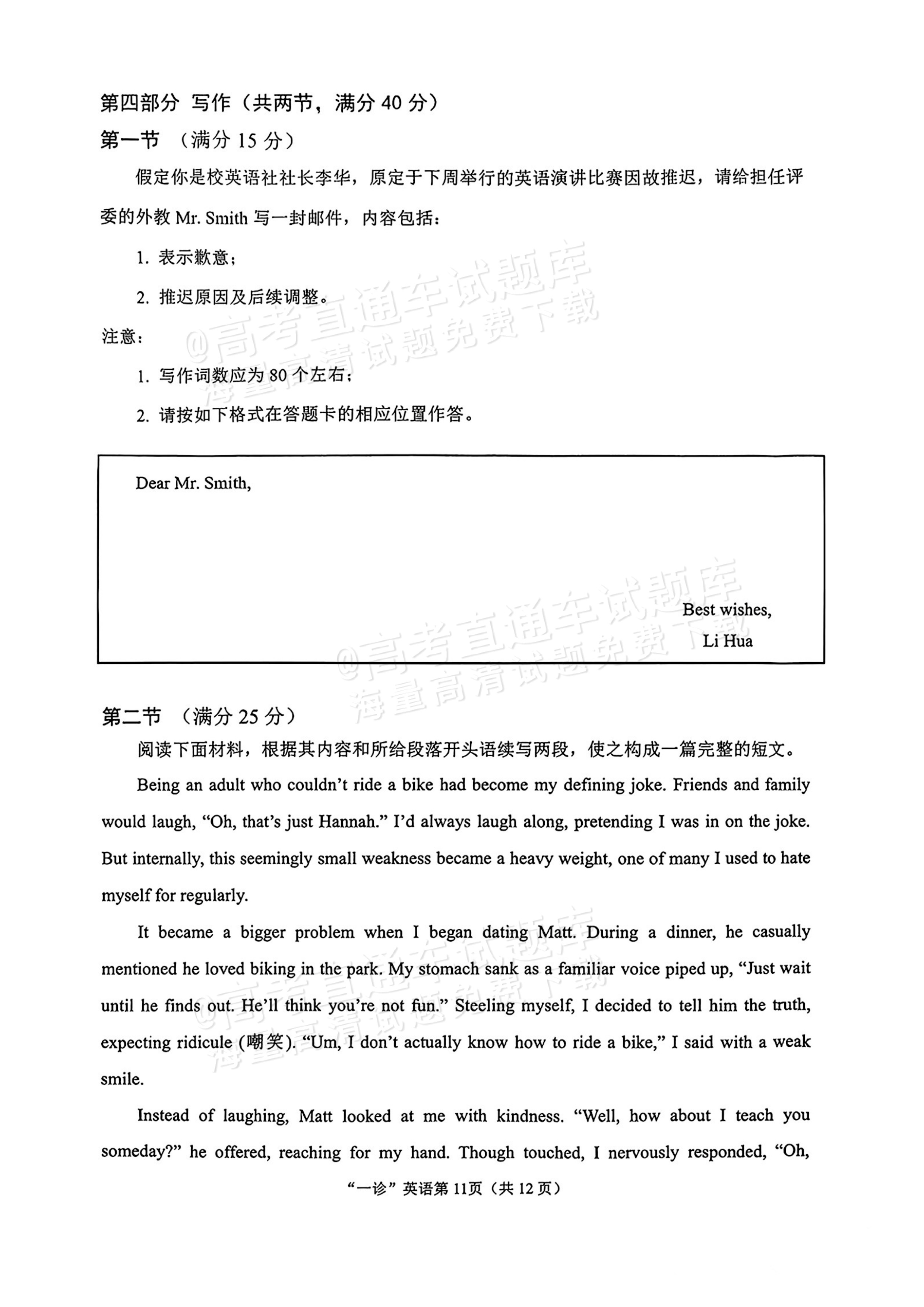
第四部分 写作(共两节,满分40分)
第一节 (满分15分)
假定你是校英语社社长李华,原定于下周举行的英语演讲比赛因故推迟,请给担任评委的外教Mr. Smith写一封邮件,内容包括:
1. 表示歉意;
2. 推迟原因及后续调整。
注意:
1. 写作词数应为80个左右;
2. 请按如下格式在答题卡的相应位置作答。
第二节 (满分25分)
阅读下面材料,根据其内容和所给段落开头语续写两段,使之构成一篇完整的短文。
Being an adult who couldn't ride a bike had become my defining joke. Friends and family would laugh, "Oh, that's just Hannah." I'd always laugh along, pretending I was in on the joke. But internally, this seemingly small weakness became a heavy weight, one of many I used to hate myself for regularly.
It became a bigger problem when I began dating Matt. During a dinner, he casually mentioned he loved biking in the park. My stomach sank as a familiar voice piped up, "Just wait until he finds out. He'll think you're not fun." Steeling myself, I decided to tell him the truth, expecting ridicule (嘲笑). "Um, I don't actually know how to ride a bike," I said with a weak smile.
Instead of laughing, Matt looked at me with kindness. "Well, how about I teach you someday?" he offered, reaching for my hand. Though touched, I nervously responded, "Oh,
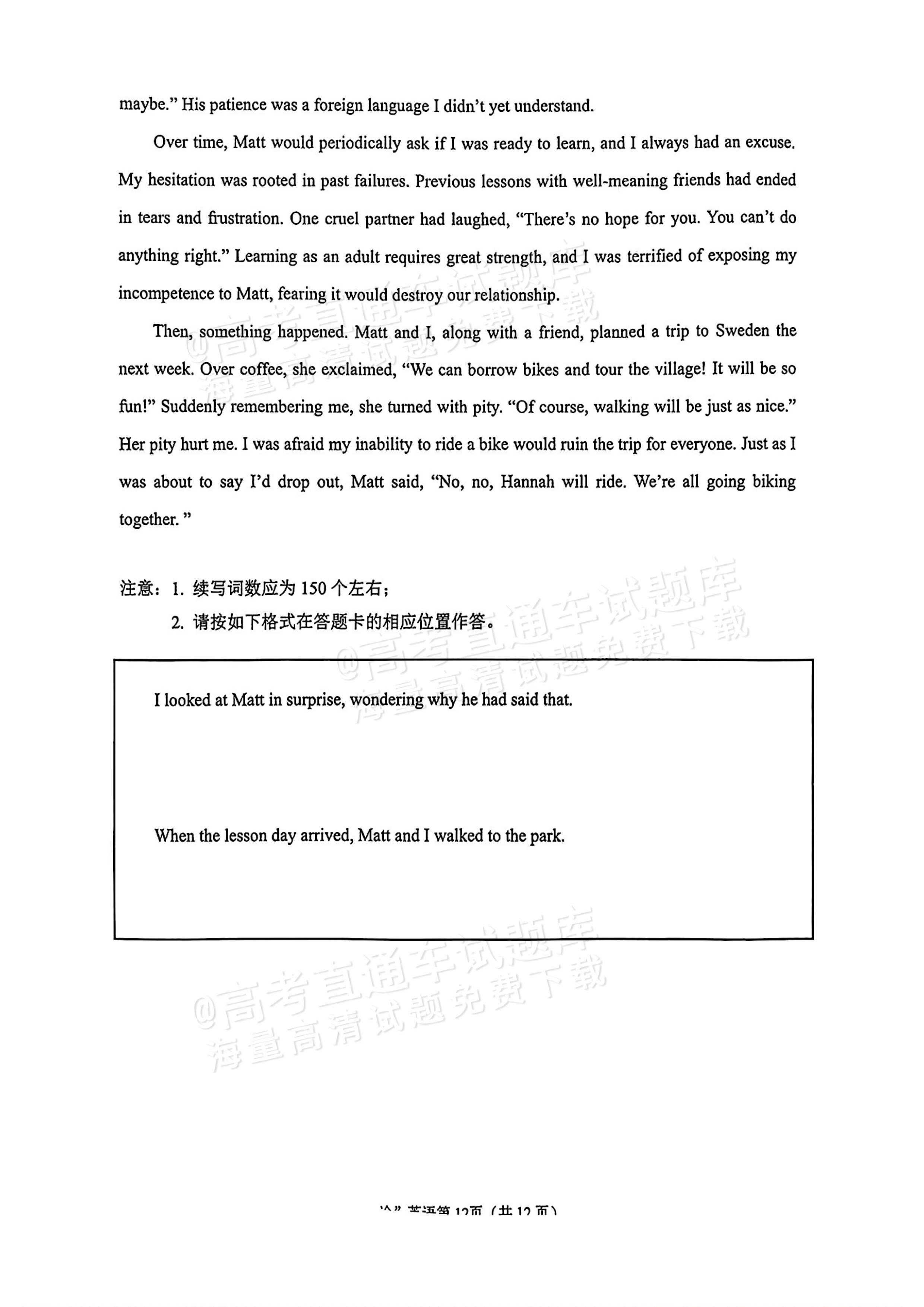
maybe." His patience was a foreign language I didn't yet understand.
Over time, Matt would periodically ask if I was ready to learn, and I always had an excuse. My hesitation was rooted in past failures. Previous lessons with well-meaning friends had ended in tears and frustration. One cruel partner had laughed, "There's no hope for you. You can't do anything right." Learning as an adult requires great strength, and I was terrified of exposing my incompetence to Matt, fearing it would destroy our relationship.
Then, something happened. Matt and I, along with a friend, planned a trip to Sweden the next week. Over coffee, she exclaimed, "We can borrow bikes and tour the village! It will be so fun!" Suddenly remembering me, she turned with pity. "Of course, walking will be just as nice." Her pity hurt me. I was afraid my inability to ride a bike would ruin the trip for everyone. Just as I was about to say I'd drop out, Matt said, "No, no, Hannah will ride. We're all going biking together."
注意:1. 续写词数应为150个左右;
2. 请按如下格式在答题卡的相应位置作答。
I looked at Matt in surprise, wondering why he had said that.When the lesson day arrived, Matt and I walked to the park.
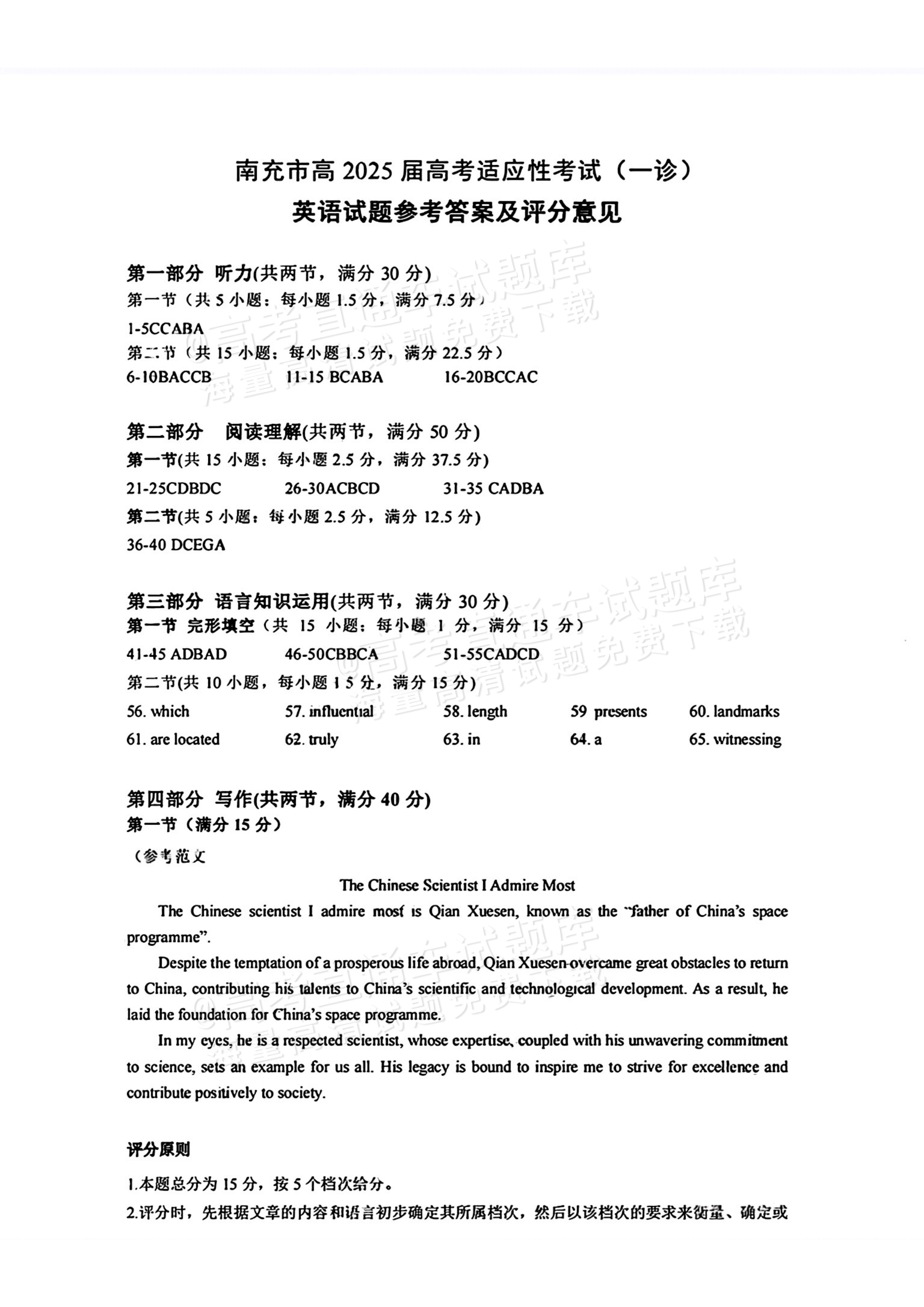
南充市高2025届高考适应性考试(一诊)英语试题参考答案及评分意见
第一部分 听力(共两节,满分30分)
第一节(共5小题:每小题1.5分,满分7.5分)
1-5CCABA
第二节(共15小题:每小题1.5分,满分22.5分)
6-10BACCB 11-15 BCABA 16-20BCCAC
第二部分 阅读理解(共两节,满分50分)
第一节(共15小题:每小题2.5分,满分37.5分)
21-25CDBDC 26-30ACBCD 31-35 CADBA
第二节(共5小题:每小题2.5分,满分12.5分)
36-40 DCEGA
第三部分 语言知识运用(共两节,满分30分)
第一节 完形填空(共15小题:每小题1分,满分15分)
41-45 ADBAD 46-50CBBCA 51-55CADCD
第二节(共10小题,每小题15分,满分15分)
56. which 57. influential 58. length 59 presents 60. landmarks
61. are located 62. truly 63. in 64. a 65. witnessing
第四部分 写作(共两节,满分40分)
第一节(满分15分)
(参考范文
The Chinese Scientist I Admire Most
The Chinese scientist I admire most is Qian Xuesen, known as the father of China's space programme".
Despite the temptation of a prosperous life abroad, Qian Xuesen-overcame great obstacles to return to China, contributing his talents to China's scientific and technological development. As a result, he laid the foundation for China's space programme.
In my eyes, he is a respected scientist, whose expertise, coupled with his unwavering commitment to science, sets an example for us all. His legacy is bound to inspire me to strive for excellence and contribute positively to society.
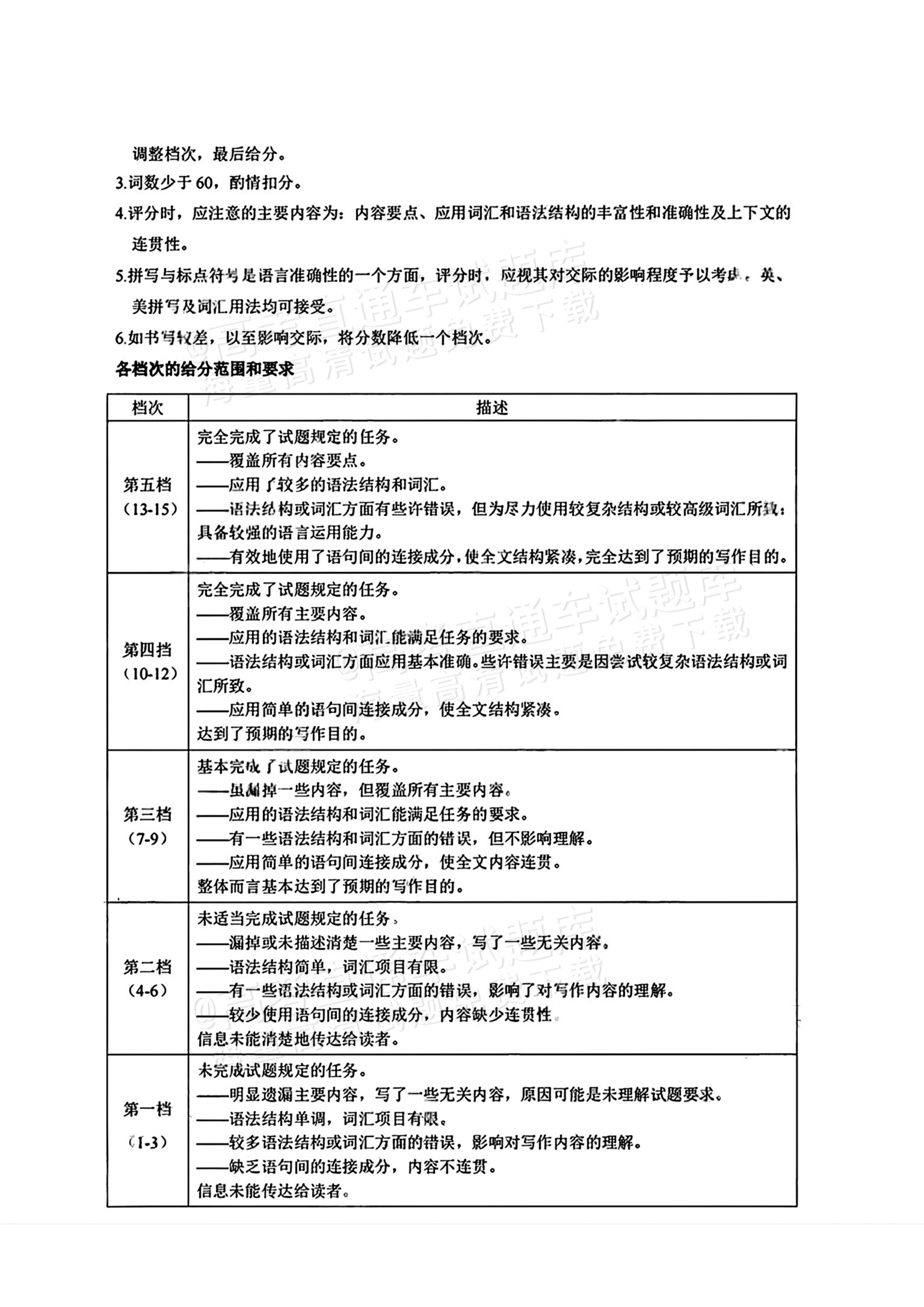
评分原则
1. 本题总分为15分,按5个档次给分。
2. 评分时,先根据文章的内容和语言初步确定其所属档次,然后以该档次的要求来衡量、确定或
调整档次,最后给分。
3. 词数少于60,酌情扣分。
4. 评分时,应注意的主要内容为:内容要点、应用词汇和语法结构的丰富性和准确性及上下文的连贯性。
5. 拼写与标点符号是语言准确性的一个方面,评分时,应视其对交际的影响程度予以考虑。英、美拼写及词汇用法均可接受。
6. 如书写较差,以至影响交际,将分数降低一个档次。
各档次的给分范围和要求
档次描述第五档(13-15)完全完成了试题规定的任务。
——覆盖所有内容要点。
——应用了较多的语法结构和词汇。
——语法结构或词汇方面有些许错误,但为尽力使用较复杂结构或较高级词汇所致;具备较强的语言运用能力。
——有效地使用了语句间的连接成分,使全文结构紧凑,完全达到了预期的写作目的。第四挡(10-12)完全完成了试题规定的任务。
——覆盖所有主要内容。
——应用的语法结构和词汇能满足任务的要求。
——语法结构或词汇方面应用基本准确。些许错误主要是因尝试较复杂语法结构或词汇所致。
——应用简单的语句间连接成分,使全文结构紧凑。
达到了预期的写作目的。第三档(7-9)基本完成了试题规定的任务。
——虽删掉一些内容,但覆盖所有主要内容。
——应用的语法结构和词汇能满足任务的要求。
——有一些语法结构和词汇方面的错误,但不影响理解。
——应用简单的语句间连接成分,使全文内容连贯。
整体而言基本达到了预期的写作目的。第二档(4-6)未适当完成试题规定的任务。
——漏掉或未描述清楚一些主要内容,写了一些无关内容。
——语法结构简单,词汇项目有限。
——有一些语法结构或词汇方面的错误,影响了对写作内容的理解。
——较少使用语句间的连接成分,内容缺少连贯性。
信息未能清楚地传达给读者。第一档(1-3)未完成试题规定的任务。
——明显遗漏主要内容,写了一些无关内容,原因可能是未理解试题要求。
——语法结构单调,词汇项目有限。
——较多语法结构或词汇方面的错误,影响对写作内容的理解。
——缺乏语句间的连接成分,内容不连贯。
信息未能传达给读者。
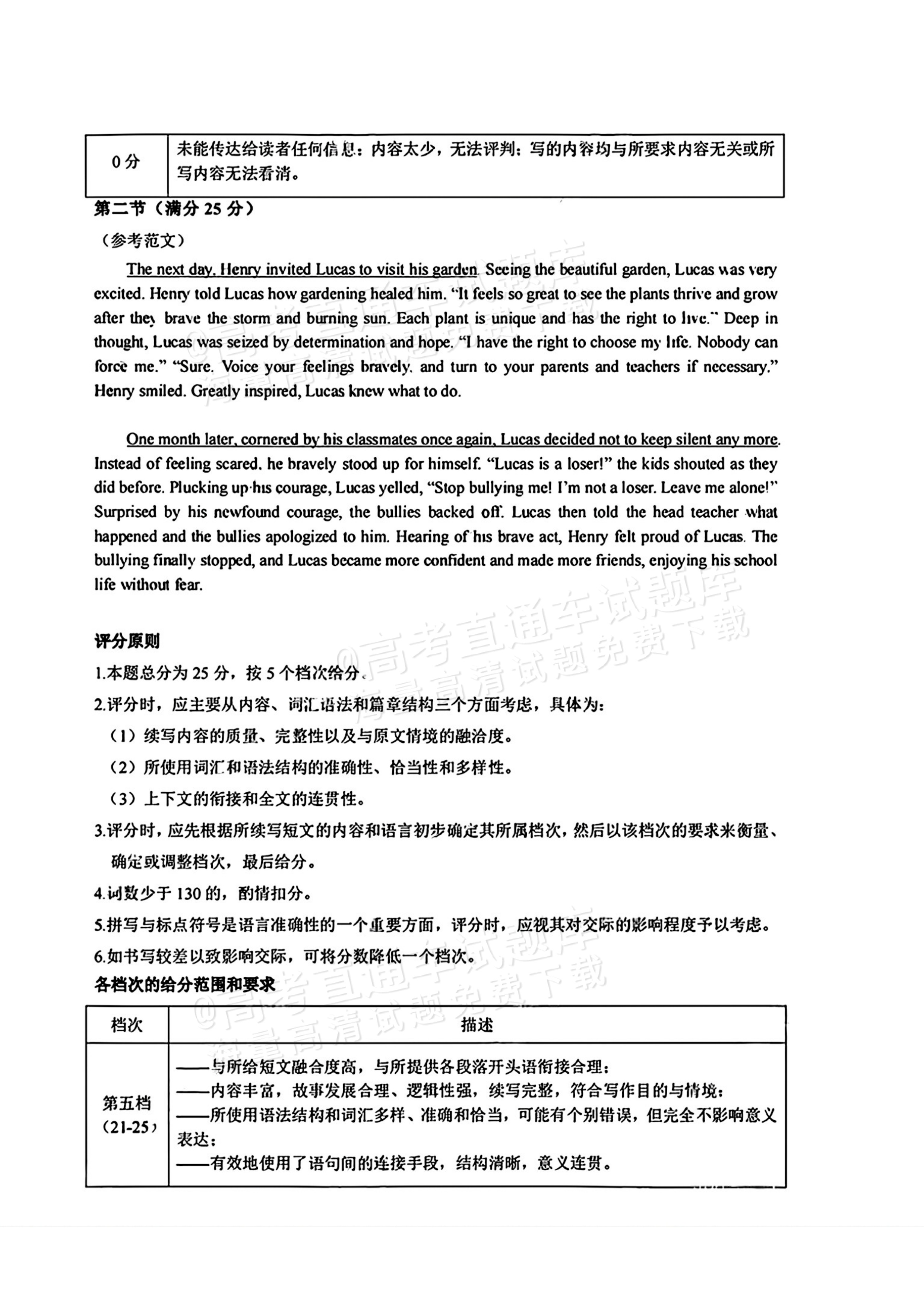
0分未能传达给读者任何信息:内容太少,无法评判;写的内容均与所要求内容无关或所写内容无法看清。
第二节(满分25分)
(参考范文)
The next day, Henry invited Lucas to visit his garden. Seeing the beautiful garden, Lucas was very excited. Henry told Lucas how gardening healed him. "It feels so great to see the plants thrive and grow after they brave the storm and burning sun. Each plant is unique and has the right to live." Deep in thought, Lucas was seized by determination and hope. "I have the right to choose my life. Nobody can force me." "Sure. Voice your feelings bravely, and turn to your parents and teachers if necessary." Henry smiled. Greatly inspired, Lucas knew what to do.
One month later, cornered by his classmates once again, Lucas decided not to keep silent any more. Instead of feeling scared, he bravely stood up for himself. "Lucas is a loser!" the kids shouted as they did before. Plucking up his courage, Lucas yelled, "Stop bullying me! I'm not a loser. Leave me alone!" Surprised by his newfound courage, the bullies backed off. Lucas then told the head teacher what happened and the bullies apologized to him. Hearing of his brave act, Henry felt proud of Lucas. The bullying finally stopped, and Lucas became more confident and made more friends, enjoying his school life without fear.
评分原则
1. 本题总分为25分,按5个档次给分。
2. 评分时,应主要从内容、词汇语法和篇章结构三个方面考虑,具体为:
(1) 续写内容的质量、完整性以及与原文情境的融洽度。
(2) 所使用词汇和语法结构的准确性、恰当性和多样性。
(3) 上下文的衔接和全文的连贯性。
3. 评分时,应先根据所续写短文的内容和语言初步确定其所属档次,然后以该档次的要求来衡量、确定或调整档次,最后给分。
4. 词数少于130的,酌情扣分。
5. 拼写与标点符号是语言准确性的一个重要方面,评分时,应视其对交际的影响程度予以考虑。
6. 如书写较差以致影响交际,可将分数降低一个档次。
各档次的给分范围和要求
档次描述第五档(21-25)——与所给短文融合度高,与所提供各段落开头语衔接合理;
——内容丰富,故事发展合理、逻辑性强,续写完整,符合写作目的与情境;
——所使用语法结构和词汇多样、准确和恰当,可能有个别错误,但完全不影响意义表达;
——有效地使用了语句间的连接手段,结构清晰,意义连贯。
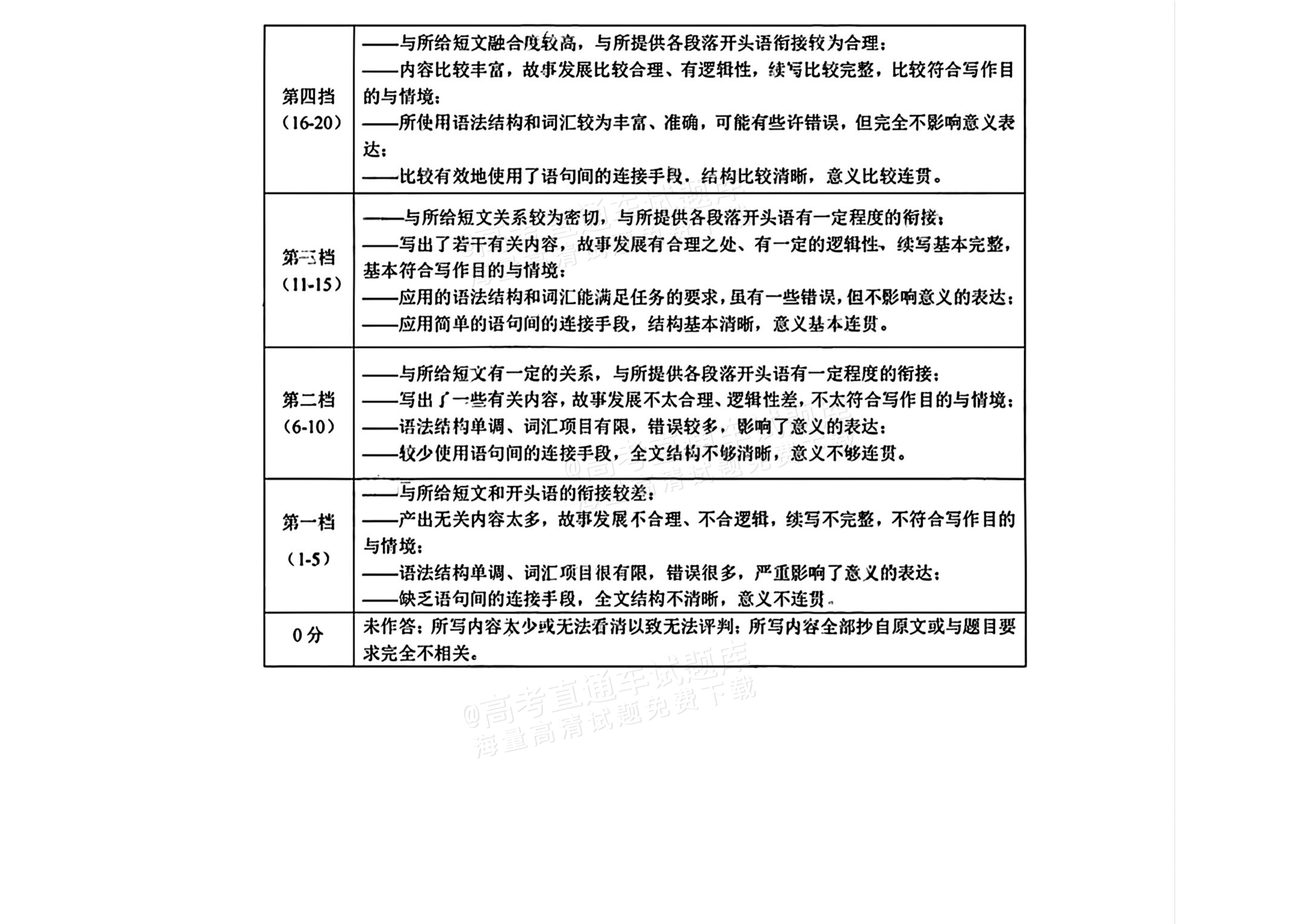
第四挡(16-20)——与所给短文融合度较高,与所提供各段落开头语衔接较为合理;
——内容比较丰富,故事发展比较合理、有逻辑性,续写比较完整,比较符合写作目的与情境;
——所使用语法结构和词汇较为丰富、准确,可能有些许错误,但完全不影响意义表达;
——比较有效地使用了语句间的连接手段,结构比较清晰,意义比较连贯。第三挡(11-15)——与所给短文关系较为密切,与所提供各段落开头语有一定程度的衔接;
——写出了若干有关内容,故事发展有合理之处、有一定的逻辑性,续写基本完整,基本符合写作目的与情境;
——应用的语法结构和词汇能满足任务的要求,虽有一些错误,但不影响意义的表达;
——应用简单的语句间的连接手段,结构基本清晰,意义基本连贯。第二档(6-10)——与所给短文有一定的关系,与所提供各段落开头语有一定程度的衔接;
——写出了一些有关内容,故事发展不太合理、逻辑性差,不太符合写作目的与情境;
——语法结构单调、词汇项目有限,错误较多,影响了意义的表达;
——较少使用语句间的连接手段,全文结构不够清晰,意义不够连贯。第一档(1-5)——与所给短文和开头语的衔接较差;
——产出无关内容太多,故事发展不合理、不合逻辑,续写不完整,不符合写作目的与情境;
——语法结构单调、词汇项目很有限,错误很多,严重影响了意义的表达;
——缺乏语句间的连接手段,全文结构不清晰,意义不连贯。0分未作答;所写内容太少或无法看清以致无法评判;所写内容全部抄自原文或与题目要求完全不相关。
展开▼
资源详情
参考答案