2026广东二调(12月光大联考)英语试题及参考答案
资源简介
2026广东二调(12月光大联考)英语试题及参考答案(PDF版下载含详细解析)广东省2026届普通高中毕业班第二次调研考试
英语
2025. 12
本试卷共8页,满分120分,考试用时120分钟。
注意事项:1. 答卷前,考生务必在答题卡写上考生姓名、考生号、考场号、座位号等相关信息
2. 选择题每小题选出答案后,用2B铅笔把答案涂在答题卡相应的位置上。
3. 非选择题必须用黑色字迹的钢笔或签字笔作答,答案必须写在答题卡各题目指定区域内;如需改动的,先划掉原来的答案,然后再写上新的答案;不准使用铅笔和涂改液,不按以上要求作答的答案无效。
4. 考生必须保持答题卡的整洁,考试结束后,将试卷和答题卡一并交回。
第二部分 阅读理解(共两节,满分50分)
第一节(共15小题:每小题2.5分,满分37.5分)
阅读下列短文,从每题所给的A、B、C和D四个选项中,选出最佳答案。
A
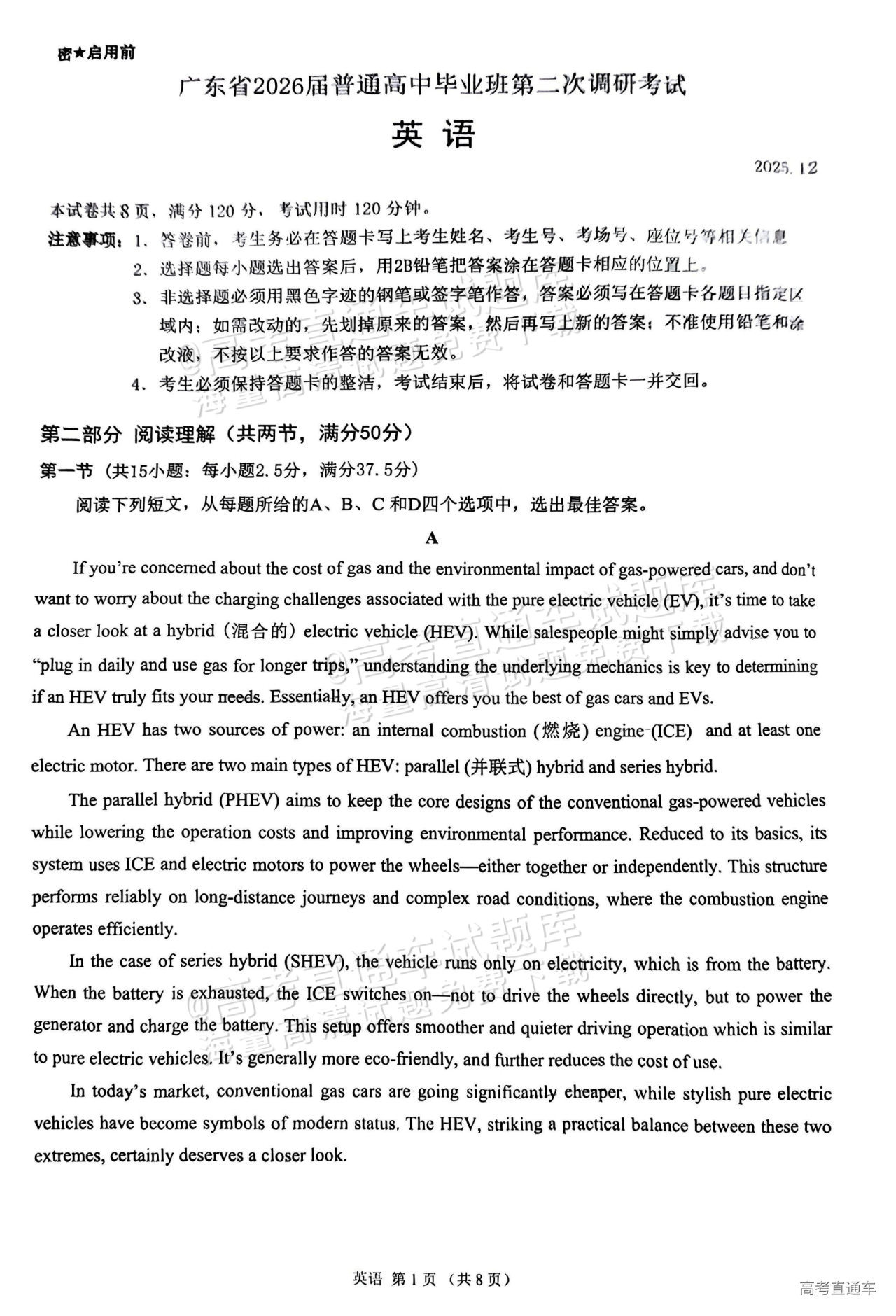
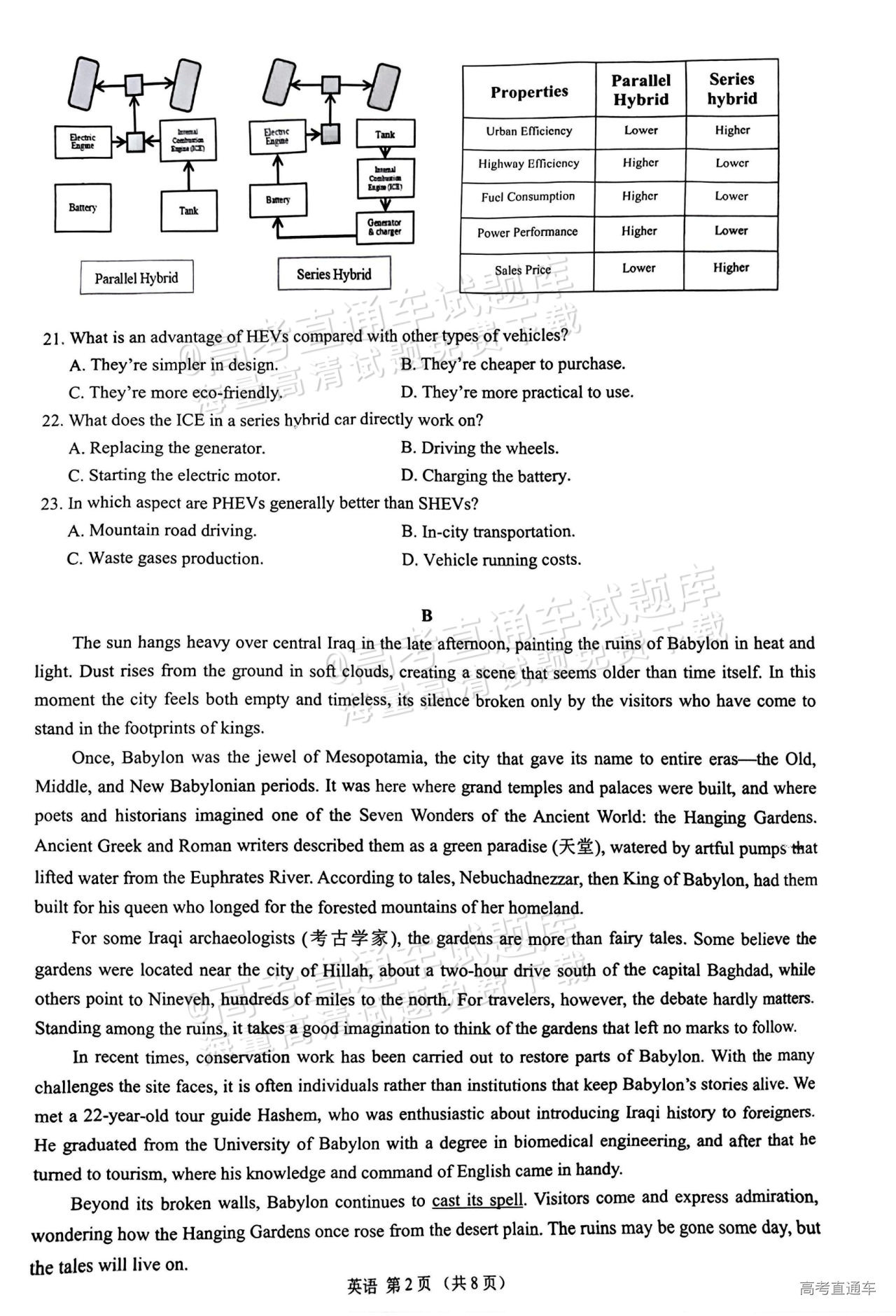
If you're concerned about the cost of gas and the environmental impact of gas-powered cars, and don't want to worry about the charging challenges associated with the pure electric vehicle (EV), it's time to take a closer look at a hybrid (混合的) electric vehicle (HEV). While salespeople might simply advise you to "plug in daily and use gas for longer trips," understanding the underlying mechanics is key to determining if an HEV truly fits your needs. Essentially, an HEV offers you the best of gas cars and EVs.
An HEV has two sources of power: an internal combustion (燃烧) engine-(ICE) and at least one electric motor. There are two main types of HEV: parallel (并联式) hybrid and series hybrid.
The parallel hybrid (PHEV) aims to keep the core designs of the conventional gas-powered vehicles while lowering the operation costs and improving environmental performance. Reduced to its basics, its system uses ICE and electric motors to power the wheels—either together or independently. This structure performs reliably on long-distance journeys and complex road conditions, where the combustion engine operates efficiently.
In the case of series hybrid (SHEV), the vehicle runs only on electricity, which is from the battery. When the battery is exhausted, the ICE switches on—not to drive the wheels directly, but to power the generator and charge the battery. This setup offers smoother and quieter driving operation which is similar to pure electric vehicles. It's generally more eco-friendly, and further reduces the cost of use.
In today's market, conventional gas cars are going significantly echeaper, while stylish pure electric vehicles have become symbols of modern status. The HEV, striking a practical balance between these two extremes, certainly deserves a closer look.
PropertiesParallel HybridSeries hybridUrban EfficiencyLowerHigherHighway EfficiencyHigherLowerFuel ConsumptionHigherLowerPower PerformanceHigherLowerSales PriceLowerHigher
21. What is an advantage of HEVs compared with other types of vehicles?
A. They're simpler in design. B. They're cheaper to purchase.
C. They're more eco-friendly. D. They're more practical to use.
22. What does the ICE in a series hybrid car directly work on?
A. Replacing the generator. B. Driving the wheels.
C. Starting the electric motor. D. Charging the battery.
23. In which aspect are PHEVs generally better than SHEVs?
A. Mountain road driving. B. In-city transportation.
C. Waste gases production. D. Vehicle running costs.
B
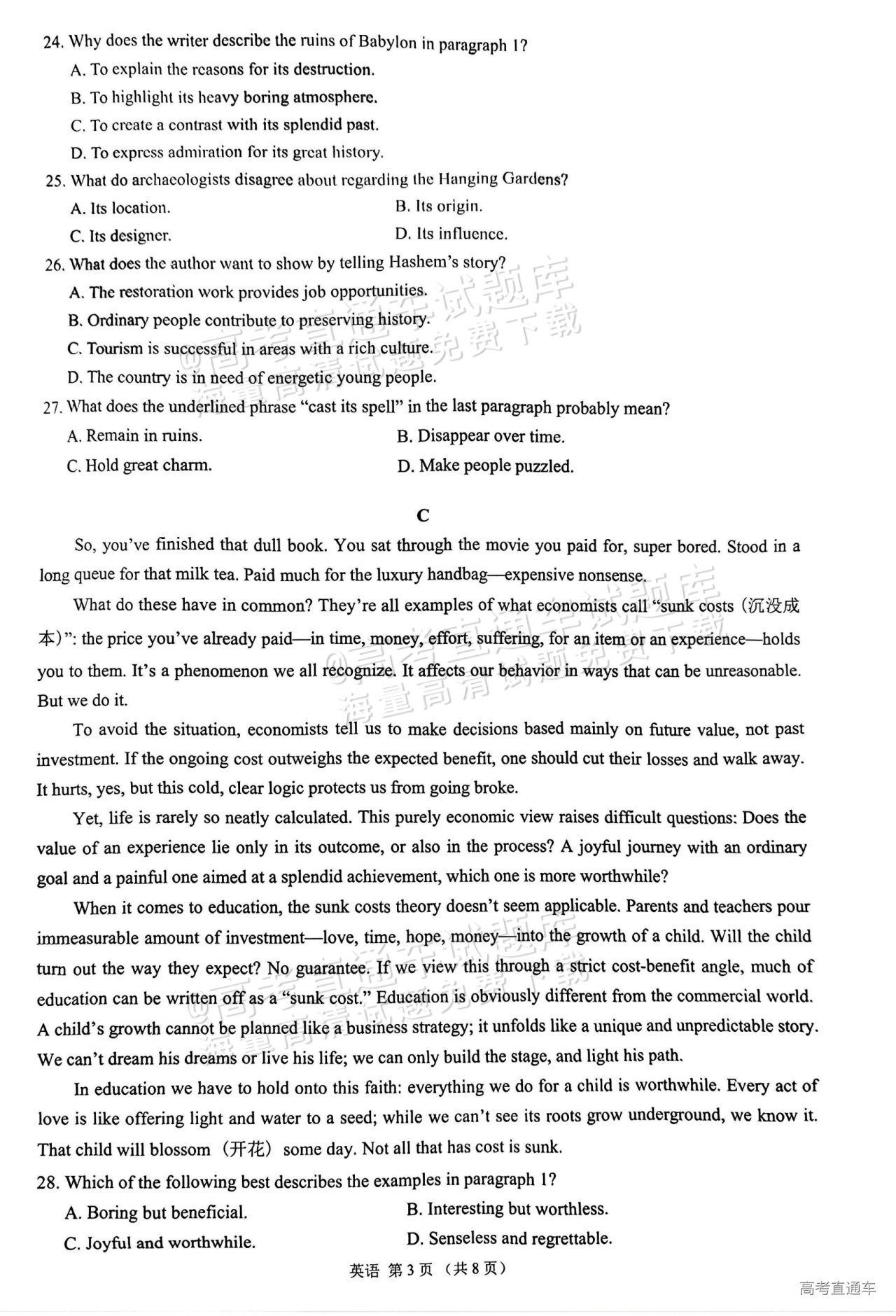
The sun hangs heavy over central Iraq in the late afternoon, painting the ruins of Babylon in heat and light. Dust rises from the ground in soft clouds, creating a scene that seems older than time itself. In this moment the city feels both empty and timeless, its silence broken only by the visitors who have come to stand in the footprints of kings.
Once, Babylon was the jewel of Mesopotamia, the city that gave its name to entire eras—the Old, Middle, and New Babylonian periods. It was here where grand temples and palaces were built, and where poets and historians imagined one of the Seven Wonders of the Ancient World: the Hanging Gardens. Ancient Greek and Roman writers described them as a green paradise (天堂), watered by artful pumps that lifted water from the Euphrates River. According to tales, Nebuchadnezzar, then King of Babylon, had them built for his queen who longed for the forested mountains of her homeland.
For some Iraqi archaeologists (考古学家), the gardens are more than fairy tales. Some believe the gardens were located near the city of Hillah, about a two-hour drive south of the capital Baghdad, while others point to Nineveh, hundreds of miles to the north. For travelers, however, the debate hardly matters. Standing among the ruins, it takes a good imagination to think of the gardens that left no marks to follow.
In recent times, conservation work has been carried out to restore parts of Babylon. With the many challenges the site faces, it is often individuals rather than institutions that keep Babylon's stories alive. We met a 22-year-old tour guide Hashem, who was enthusiastic about introducing Iraqi history to foreigners. He graduated from the University of Babylon with a degree in biomedical engineering, and after that he turned to tourism, where his knowledge and command of English came in handy.
Beyond its broken walls, Babylon continues to cast its spell. Visitors come and express admiration, wondering how the Hanging Gardens once rose from the desert plain. The ruins may be gone some day, but the tales will live on.
24. Why does the writer describe the ruins of Babylon in paragraph 1?
A. To explain the reasons for its destruction.
B. To highlight its heavy boring atmosphere.
C. To create a contrast with its splendid past.
D. To express admiration for its great history.
25. What do archaeologists disagree about regarding the Hanging Gardens?
A. Its location. B. Its origin.
C. Its designer. D. Its influence.
26. What does the author want to show by telling Hashem's story?
A. The restoration work provides job opportunities.
B. Ordinary people contribute to preserving history.
C. Tourism is successful in areas with a rich culture.
D. The country is in need of energetic young people.
27. What does the underlined phrase "cast its spell" in the last paragraph probably mean?
A. Remain in ruins. B. Disappear over time.
C. Hold great charm. D. Make people puzzled.
C
So, you've finished that dull book. You sat through the movie you paid for, super bored. Stood in a long queue for that milk tea. Paid much for the luxury handbag—expensive nonsense.
What do these have in common? They're all examples of what economists call "sunk costs (沉没成本)": the price you've already paid—in time, money, effort, suffering, for an item or an experience—holds you to them. It's a phenomenon we all recognize. It affects our behavior in ways that can be unreasonable. But we do it.
To avoid the situation, economists tell us to make decisions based mainly on future value, not past investment. If the ongoing cost outweighs the expected benefit, one should cut their losses and walk away. It hurts, yes, but this cold, clear logic protects us from going broke.
Yet, life is rarely so neatly calculated. This purely economic view raises difficult questions: Does the value of an experience lie only in its outcome, or also in the process? A joyful journey with an ordinary goal and a painful one aimed at a splendid achievement, which one is more worthwhile?
When it comes to education, the sunk costs theory doesn't seem applicable. Parents and teachers pour immeasurable amount of investment—love, time, hope, money—into the growth of a child. Will the child turn out the way they expect? No guarantee. If we view this through a strict cost-benefit angle, much of education can be written off as a "sunk cost." Education is obviously different from the commercial world. A child's growth cannot be planned like a business strategy; it unfolds like a unique and unpredictable story. We can't dream his dreams or live his life; we can only build the stage, and light his path.
In education we have to hold onto this faith: everything we do for a child is worthwhile. Every act of love is like offering light and water to a seed; while we can't see its roots grow underground, we know it. That child will blossom (开花) some day. Not all that has cost is sunk.
28. Which of the following best describes the examples in paragraph 1?
A. Boring but beneficial. B. Interesting but worthless.
C. Joyful and worthwhile. D. Senseless and regrettable.
29. What do economists advise us to do to avoid sunk costs?
A. Focus on the outcome. B. Ignore the future losses.
C. Calculate the past cost. D. Pursue the hidden gains.
30. What is the writer's attitude towards the investment in education?
A. Indifferent. B. Favorable.
C. Balanced. D. Critical.
31. Why does the author write the text?
A. To promote a principle. B. To correct a misbehavior.
C. To challenge a concept. D. To present a phenomenon.
D
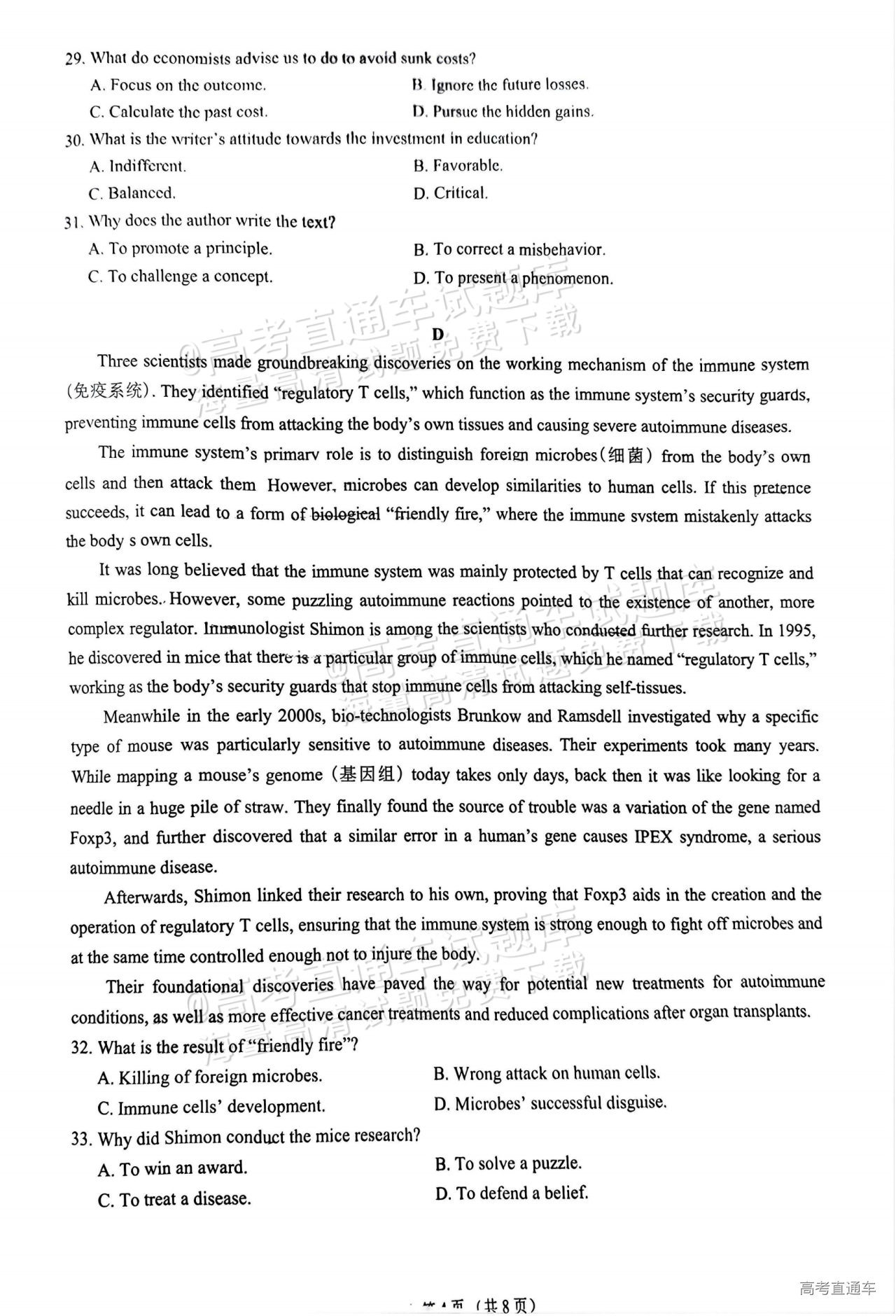
Three scientists made groundbreaking discoveries on the working mechanism of the immune system (免疫系统). They identified "regulatory T cells," which function as the immune system's security guards, preventing immune cells from attacking the body's own tissues and causing severe autoimmune diseases.
The immune system's primarv role is to distinguish foreign microbes(细菌)from the body's own cells and then attack them However, microbes can develop similarities to human cells. If this pretence succeeds, it can lead to a form of biological "friendly fire," where the immune svstem mistakenly attacks the body's own cells.
It was long believed that the immune system was mainly protected by T cells that can recognize and kill microbes. However, some puzzling autoimmune reactions pointed to the existence of another, more complex regulator. Immunologist Shimon is among the scientists who conducted further research. In 1995, he discovered in mice that there is a particular group of immune cells, which he named "regulatory T cells," working as the body's security guards that stop immune cells from attacking self-tissues.
Meanwhile in the early 2000s, bio-technologists Brunkow and Ramsdell investigated why a specific type of mouse was particularly sensitive to autoimmune diseases. Their experiments took many years. While mapping a mouse's genome (基因组) today takes only days, back then it was like looking for a needle in a huge pile of straw. They finally found the source of trouble was a variation of the gene named Foxp3, and further discovered that a similar error in a human's gene causes IPEX syndrome, a serious autoimmune disease.
Afterwards, Shimon linked their research to his own, proving that Foxp3 aids in the creation and the operation of regulatory T cells, ensuring that the immune system is strong enough to fight off microbes and at the same time controlled enough not to injure the body.
Their foundational discoveries have paved the way for potential new treatments for autoimmune conditions, as well as more effective cancer treatments and reduced complications after organ transplants.
32. What is the result of "friendly fire"?
A. Killing of foreign microbes. B. Wrong attack on human cells.
C. Immune cells' development. D. Microbes' successful disguise.
33. Why did Shimon conduct the mice research?
A. To win an award. B. To solve a puzzle.
C. To treat a disease. D. To defend a belief.
34. What's the purpose of mentioning "a needle in a huge pile of straw" in paragraph 4?
A. To introduce the long history of medical science.
B. To emphasize the important role of the lab mice.
C. To stress the difficulty of doing the experiments.
D. To show the rareness of an autoimmune disease.
35. What is the root reason of autoimmune diseases according to the discoveries?
A. An error happens to the Foxp3 gene.
B. Regulatory T cells are distinguished.
C. The immune system is under attack.
D. Microbes force into the human body.
第二节(共5小题;每小题2.5分,满分12.5分)
阅读下面短文,从短文后的选项中选出能填入空白处的最佳选项。选项中有两项为多余选项。
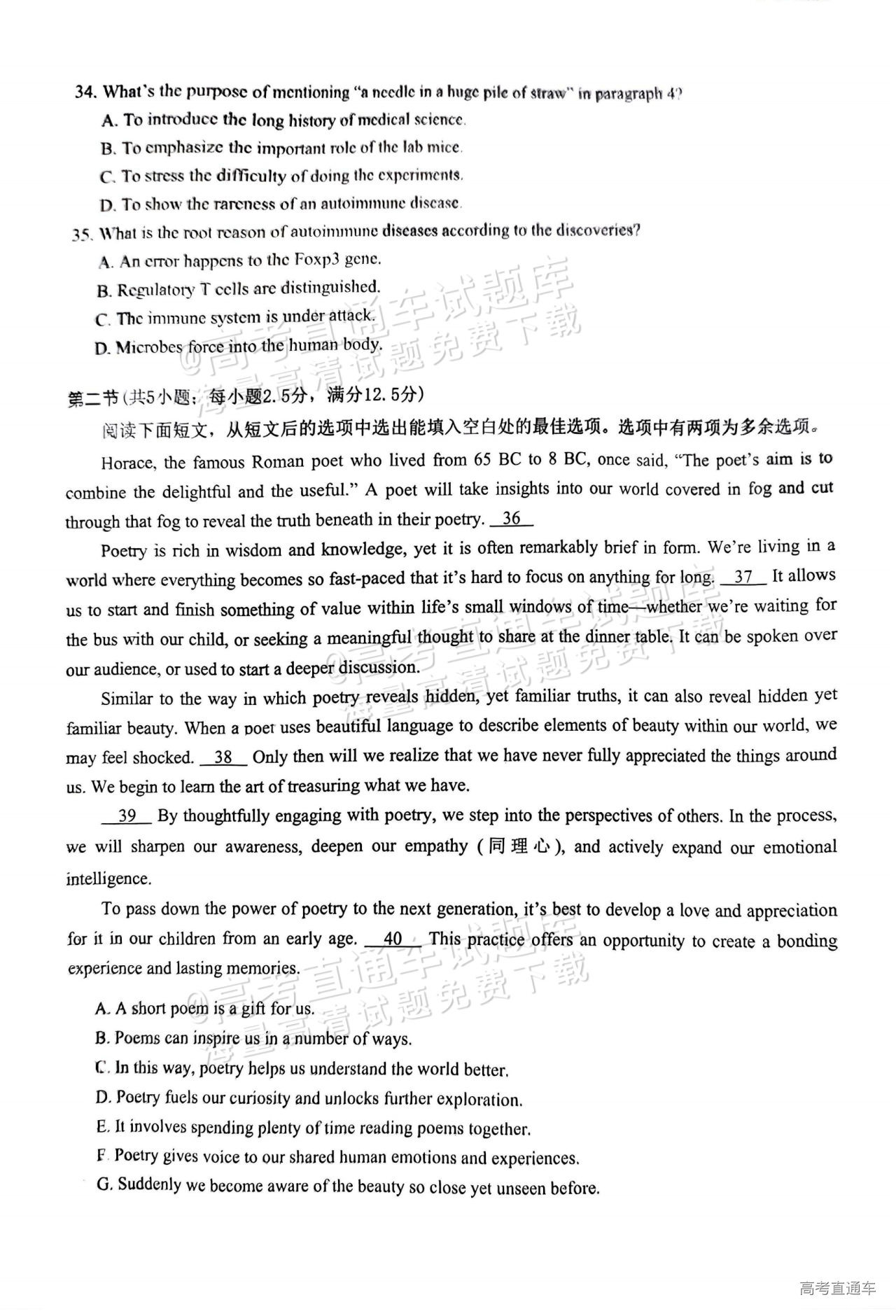
Horace, the famous Roman poet who lived from 65 BC to 8 BC, once said, "The poet's aim is to combine the delightful and the useful." A poet will take insights into our world covered in fog and cut through that fog to reveal the truth beneath in their poetry. 36
Poetry is rich in wisdom and knowledge, yet it is often remarkably brief in form. We're living in a world where everything becomes so fast-paced that it's hard to focus on anything for long. 37 It allows us to start and finish something of value within life's small windows of time—whether we're waiting for the bus with our child, or seeking a meaningful thought to share at the dinner table. It can be spoken over our audience, or used to start a deeper discussion.
Similar to the way in which poetry reveals hidden, yet familiar truths, it can also reveal hidden yet familiar beauty. When a poet uses beautiful language to describe elements of beauty within our world, we may feel shocked. 38 Only then will we realize that we have never fully appreciated the things around us. We begin to learn the art of treasuring what we have.
39 By thoughtfully engaging with poetry, we step into the perspectives of others. In the process, we will sharpen our awareness, deepen our empathy (同理心), and actively expand our emotional intelligence.
To pass down the power of poetry to the next generation, it's best to develop a love and appreciation for it in our children from an early age. 40 This practice offers an opportunity to create a bonding experience and lasting memories.
A. A short poem is a gift for us.
B. Poems can inspire us in a number of ways.
C. In this way, poetry helps us understand the world better.
D. Poetry fuels our curiosity and unlocks further exploration.
E. It involves spending plenty of time reading poems together.
F Poetry gives voice to our shared human emotions and experiences.
G. Suddenly we become aware of the beauty so close yet unseen before.
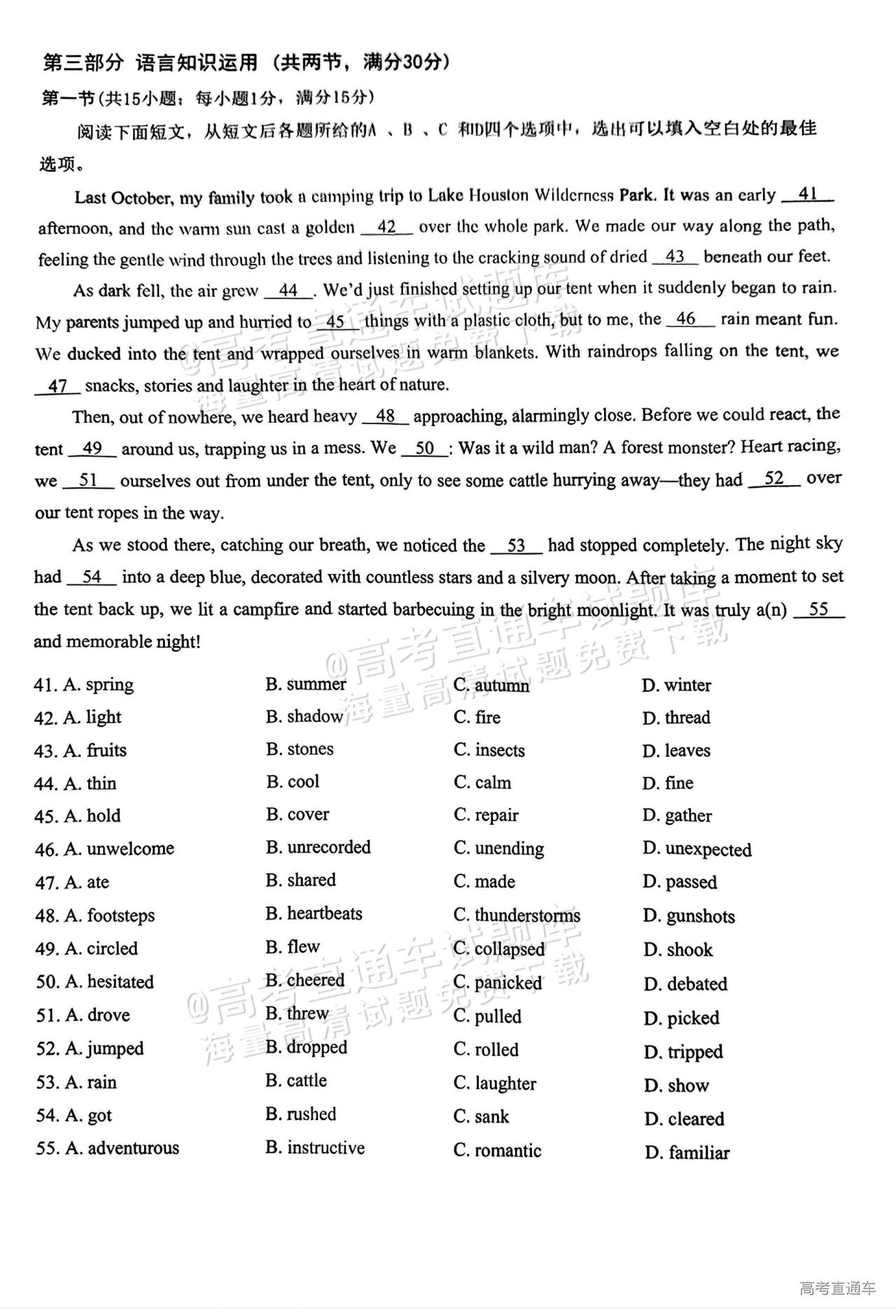
第三部分 语言知识运用(共两节,满分30分)
第一节(共15小题;每小题1分,满分15分)
阅读下面短文,从短文后各题所给的A、B、C和D四个选项中,选出可以填入空白处的最佳选项。
Last October, my family took a camping trip to Lake Houston Wilderness Park. It was an early 41 afternoon, and the warm sun cast a golden 42 over the whole park. We made our way along the path, feeling the gentle wind through the trees and listening to the cracking sound of dried 43 beneath our feet.
As dark fell, the air grew 44. We'd just finished setting up our tent when it suddenly began to rain. My parents jumped up and hurried to 45 things with a plastic cloth, but to me, the 46 rain meant fun. We ducked into the tent and wrapped ourselves in warm blankets. With raindrops falling on the tent, we 47 snacks, stories and laughter in the heart of nature.
Then, out of nowhere, we heard heavy 48 approaching, alarmingly close. Before we could react, the tent 49 around us, trapping us in a mess. We 50: Was it a wild man? A forest monster? Heart racing, we 51 ourselves out from under the tent, only to see some cattle hurrying away—they had 52 over our tent ropes in the way.
As we stood there, catching our breath, we noticed the 53 had stopped completely. The night sky had 54 into a deep blue, decorated with countless stars and a silvery moon. After taking a moment to set the tent back up, we lit a campfire and started barbecuing in the bright moonlight. It was truly a(n) 55 and memorable night!
41. A. spring B. summer C. autumn D. winter
42. A. light B. shadow C. fire D. thread
43. A. fruits B. stones C. insects D. leaves
44. A. thin B. cool C. calm D. fine
45. A. hold B. cover C. repair D. gather
46. A. unwelcome B. unrecorded C. unending D. unexpected
47. A. ate B. shared C. made D. passed
48. A. footsteps B. heartbeats C. thunderstorms D. gunshots
49. A. circled B. flew C. collapsed D. shook
50. A. hesitated B. cheered C. panicked D. debated
51. A. drove B. threw C. pulled D. picked
52. A. jumped B. dropped C. rolled D. tripped
53. A. rain B. cattle C. laughter D. show
54. A. got B. rushed C. sank D. cleared
55. A. adventurous B. instructive C. romantic D. familiar
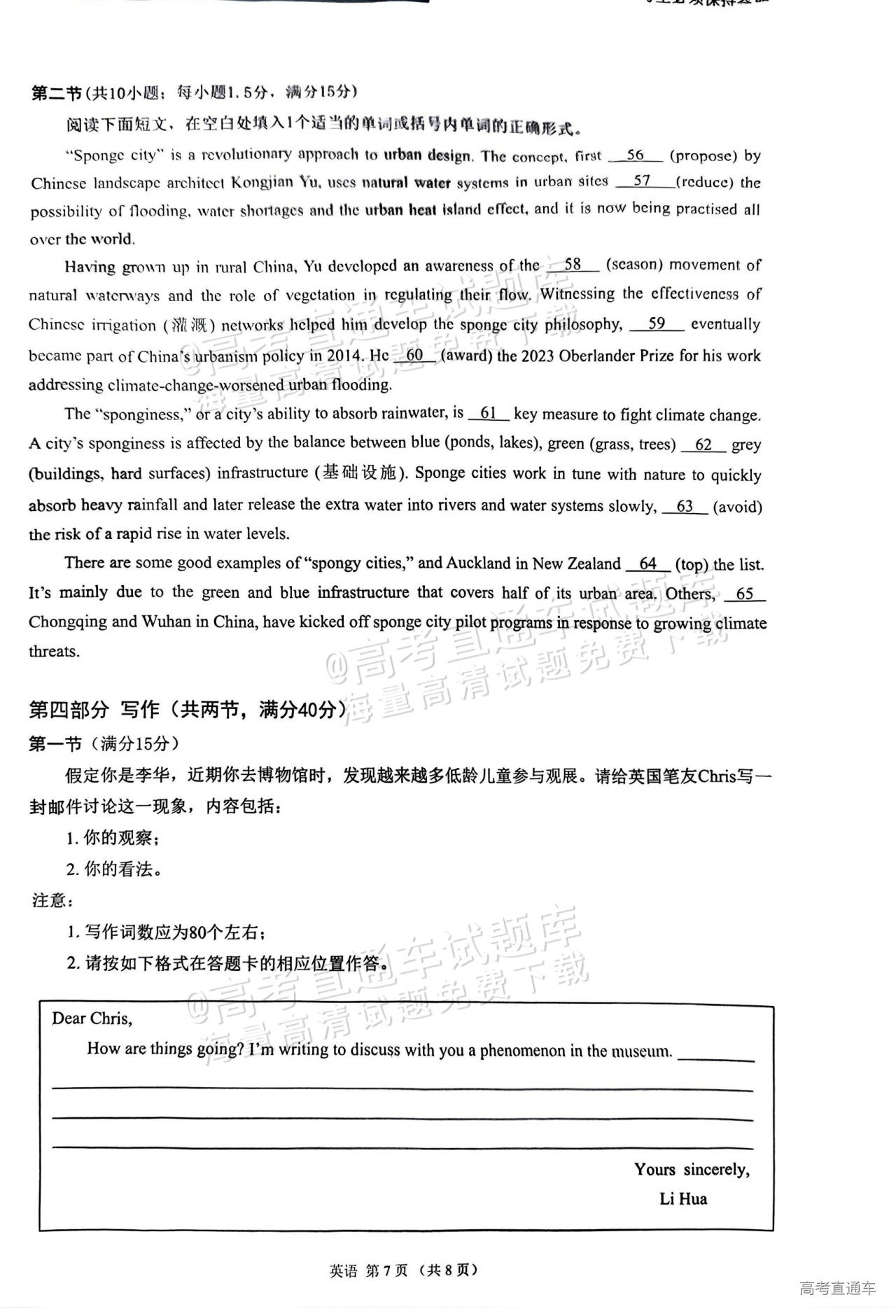
第二节(共10小题;每小题1.5分,满分15分)
阅读下面短文,在空白处填入1个适当的单词或括号内单词的正确形式。
"Sponge city" is a revolutionary approach to urban design. The concept, first 56 (propose) by Chinese landscape architect Kongjian Yu, uses natural water systems in urban sites 57 (reduce) the possibility of flooding, water shortages and the urban heat island effect, and it is now being practised all over the world.
Having grown up in rural China, Yu developed an awareness of the 58 (season) movement of natural waterways and the role of vegetation in regulating their flow. Witnessing the effectiveness of Chinese irrigation (灌溉) networks helped him develop the sponge city philosophy, 59 eventually became part of China's urbanism policy in 2014. He 60 (award) the 2023 Oberlander Prize for his work addressing climate-change-worsened urban flooding.
The "sponginess," or a city's ability to absorb rainwater, is 61 key measure to fight climate change. A city's sponginess is affected by the balance between blue (ponds, lakes), green (grass, trees) 62 grey (buildings, hard surfaces) infrastructure (基础设施). Sponge cities work in tune with nature to quickly absorb heavy rainfall and later release the extra water into rivers and water systems slowly, 63 (avoid) the risk of a rapid rise in water levels.
There are some good examples of "spongy cities," and Auckland in New Zealand 64 (top) the list. It's mainly due to the green and blue infrastructure that covers half of its urban area. Others, 65 Chongqing and Wuhan in China, have kicked off sponge city pilot programs in response to growing climate threats.
第四部分 写作(共两节,满分40分)
第一节(满分15分)
假定你是李华,近期你去博物馆时,发现越来越多低龄儿童参与观展。请给英国笔友Chris写一封邮件讨论这一现象,内容包括:
1. 你的观察;
2. 你的看法。
注意:
1. 写作词数应为80个左右;
2. 请按如下格式在答题卡的相应位置作答。
Dear Chris,
How are things going? I'm writing to discuss with you a phenomenon in the museum. ___
Yours sincerely,
Li Hua
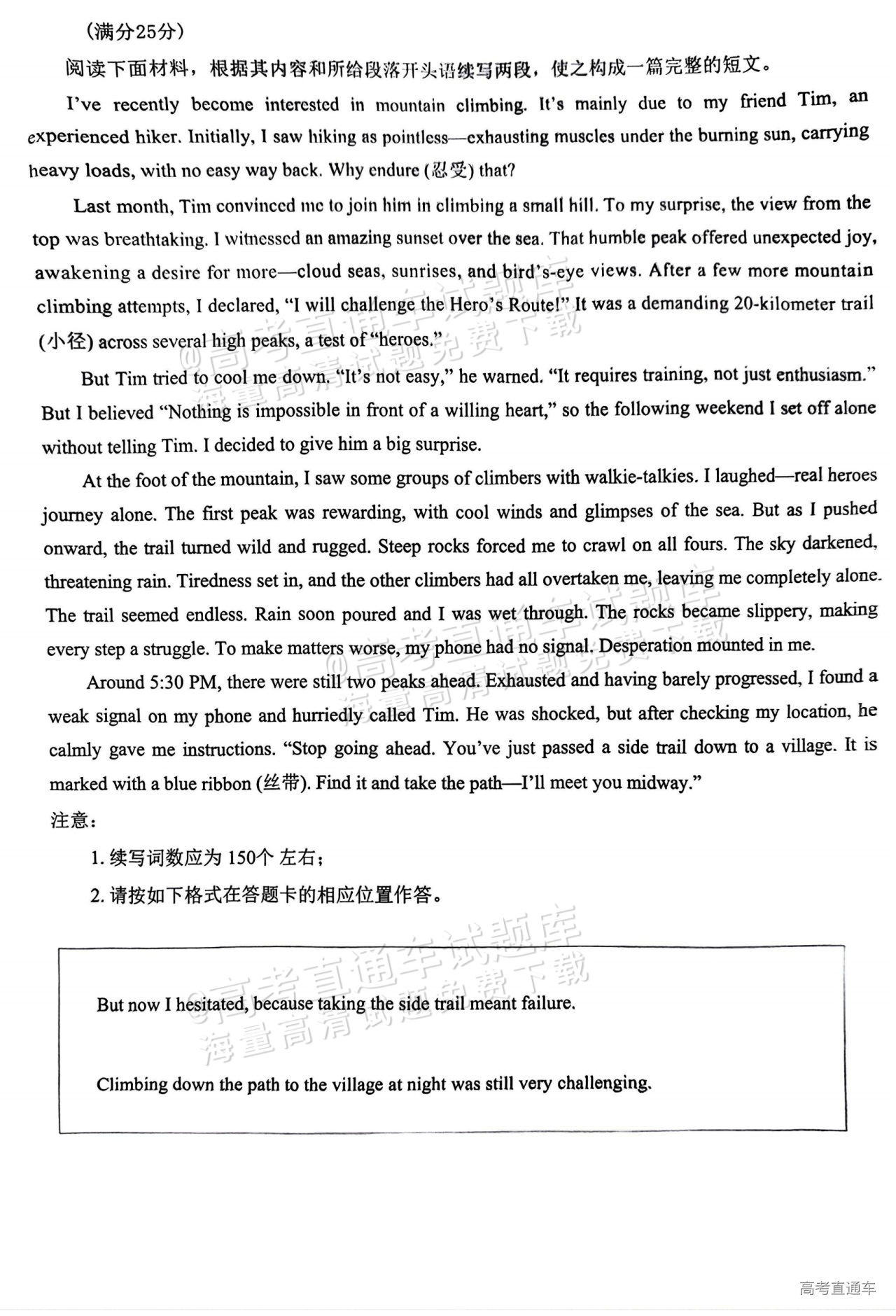
(满分25分)
阅读下面材料,根据其内容和所给段落开头语续写两段,使之构成一篇完整的短文。
I've recently become interested in mountain climbing. It's mainly due to my friend Tim, an experienced hiker. Initially, I saw hiking as pointless—exhausting muscles under the burning sun, carrying heavy loads, with no easy way back. Why endure (忍受) that?
Last month, Tim convinced me to join him in climbing a small hill. To my surprise, the view from the top was breathtaking. I witnessed an amazing sunset over the sea. That humble peak offered unexpected joy, awakening a desire for more—cloud seas, sunrises, and bird's-eye views. After a few more mountain climbing attempts, I declared, "I will challenge the Hero's Route!" It was a demanding 20-kilometer trail (小径) across several high peaks, a test of "heroes."
But Tim tried to cool me down. "It's not easy," he warned. "It requires training, not just enthusiasm." But I believed "Nothing is impossible in front of a willing heart," so the following weekend I set off alone without telling Tim. I decided to give him a big surprise.
At the foot of the mountain, I saw some groups of climbers with walkie-talkies. I laughed—real heroes journey alone. The first peak was rewarding, with cool winds and glimpses of the sea. But as I pushed onward, the trail turned wild and rugged. Steep rocks forced me to crawl on all fours. The sky darkened, threatening rain. Tiredness set in, and the other climbers had all overtaken me, leaving me completely alone. The trail seemed endless. Rain soon poured and I was wet through. The rocks became slippery, making every step a struggle. To make matters worse, my phone had no signal. Desperation mounted in me.
Around 5:30 PM, there were still two peaks ahead. Exhausted and having barely progressed, I found a weak signal on my phone and hurriedly called Tim. He was shocked, but after checking my location, he calmly gave me instructions. "Stop going ahead. You've just passed a side trail down to a village. It is marked with a blue ribbon (丝带). Find it and take the path—I'll meet you midway."
注意:
1. 续写词数应为150个左右;
2. 请按如下格式在答题卡的相应位置作答。
But now I hesitated, because taking the side trail meant failure.
Climbing down the path to the village at night was still very challenging.
广东省2026届普通高中毕业班第二次调研考试
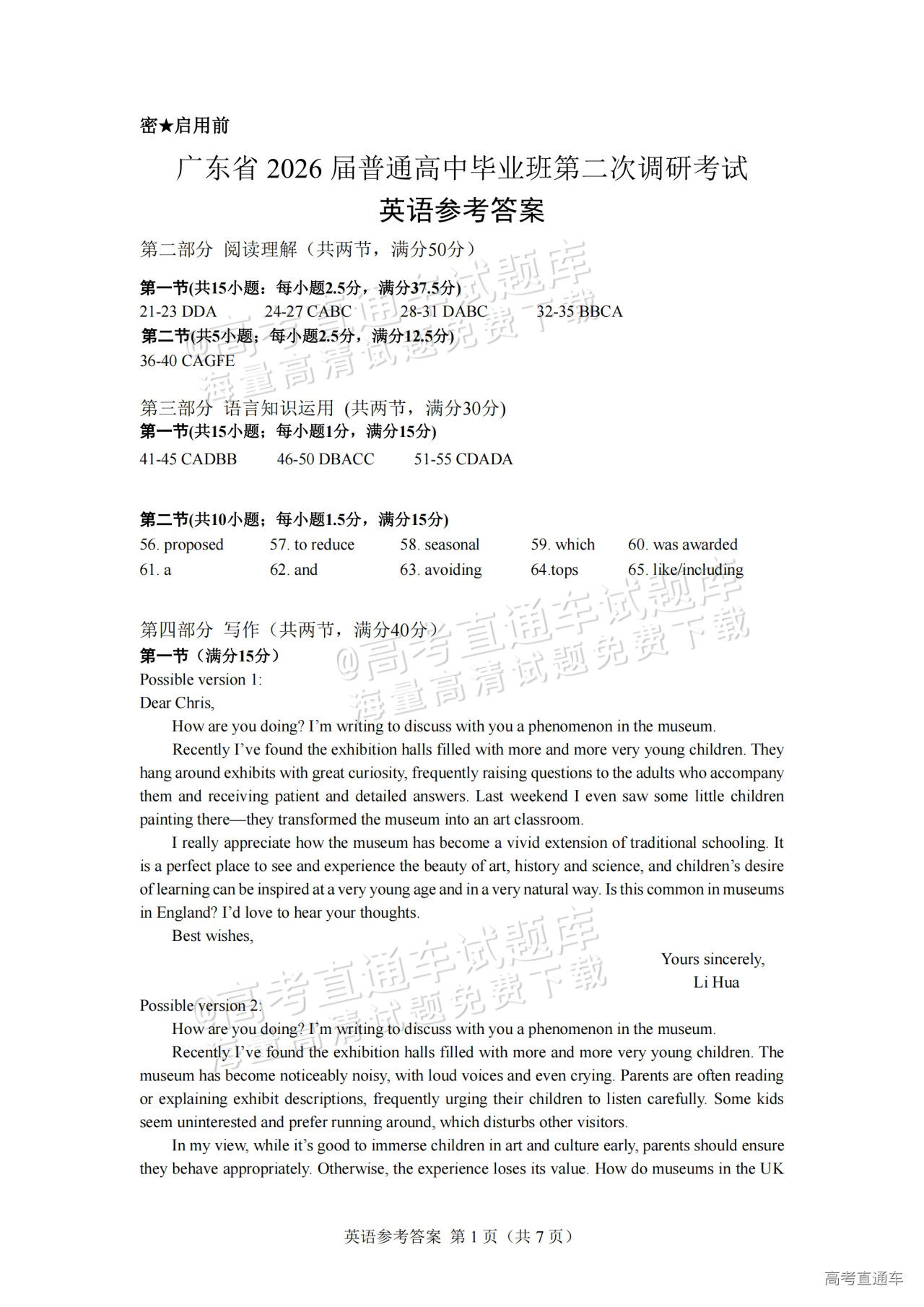
英语参考答案
第二部分 阅读理解(共两节,满分50分)
第一节(共15小题:每小题2.5分,满分37.5分)
21-23 DDA 24-27 CABC 28-31 DABC 32-35 BBCA
第二节(共5小题;每小题2.5分,满分12.5分)
36-40 CAGFE
第三部分 语言知识运用(共两节,满分30分)
第一节(共15小题;每小题1分,满分15分)
41-45 CADBB 46-50 DBACC 51-55 CDADA
第二节(共10小题;每小题1.5分,满分15分)
56. proposed 57. to reduce 58. seasonal 59. which 60. was awarded
61. a 62. and 63. avoiding 64.tops 65. like/including
第四部分 写作(共两节,满分40分)
第一节(满分15分)
Possible version 1:
Dear Chris,
How are you doing? I'm writing to discuss with you a phenomenon in the museum.
Recently I've found the exhibition halls filled with more and more very young children. They hang around exhibits with great curiosity, frequently raising questions to the adults who accompany them and receiving patient and detailed answers. Last weekend I even saw some little children painting there—they transformed the museum into an art classroom.
I really appreciate how the museum has become a vivid extension of traditional schooling. It is a perfect place to see and experience the beauty of art, history and science, and children's desire of learning can be inspired at a very young age and in a very natural way. Is this common in museums in England? I'd love to hear your thoughts.
Best wishes,
Yours sincerely,
Li Hua
Possible version 2:
How are you doing? I'm writing to discuss with you a phenomenon in the museum.
Recently I've found the exhibition halls filled with more and more very young children. The museum has become noticeably noisy, with loud voices and even crying. Parents are often reading or explaining exhibit descriptions, frequently urging their children to listen carefully. Some kids seem uninterested and prefer running around, which disturbs other visitors.
In my view, while it's good to immerse children in art and culture early, parents should ensure they behave appropriately. Otherwise, the experience loses its value. How do museums in the UK
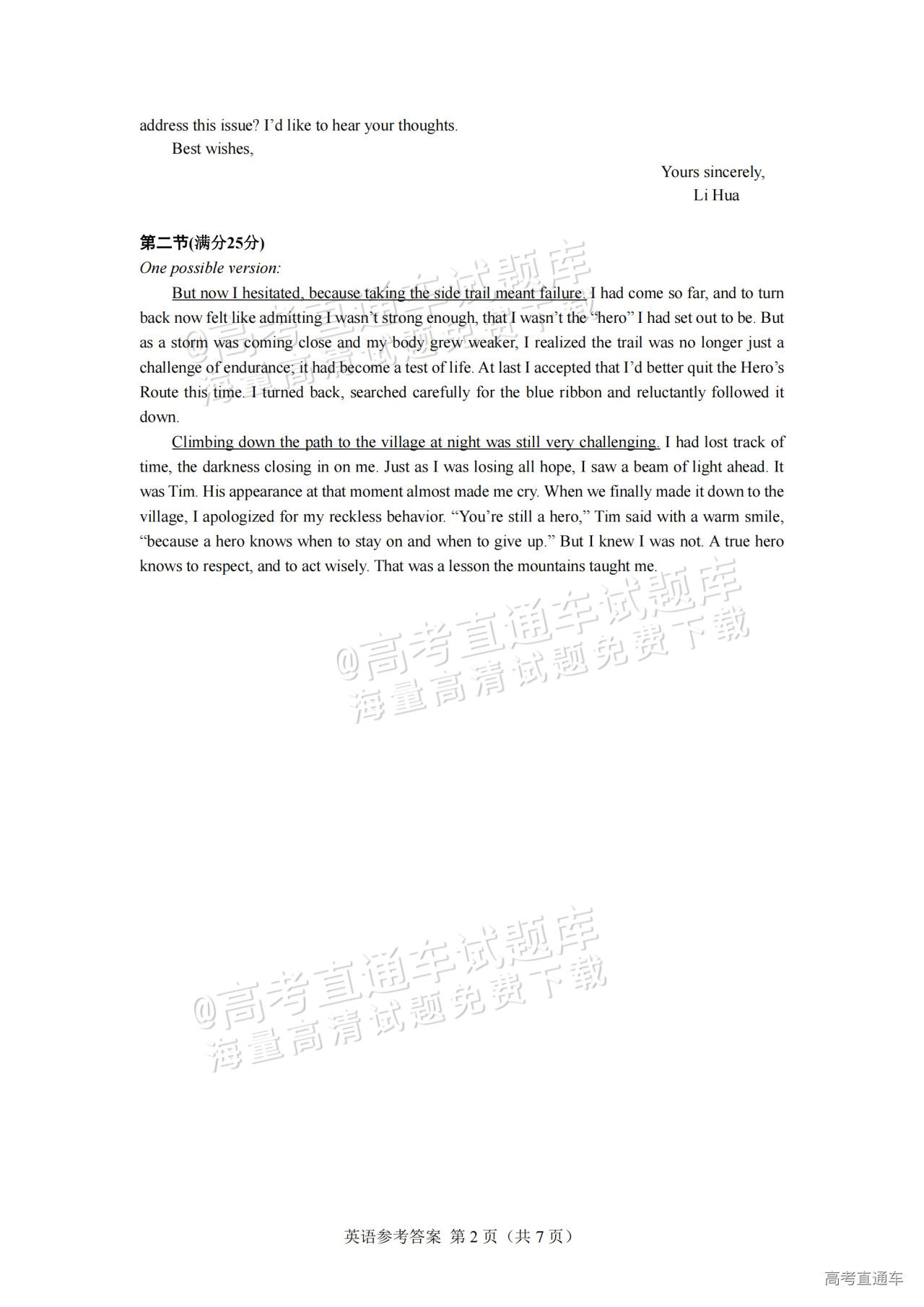
address this issue? I'd like to hear your thoughts.
Best wishes,
Yours sincerely Li Hua
第二节(满分25分)
One possible version:
But now I hesitated, because taking the side trail meant failure. I had come so far, and to turn back now felt like admitting I wasn't strong enough, that I wasn't the "hero" I had set out to be. But as a storm was coming close and my body grew weaker, I realized the trail was no longer just a challenge of endurance; it had become a test of life. At last I accepted that I'd better quit the Hero's Route this time. I turned back, searched carefully for the blue ribbon and reluctantly followed it down.
Climbing down the path to the village at night was still very challenging. I had lost track of time, the darkness closing in on me. Just as I was losing all hope, I saw a beam of light ahead. It was Tim. His appearance at that moment almost made me cry. When we finally made it down to the village, I apologized for my reckless behavior. "You're still a hero," Tim said with a warm smile, "because a hero knows when to stay on and when to give up." But I knew I was not. A true hero knows to respect, and to act wisely. That was a lesson the mountains taught me.
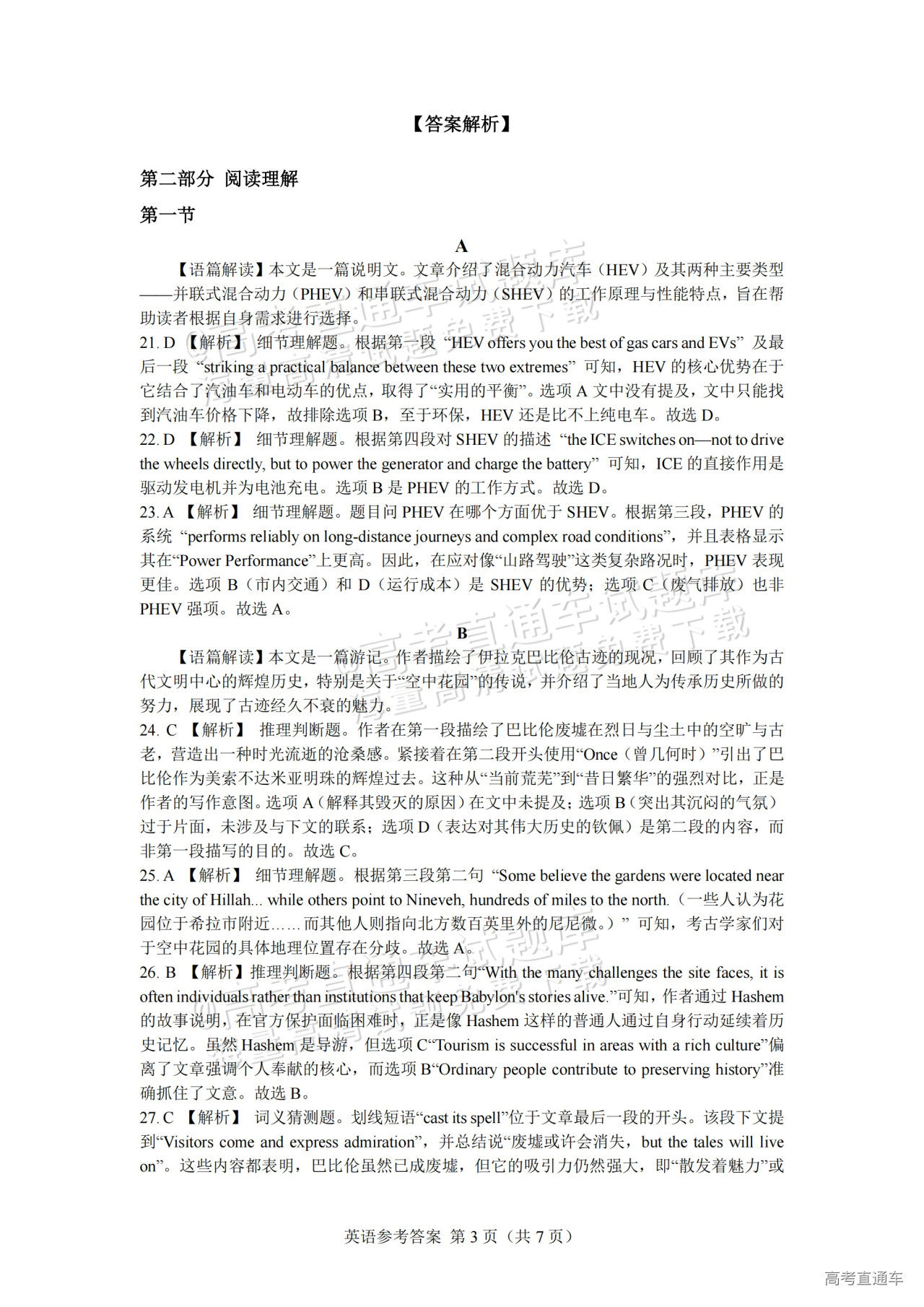
【答案解析】
第二部分 阅读理解
第一节
A
【语篇解读】本文是一篇说明文。文章介绍了混合动力汽车(HEV)及其两种主要类型并联式混合动力(PHEV)和串联式混合动力(SHEV)的工作原理与性能特点,旨在帮助读者根据自身需求进行选择。
21. D【解析】细节理解题。根据第一段“HEV offers you the best of gas cars and EVs”及最后一段“striking a practical balance between these two extremes”可知,HEV的核心优势在于它结合了汽油车和电动车的优点,取得了“实用的平衡”。选项A文中没有提及,文中只能找到汽油车价格下降,故排除选项B,至于环保,HEV还是比不上纯电车。故选D。
22. D【解析】细节理解题。根据第四段对SHEV的描述“the ICE switches on—not to drive the wheels directly, but to power the generator and charge the battery”可知,ICE的直接作用是驱动发电机并为电池充电。选项B是PHEV的工作方式。故选D。
23. A【解析】细节理解题。题目问PHEV在哪个方面优于SHEV。根据第三段,PHEV的系统“performs reliably on long-distance journeys and complex road conditions”,并且表格显示其在“Power Performance”上更高。因此,在应对像“山路驾驶”这类复杂路况时,PHEV表现更佳。选项B(市内交通)和D(运行成本)是SHEV的优势;选项C(废气排放)也非PHEV强项。故选A。
B
【语篇解读】本文是一篇游记。作者描绘了伊拉克巴比伦古迹的现况,回顾了其作为古代文明中心的辉煌历史,特别是关于“空中花园”的传说,并介绍了当地人为传承历史所做的努力,展现了古迹经久不衰的魅力。
24. C【解析】推理判断题。作者在第一段描绘了巴比伦废墟在烈日与尘土中的空旷与古老,营造出一种时光流逝的沧桑感。紧接着在第二段开头使用“Once(曾几何时)”引出了巴比伦作为美索不达米亚明珠的辉煌过去。这种从“当前荒芜”到“昔日繁华”的强烈对比,正是作者的写作意图。选项A(解释其毁灭的原因)在文中未提及;选项B(突出其沉闷的气氛)过于片面,未涉及与下文的联系;选项D(表达对其伟大历史的钦佩)是第二段的内容,而非第一段描写的目的。故选C。
25. A【解析】细节理解题。根据第三段第二句“Some believe the gardens were located near the city of Hillah... while others point to Nineveh, hundreds of miles to the north.(一些人认为花园位于希拉市附近...而其他人则指向北方数百英里外的尼尼微。)”可知,考古学家们对于空中花园的具体地理位置存在分歧。故选A。
26. B【解析】推理判断题。根据第四段第二句“With the many challenges the site faces, it is often individuals rather than institutions that keep Babylon's stories alive.”可知,作者通过Hashem的故事说明,在官方保护面临困难时,正是像Hashem这样的普通人通过自身行动延续着历史记忆。虽然Hashem是导游,但选项C“Tourism is successful in areas with a rich culture”偏离了文章强调个人奉献的核心,而选项B“Ordinary people contribute to preserving history”准确抓住了文意。故选B。
27. C【解析】词义猜测题。划线短语“cast its spell”位于文章最后一段的开头。该段下文提到“Visitors come and express admiration”,并总结说“废墟或许会消失,但the tales will live on”。这些内容都表明,巴比伦虽然已成废墟,但它的吸引力仍然强大,即“散发着魅力”或
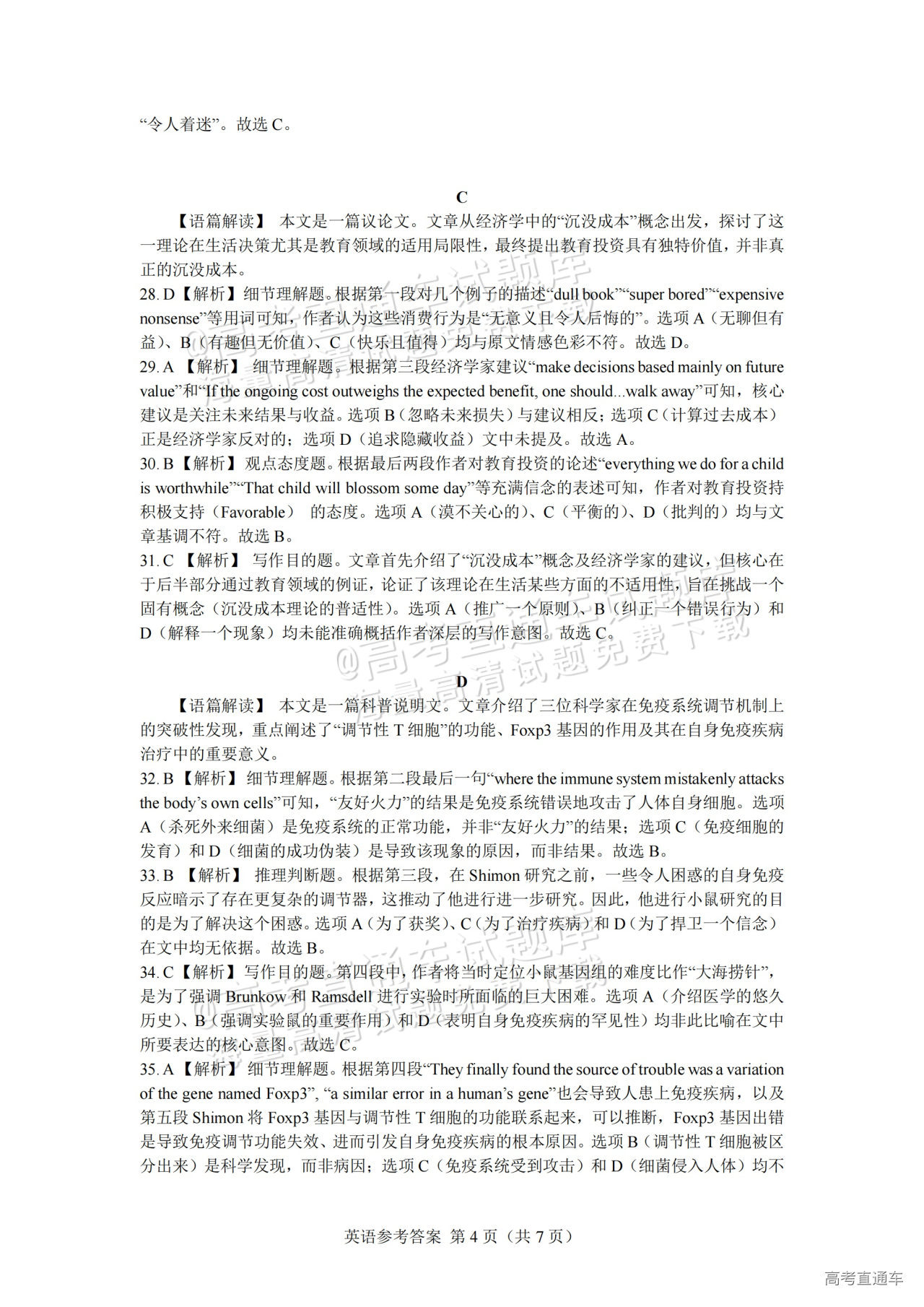
“令人着迷”。故选C。
C
【语篇解读】本文是一篇议论文。文章从经济学中的“沉没成本”概念出发,探讨了这一理论在生活决策尤其是教育领域的适用局限性,最终提出教育投资具有独特价值,并非真正的沉没成本。
28. D【解析】细节理解题。根据第一段对几个例子的描述“dull book”“super bored”“expensive nonsense”等用词可知,作者认为这些消费行为是“无意义且令人后悔的”。选项A(无聊但有益)、B(有趣但无价值)、C(快乐且值得)均与原文情感色彩不符。故选D。
29. A【解析】细节理解题。根据第三段经济学家建议“make decisions based mainly on future value”和“If the ongoing cost outweighs the expected benefit, one should...walk away”可知,核心建议是关注未来结果与收益。选项B(忽略未来损失)与建议相反;选项C(计算过去成本)正是经济学家反对的;选项D(追求隐藏收益)文中未提及。故选A。
30. B【解析】观点态度题。根据最后两段作者对教育投资的论述“everything we do for a child is worthwhile”“That child will blossom some day”等充满信念的表述可知,作者对教育投资持积极支持(Favorable)的态度。选项A(漠不关心的)、C(平衡的)、D(批判的)均与文章基调不符。故选B。
31. C【解析】写作目的题。文章首先介绍了“沉没成本”概念及经济学家的建议,但核心在于后半部分通过教育领域的例证,论证了该理论在生活某些方面的不适用性,旨在挑战一个固有概念(沉没成本理论的普适性)。选项A(推广一个原则)、B(纠正一个错误行为)和D(解释一个现象)均未能准确概括作者深层的写作意图。故选C。
D
【语篇解读】本文是一篇科普说明文。文章介绍了三位科学家在免疫系统调节机制上的突破性发现,重点阐述了“调节性T细胞”的功能、Foxp3基因的作用及其在自身免疫疾病治疗中的重要意义。
32. B【解析】细节理解题。根据第二段最后一句“where the immune system mistakenly attacks the body's own cells”可知,“友好火力”的结果是免疫系统错误地攻击了人体自身细胞。选项A(杀死外来细菌)是免疫系统的正常功能,并非“友好火力”的结果;选项C(免疫细胞的发育)和D(细菌的成功伪装)是导致该现象的原因,而非结果。故选B。
33. B【解析】推理判断题。根据第三段,在Shimon研究之前,一些令人困惑的自身免疫反应暗示了存在更复杂的调节器,这推动了他进行进一步研究。因此,他进行小鼠研究的目的是为了解决这个困惑。选项A(为了获奖)、C(为了治疗疾病)和D(为了捍卫一个信念)在文中均无依据。故选B。
34. C【解析】写作目的题。第四段中,作者将当时定位小鼠基因组的难度比作“大海捞针”,是为了强调 Brunkow 和 Ramsdell 进行实验时所面临的巨大困难。选项 A(介绍医学的悠久历史)、B(强调实验鼠的重要作用)和 D(表明自身免疫疾病的罕见性)均非此比喻在文中所要表达的核心意图。故选 C。
35. A【解析】细节理解题。根据第四段“They finally found the source of trouble was a variation of the gene named Foxp3”,“a similar error in a human's gene”也会导致人患上免疫疾病,以及第五段Shimon将Foxp3基因与调节性T细胞的功能联系起来,可以推断,Foxp3基因出错是导致免疫调节功能失效、进而引发自身免疫疾病的根本原因。选项B(调节性T细胞被区分出来)是科学发现,而非病因;选项C(免疫系统受到攻击)和D(细菌侵入人体)均不
是文中所述的自身免疫疾病的根源。故选A。
第二节
【语篇解读】本文是一篇议论文。文章围绕诗歌的价值展开论述,从揭示真理、呈现美感、提升情商以及代际传承等多个层面,阐释了诗歌在快节奏现代生活中的独特意义。
36. C【解析】该空承上启下。上文引用贺拉斯的名言并阐述诗人能“cut through that fog to reveal the truth beneath”,选项C中的“In this way”完美承接上文“揭示真理”这一功能,并总结指出其作用是“understand the world better”,对应前文中诗人能“take insights into our world”。故选C。
37. A【解析】该空需要对下文进行概括。下文具体描述了在等公交、晚餐分享等“life's small windows of time”里,诗歌可以开始并完成一件有价值的事。选项A“A short poem is a gift for us”是对这一情景的精准比喻和概括,与之形成呼应,也对应此段的段首句中提到的诗歌精短的特点,“it is often remarkably brief in form”。故选A。
38. G【解析】该空与上文构成顺承关系。上文提到诗人用美言描绘世间美,我们可能会感到震撼。选项G以“Suddenly”开头,生动地描绘了震撼后的结果——“we become aware of the beauty so close yet unseen before”,这与下文的“we have never fully appreciated the things around us”形成自然的逻辑衔接。故选G。
39. F【解析】该空为段落主旨句。下文的核心是“通过诗歌,we step into the perspectives of others,提升同理心和情商”。选项F指出“Poetry gives voice to our shared human emotions and experiences”,这句段首句也是段落的中心句,完美统领整个段落。故选F。
40. E【解析】该空需要提出具体建议。上文提到要从小培养孩子对诗歌的热爱,下文则说“这个实践”能创造 bonding experience(亲密体验)。选项E提出的“spending plenty of time reading poems together”正是这样一个具体且可操作的“practice”,与上下文紧密衔接。故选E。多余选项分析:
B项“诗歌能以多种方式激励我们”:内容过于宽泛,与文章中任何一段的具体论述焦点都不完全匹配。
D项“诗歌激发好奇心,开启进一步探索”:文章未涉及“探索”这一层面,故无法填入。
第三部分 语言知识运用
第一节
【语篇解读】本文是一篇记叙文。文章生动讲述了作者一家在秋日露营时经历的一场意外冒险:从享受温馨的雨中时光,到帐篷被牛群绊倒的惊慌,最后在雨过天晴的星空下烧烤,度过了一个充满惊喜而又难忘的夜晚。
41. C【解析】上下文逻辑题。根据开篇时间状语 "Last October" 可知,故事发生在秋季(autumn)。后文 "dried ... beneath our feet" 也暗示了秋天的落叶景象。
42. A【解析】名词辨析与语境题。句子"the warm sun cast a golden..."描述太阳洒下金色的光芒。A. light(光)最符合此意境。B. shadow(阴影)与"golden"和"warm sun"的积极意境矛盾;C. fire(火焰)过于强烈;D. thread(线)无法与"cast"形成合理搭配。
43. D【解析】名词辨析与常识题。在秋天的公园,脚下最可能发出"cracking sound"的是干枯的树叶(leaves)。
44. B【解析】形容词辨析与常识题。描述 "As dark fell, the air grew ..."。根据常识,入夜后空气会变得凉爽(cool)。A. thin(稀薄)不用于描述温度;C. calm(平静)描述状态而非
温度;D. fine(晴朗)不符合夜幕降临时的温度变化规律。
45. B【解析】动词辨析与语境题。下雨时,父母用塑料布去遮盖(cover)物品。A. hold (拿着)、C. repair(修理)、D. gather(收集)均不如"cover"能准确描述用防水布保护物品的动作。
46. D【解析】形容词辨析与上下文逻辑题。前文提到 "it suddenly began to rain", 所以这场雨是意外的 (unexpected)。A. unwelcome(不受欢迎的)是父母的视角,不是"我"的感受;B. unrecorded(未记录的)与文意无关;C. unending(无休止的)与后文雨停的事实矛盾。
47. B【解析】动词辨析与固定搭配题。在帐篷里,一家人分享(shared)着"snacks, stories and laughter"。A. ate(吃)只涉及零食,不够全面;C. made(制作)、D. passed(传递)不如"shared"能准确描述共同分享美好时光的意境。
48. A【解析】名词辨析与上下文逻辑题。根据后文"some cattle hurrying away"可知,他们听到的是沉重的脚步声(footsteps)。B. heartbeats(心跳声)不会从外部靠近;C. thunderstorms(雷雨)与后文"the...had stopped completely"矛盾;D. gunshots(枪声)与故事温馨的基调不符。
49. C【解析】动词辨析与上下文逻辑题。根据后文关键信息“trapping us in a mess”可知,帐篷是“倒塌”了,也对应下一段的“set the tent back up”。A. circled(环绕)不符合被困住的场景;B. flew(飞走)不符合实际;D. shook(摇晃)程度过轻,无法导致“被困”的结果。只有C. collapsed(倒塌)能准确描述帐篷倒下并将人困住的情形。
50. C【解析】动词辨析与上下文逻辑题。根据前文“alarmingly close(令人惊恐地接近)”和后文“Heart racing(心跳加速)”可知,当时情况突发且可怕,一家人的反应应是“惊慌”。A. hesitated(犹豫)和D. debated(争论)都显得过于冷静;B. cheered(欢呼)与惊恐的情绪完全相反。只有C. panicked(惊慌)能准确体现他们面对未知危险时的本能恐惧反应。
51. C【解析】动词辨析与语境题。他们需要把自己从塌掉的帐篷下拉(pulled)出来。A. drove(驱赶)、B. threw(扔)不符合从被困处脱身的动作。
52. D【解析】动词辨析与搭配题。牛群是绊倒(tripped)在帐篷绳上。trip此处是动词,一词多义。A. jumped(跳过)、C. rolled(滚过)都无法解释帐篷被拉塌的原因。
53. A【解析】名词辨析与上下文逻辑题。他们脱困后,注意到雨(rain)已经完全停了。 B. cattle(牛群)已经跑开;C. laughter(笑声)和D. show(表演)与上下文描述的天气变化无关。
54. D【解析】动词辨析与上常识题。雨停了,夜空变得晴朗(cleared)。
55. A【解析】形容词辨析与总结题。这次经历包含了意外、惊慌和最终的圆满,整体是一个冒险的、惊险刺激的(adventurous)夜晚。B. instructive(有教育意义的)、C. romantic(浪漫的)只体现了经历的某个方面;D. familiar(熟悉的)与这次独特而意外的经历矛盾。
第二节
【语篇解读】本文是一篇说明文。文章介绍了由我国景观设计师俞孔坚提出的“海绵城市”理念。该理念通过利用自然水系来缓解城市内涝、水资源短缺和热岛效应,现已在全球范围内实践。文章阐述了该理念的灵感来源、核心原理、作用机制,并列举了国内外实践的成功案例。
56. proposed【解析】考查非谓语动词。句子主语 The concept 与动词 propose 之间是被动关系(概念是被提出的),且 first 表明动作已完成,故用过去分词 proposed 作后置定语。57. to reduce【解析】考查非谓语动词。此处表示“uses natural water systems”的目的是“减少...的可能性”,应用动词不定式 to reduce 作目的状语。
58. seasonal 【解析】 考查词性转换。空格后为名词 movement,前面需要形容词作定语。
名词 season 的形容词形式为 seasonal,意为“季节性的”。
59. which【解析】考查定语从句关系词。分析句子结构,空格前后都是完整的句子,且逗号隔开,判断为非限制性定语从句。空格指代“the sponge city philosophy”,并在从句中作主语,故用关系代词 which。
60. was awarded 【解析】考查动词时态和语态。主语 He 与动词 award(授予)之间是被动关系,且根据时间状语 the 2023 Oberlander Prize 可知为过去事件,故用一般过去时的被动语态 was awarded。
61. a【解析】考查冠词。名词 measure(措施)为可数名词单数,且此处为首次提及,表泛指,故用不定冠词 a。a key measure 意为“一项关键措施”。
62. and 【解析】考查固定搭配。between...and...是固定搭配,意为“在...和...之间”。此处连接 blue, green, grey 三类基础设施,结构为 between A, B and C。
63. avoiding 【解析】考查非谓语动词。分析句子结构,主句 Sponge cities work in tune with nature to quickly absorb... and later release...结构完整,用现在分词 avoiding 作结果状语。
64. tops【解析】考查动词时态和主谓一致。本句描述一个客观事实(奥克兰在榜单上位居榜首),应用一般现在时。主语 Auckland 为单数,故谓语动词用第三人称单数形式 tops。 65. like 或 including【解析】考查介词。空格后 Chongqing and Wuhan 是 Others 的举例说明。此处需要可以表示“例如”的介词如 like;也可以用“包括”的介词如 including。
展开▼
资源详情
参考答案